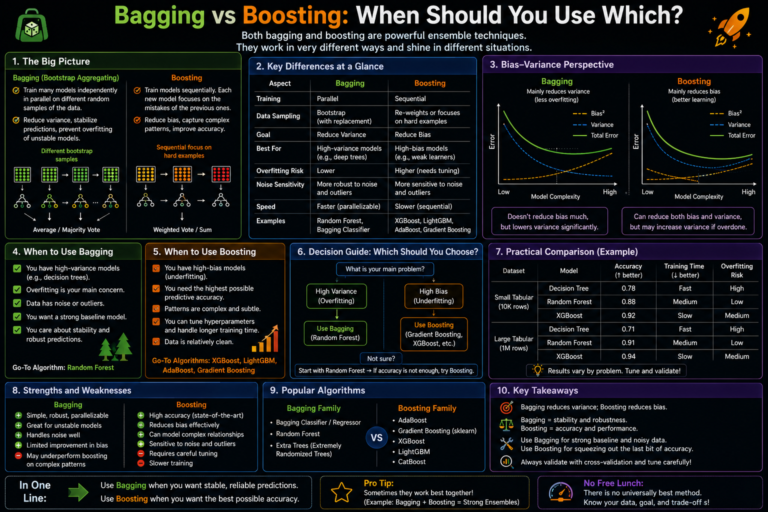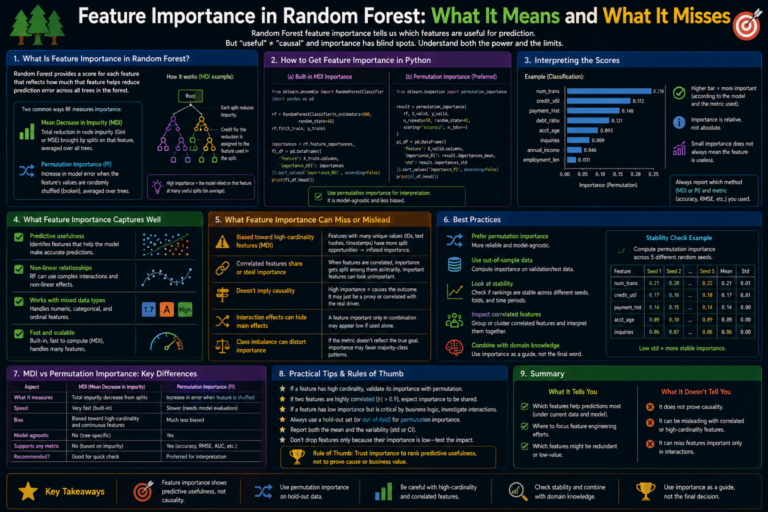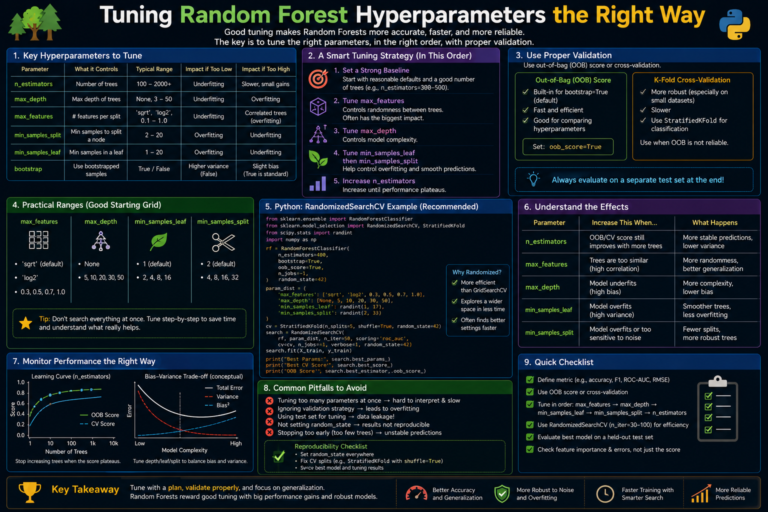

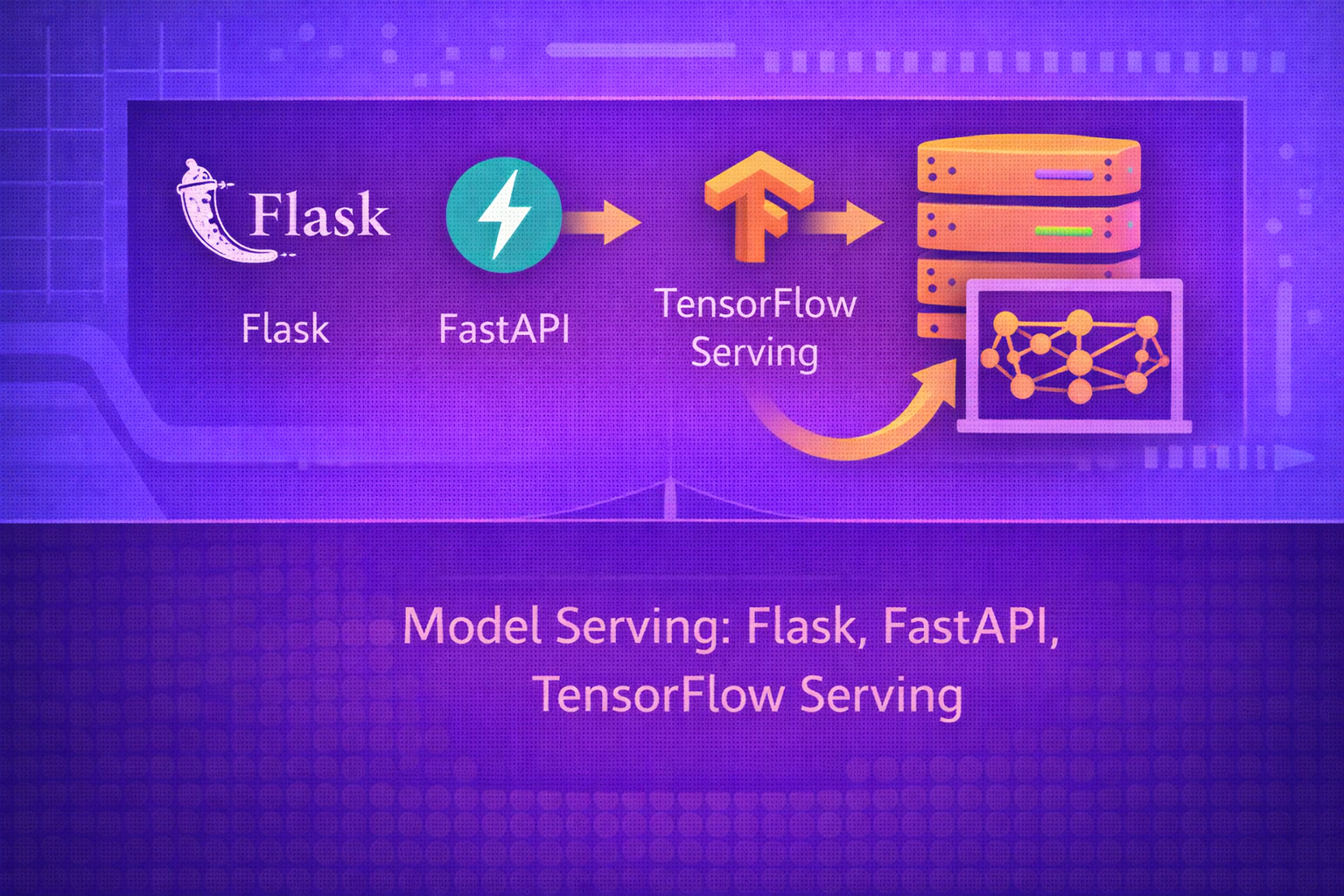
Model serving is the discipline of making trained machine learning models available for real-time or near-real-time inference in production systems. It bridges the gap between offline model development and live application usage by exposing prediction functionality through stable, scalable, and observable interfaces. This whitepaper explains the foundations of model serving and compares three common serving approaches: Flask, FastAPI, and TensorFlow Serving.
Abstract
Training a model is only one stage in the machine learning lifecycle. To create operational value, the model must be deployed in a way that reliably accepts inputs, transforms them into inference-ready format, executes prediction logic, and returns outputs within performance and availability targets. Model serving systems must therefore manage not only model execution, but also serialization, API contracts, concurrency, batching, versioning, scaling, monitoring, security, and rollback. This paper explains model serving architecture, request-response design, preprocessing and postprocessing, latency and throughput trade-offs, synchronous and asynchronous inference, online vs batch serving, canary deployment, and observability. It then examines Flask, FastAPI, and TensorFlow Serving as three important serving approaches with different design goals and operational strengths. All formulas are embedded inline in HTML-friendly format for direct use in WordPress or similar editors.
1. Introduction
Let a trained model be represented as:
ŷ = f(x; θ),
where x is the input feature vector,
θ is the trained parameter state, and
ŷ is the model output.
Model serving is the process of exposing f to external systems so that they can submit
inputs and receive predictions in a controlled production setting.
In operational terms, model serving usually involves:
- loading a model artifact
- accepting requests through an interface
- validating and transforming inputs
- running inference
- transforming outputs
- returning responses with latency and reliability guarantees
2. Why Model Serving Matters
A model that only exists in notebooks or offline scripts cannot create live product value in most applications. Production systems require serving because applications need:
- real-time predictions for user-facing decisions
- consistent interfaces for integration
- controlled version management
- scalable request handling
- observability and incident response
Model serving therefore transforms a trained artifact into an operational service.
3. Basic Serving Architecture
A simple model serving pipeline can be represented as:
request → validation → preprocessing → model inference → postprocessing → response.
If raw request input is r, preprocessing function is
φ, model is f, and postprocessing is
ψ, then the full serving path may be written as:
response = ψ(f(φ(r); θ)).
This shows that the serving system is broader than just the model itself.
4. Online vs Batch Inference
4.1 Online Inference
Online serving handles one or a few requests at a time with low latency. This is common in:
- recommendation APIs
- fraud scoring
- search ranking
- chat or assistant responses
- interactive personalization
4.2 Batch Inference
Batch inference scores many records periodically. If dataset is
D = {x1, ..., xN},
then batch output is:
Ŷ = {f(xi; θ)}i=1N.
Flask, FastAPI, and TensorFlow Serving are typically associated with online serving, though they can support batch patterns indirectly.
5. Synchronous vs Asynchronous Serving
5.1 Synchronous Serving
In synchronous serving, the client sends a request and waits for the result in the same interaction. This is the most common API pattern for prediction services.
5.2 Asynchronous Serving
In asynchronous serving, the request is accepted and processed later, often through a queue or job system. This is useful when inference is expensive or when response latency is less critical than throughput or reliability.
6. Latency and Throughput
Two central performance measures in model serving are:
- latency: time to respond to one request
- throughput: number of requests processed per unit time
If request processing time is L, then average latency may be represented as
E[L]. Throughput can be approximated as:
T ≈ (# completed requests) / time.
Many serving optimizations improve one at the expense of the other.
7. Request Validation
A serving system should validate the shape and type of input before inference. If the expected schema is:
S = {(name1, type1), ..., (namem, typem)},
then incoming request data should be checked against S.
This prevents malformed requests, silent type coercion issues, and inconsistent inference behavior.
8. Preprocessing and Feature Consistency
One of the most important serving risks is mismatch between training-time preprocessing and serving-time
preprocessing. If training used transformation
φtrain and serving uses
φserve, then serving is reliable only if:
φtrain(x) = φserve(x)
or at least remains semantically equivalent.
Otherwise, training-serving skew can degrade model performance immediately.
9. Postprocessing
Serving often includes postprocessing such as:
- thresholding probabilities
- mapping class indices to labels
- rounding regression scores
- formatting top-k predictions
- adding confidence or explanation metadata
If score is p and business threshold is
τ, a decision rule may be:
decision = 1 if p ≥ τ, else 0.
10. Model Serialization and Loading
A served model must be stored in a deployable format and loaded consistently. Common formats include:
- pickle or joblib for Python-centric models
- SavedModel for TensorFlow
- ONNX for interoperable serving scenarios
- framework-specific checkpoints
Serving reliability depends on correct versioned loading of the model artifact together with compatible runtime dependencies.
11. Flask for Model Serving
Flask is a lightweight Python web framework commonly used for simple model-serving APIs. It is popular because it is:
- easy to learn
- minimal and flexible
- good for prototypes and simple services
- easy to integrate with standard Python ML code
11.1 Flask Serving Pattern
A common Flask serving pattern is:
- load the model once when the app starts
- define one or more HTTP routes
- parse JSON input
- run preprocessing and inference
- return JSON output
This pattern works well for small deployments and internal tools.
11.2 Strengths of Flask
- simple and minimal
- low barrier to entry
- high flexibility
- easy integration with custom business logic
11.3 Limitations of Flask
- manual input validation unless extra tooling is added
- less structure for large APIs
- not designed specifically around modern typed async API patterns
- production scaling usually needs extra infrastructure decisions
12. FastAPI for Model Serving
FastAPI is a modern Python web framework designed for high-performance APIs with type hints and automatic request validation. It is particularly attractive for ML serving because it combines:
- developer productivity
- schema validation
- automatic documentation generation
- strong async support
- high runtime performance for Python-based APIs
12.1 FastAPI Serving Pattern
A common FastAPI serving pattern is:
- define input and output schemas using typed models
- load the model at startup
- use dependency injection or app state where useful
- serve prediction endpoints with automatic validation
- expose OpenAPI-compatible documentation automatically
12.2 Why FastAPI Is Popular for ML APIs
FastAPI is widely used because input structure matters greatly in serving. Built-in typed validation reduces the
risk of malformed requests. If request body field
xj must be numeric, the framework can reject invalid payloads before model
execution.
12.3 Strengths of FastAPI
- automatic validation and serialization
- built-in interactive API docs
- high-performance Python web stack
- clean design for production APIs
- good support for asynchronous workflows
12.4 Limitations of FastAPI
- still requires the user to manage model lifecycle logic
- Python runtime may remain a bottleneck for certain heavy workloads
- framework convenience does not replace broader serving infrastructure such as scaling, monitoring, or canary control
13. Flask vs FastAPI
Flask and FastAPI are both application-framework approaches to model serving, but they reflect different philosophies.
- Flask emphasizes minimalism and manual control.
- FastAPI emphasizes structured API development, validation, and performance-oriented modern design.
For simple prototypes, Flask may be sufficient. For more structured production-grade APIs, FastAPI is often more ergonomic.
14. TensorFlow Serving
TensorFlow Serving is a specialized serving system designed for production deployment of machine learning models, especially TensorFlow models. Unlike Flask and FastAPI, which are general-purpose web frameworks, TensorFlow Serving is purpose-built for high-performance model inference.
14.1 Core Idea of TensorFlow Serving
TensorFlow Serving treats model serving as a systems problem rather than a standard web route problem. It is designed to:
- load models efficiently
- serve versions of models
- support gRPC and HTTP interfaces
- handle concurrent inference workloads
- optimize inference execution for TensorFlow artifacts
14.2 SavedModel Integration
TensorFlow Serving is tightly integrated with TensorFlow SavedModel format. This allows model signatures and serving functions to be exported and loaded consistently in production.
14.3 Version Management
A major strength of TensorFlow Serving is model version management. If deployed model versions are
M(1), M(2), ..., M(t),
the serving system can load and expose specific versions in a controlled way.
This supports safer upgrades and rollback patterns.
14.4 Batching and Performance Optimization
TensorFlow Serving can support request batching, where multiple incoming requests are combined into one inference
batch. If requests are
x1, ..., xn, then batch inference computes:
Ŷ = f([x1, ..., xn]; θ).
Batching can improve throughput substantially, though it may increase per-request latency if not tuned carefully.
14.5 Strengths of TensorFlow Serving
- purpose-built for model inference
- strong model version handling
- high-performance serving path
- good support for TensorFlow artifacts
- efficient concurrency and batching patterns
14.6 Limitations of TensorFlow Serving
- most natural for TensorFlow ecosystems
- less flexible for custom Python business logic than Flask or FastAPI
- preprocessing and orchestration may still require companion services
- more specialized operational footprint
15. REST vs gRPC Serving Interfaces
Model-serving systems often expose either REST-style HTTP APIs or gRPC endpoints.
- REST: simple JSON-based integration, human-readable, easy adoption
- gRPC: binary protocol, efficient serialization, lower overhead, strong typed contracts
TensorFlow Serving commonly supports both. Flask and FastAPI are typically used with REST-style APIs unless extended.
16. Concurrency and Worker Models
Serving systems must handle concurrent requests. If concurrent request count is
n, system design must ensure acceptable latency and stability as
n increases.
In Python-based frameworks, concurrency behavior depends on:
- web server choice
- worker process count
- threading or async model
- whether inference releases interpreter constraints
17. Autoscaling and Replication
In production, a serving system often runs multiple replicas behind a load balancer. If one replica can process
throughput T1 and there are
R replicas, idealized total throughput may scale toward:
T ≈ R · T1.
In practice, network overhead, shared dependencies, and model loading constraints reduce perfect scaling.
18. Warm Start and Cold Start
Model serving performance is affected by startup behavior. A cold start may include:
- loading model weights from disk or remote storage
- initializing runtime libraries
- warming caches or graph execution state
If warm latency is Lwarm and cold initialization cost is
Δcold, then initial request latency may be:
Lcold = Lwarm + Δcold.
19. Model Versioning and Routing
Serving systems must often support more than one model version. Common patterns include:
- single active production version
- side-by-side versions for comparison
- canary routing to a new model
- A/B test traffic splitting
If traffic fraction to a new model is p, then:
Trafficnew = p · Traffictotal.
20. Observability in Model Serving
A robust serving system should expose:
- request count
- latency distribution
- error rate
- resource usage
- model version used
- input and prediction monitoring summaries where privacy policy allows
Observability is essential for production debugging, drift detection, and reliability management.
21. Security in Serving
Model-serving endpoints should be protected with:
- authentication and authorization
- rate limiting
- input size and schema controls
- transport security
- audit logging
This is especially important when the model exposes business-sensitive logic or processes sensitive user data.
22. Flask Use Cases
Flask is often a good fit for:
- small internal APIs
- prototypes and proofs of concept
- simple Python-first serving paths
- cases where custom business routing is more important than framework structure
23. FastAPI Use Cases
FastAPI is often a good fit for:
- production Python APIs
- typed request/response contracts
- teams needing automatic docs and schema validation
- services combining ML inference with broader application logic
24. TensorFlow Serving Use Cases
TensorFlow Serving is often a good fit for:
- high-performance TensorFlow inference
- multi-version TensorFlow model hosting
- environments needing gRPC and optimized model execution
- specialized serving layers where custom API logic is handled elsewhere
25. Choosing Among Flask, FastAPI, and TensorFlow Serving
The right serving choice depends on the system’s priorities.
- Choose Flask for simplicity and rapid custom prototyping.
- Choose FastAPI for structured, modern Python APIs with validation and strong developer ergonomics.
- Choose TensorFlow Serving for high-performance TensorFlow-centric inference and versioned serving infrastructure.
26. Common Failure Modes
- training-serving preprocessing mismatch
- lack of input validation
- slow cold starts due to large model load time
- poor monitoring and no model version visibility
- using a general-purpose API stack when specialized serving performance is required
- returning unstable outputs because model and postprocessing versions are not aligned
27. Strengths of a Good Serving Architecture
- turns trained models into real application value
- supports repeatable integration with upstream and downstream services
- enables scaling, rollback, and version control
- creates a foundation for monitoring and continuous improvement
- reduces operational fragility in production inference
28. Limitations and Trade-Offs
- serving infrastructure adds operational complexity
- latency and throughput goals can conflict
- framework convenience does not replace lifecycle governance
- specialized serving systems may reduce flexibility
- general-purpose Python APIs may be easier to build but harder to optimize at very high scale
29. Best Practices
- Keep preprocessing and postprocessing versioned together with the model.
- Validate every request against an explicit schema before inference.
- Monitor latency, errors, traffic, and model version continuously.
- Use canary or staged rollout for new model versions.
- Choose the serving stack based on performance and ecosystem fit, not only familiarity.
- Use Flask for lightweight simplicity, FastAPI for structured Python APIs, and TensorFlow Serving for optimized TensorFlow inference workloads.
30. Conclusion
Model serving is the operational bridge between machine learning development and real-world application use. It is not simply a matter of exposing a function over HTTP; it is a systems discipline that includes model loading, validation, preprocessing consistency, version control, concurrency, observability, and reliability engineering.
Flask, FastAPI, and TensorFlow Serving represent three different but important approaches to this problem. Flask is lightweight and flexible, FastAPI is structured and modern for production Python APIs, and TensorFlow Serving is a specialized high-performance solution for TensorFlow model inference. Understanding their trade-offs helps teams choose the right serving architecture for their performance goals, operational maturity, and model ecosystem.