
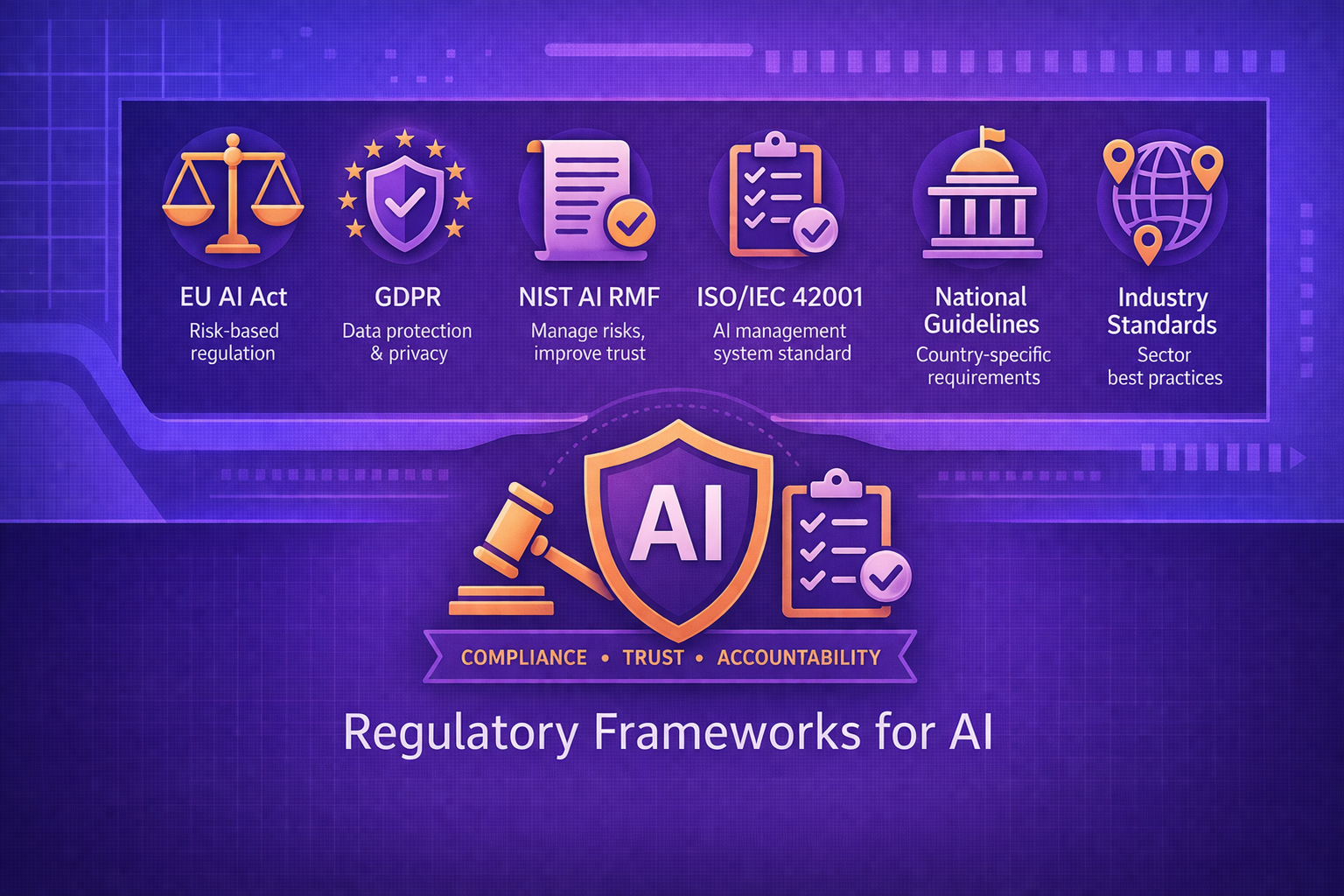
Regulatory frameworks for AI are the legal, standards-based, and policy mechanisms used to shape how AI systems are designed, deployed, monitored, and governed. As AI moves into high-impact domains, regulation increasingly focuses not only on model performance but on risk classification, transparency, accountability, safety, data governance, human oversight, and post-deployment control. This whitepaper explains the technical and governance foundations of AI regulation and maps the major framework types that organizations use in practice.
Abstract
AI regulation is evolving from broad ethical guidance into enforceable legal and operational control structures. Organizations deploying AI now face a layered environment that includes statutory law, sector-specific obligations, international standards, voluntary risk management frameworks, and internal governance controls. These frameworks aim to manage harms related to safety, discrimination, privacy, transparency, security, accountability, and misuse, while still allowing innovation. This paper explains the main architectural patterns of AI regulation, including risk-based classification, prohibited-use controls, high-risk system obligations, technical documentation, conformity-style assessment, post-market monitoring, and governance system requirements. It also explains how legal rules interact with standards and voluntary frameworks such as the NIST AI RMF, ISO/IEC 42001, and the OECD AI Principles. All formulas are embedded inline in HTML-friendly format for direct use in WordPress or similar editors.
1. Introduction
Let an AI system be represented as:
S = (D, φ, M, U, R, G),
where:
Dis the data and data governance contextφis the transformation, prompt, or feature logicMis the model or automated decision logicUis the deployment and use contextRis the applicable regulatory environmentGis the governance and oversight system
Regulatory frameworks govern not only the artifact M, but the full operational system
S.
2. Why AI Requires Regulatory Frameworks
AI systems differ from ordinary software in several ways that create regulatory concern:
- they can affect rights, opportunities, safety, and public trust
- their behavior may change as data or prompts change
- their outputs are probabilistic rather than fully deterministic
- their reasoning may be difficult for users to inspect directly
- they may create bias, privacy leakage, or unsafe automation at scale
Regulation is therefore used to ensure that innovation is paired with accountability and control.
3. What Counts as an AI Regulatory Framework
A regulatory framework for AI may include:
- binding legislation
- sector-specific regulatory obligations
- international standards
- voluntary risk management frameworks
- supervisory guidance
- internal corporate control systems
In practice, organizations often comply with several of these layers simultaneously.
4. Risk-Based Regulation
One of the most influential design patterns in AI regulation is risk-based control. Instead of regulating all AI systems identically, frameworks assign stronger obligations to systems with greater potential impact.
If system risk is denoted by Risk(S), then regulatory intensity can be viewed
conceptually as:
Control(S) = g(Risk(S)).
High-risk systems face stronger documentation, monitoring, oversight, and approval requirements than low-risk systems.
5. Typical Regulatory Objectives
Most AI regulatory frameworks aim to improve one or more of the following:
- safety and reliability
- fairness and non-discrimination
- privacy and data protection
- transparency and explainability
- security and misuse resistance
- human oversight and accountability
- traceability and auditability
6. Prohibited, Restricted, and High-Risk Categories
Many frameworks distinguish among:
- prohibited uses that are considered unacceptable
- high-risk uses that are allowed only under strong obligations
- lower-risk or transparency-only uses with lighter controls
This structure helps regulators focus on real-world impact rather than treating all AI features as equally dangerous.
7. Transparency Obligations
A common regulatory theme is that users should know when they are interacting with AI, when content is synthetic, or when decisions are significantly automated. Transparency obligations often concern:
- disclosure of AI use
- labeling of synthetic or generated content
- documentation of system limitations
- availability of meaningful information for oversight
8. Documentation and Technical Files
AI regulation often requires documentation that makes systems reviewable. Typical required artifacts include:
- system description
- intended purpose and boundaries of use
- training and evaluation summary
- data governance description
- risk assessment and mitigation evidence
- monitoring and incident response plan
Documentation is critical because regulation depends on evidence, not only on vendor claims.
9. Human Oversight Requirements
Many regulatory approaches require that certain AI systems support meaningful human oversight. This may include:
- manual approval or review steps
- override or abort capability
- appeal and contestability mechanisms
- clear responsibility assignment for operators
The principle is that high-impact automated systems should not become unreviewable black boxes.
10. Data Governance Requirements
AI regulatory frameworks often address data quality and governance because model quality depends heavily on data. Typical control areas include:
- data relevance
- data quality and representativeness
- bias risk assessment
- lawful data use
- retention and access control
- lineage and provenance
11. Accuracy, Robustness, and Cybersecurity
Regulatory frameworks increasingly expect AI systems to meet performance and resilience expectations. If model output
is ŷ = f(x), regulation may require testing not only on ordinary inputs but also under
stress, shift, or misuse conditions.
The emphasis is on whether the system remains reliable enough for its intended purpose and risk level.
12. Post-Deployment Monitoring
AI regulation is increasingly lifecycle-based rather than one-time approval-based. This means obligations may continue after deployment through:
- logging
- drift monitoring
- incident reporting
- change management
- corrective action and recall processes
If monitored risk indicator is M(t), post-deployment control typically requires action
when:
M(t)
exceeds threshold τ.
13. Conformity and Assurance Concepts
Some regulatory structures use assurance-oriented concepts similar to conformity assessment, where systems must satisfy defined requirements before or during market placement. This may include:
- self-assessment
- internal control procedures
- third-party review in some cases
- technical documentation retention
- demonstrable compliance evidence
14. The EU AI Act
The EU AI Act is one of the most prominent binding regulatory frameworks for AI. It uses a risk-based approach and sets obligations that vary according to the nature and impact of the AI use case.
The European Commission states that the AI Act entered into force on 1 August 2024 and will become fully applicable on 2 August 2026, with staged application dates for specific obligations. Prohibited AI practices and AI literacy obligations started applying from 2 February 2025, and governance rules and obligations for general-purpose AI models became applicable from 2 August 2025. citeturn655480search8
14.1 Structure of the EU AI Act
At a high level, the EU AI Act organizes systems into regulatory bands such as:
- unacceptable-risk or prohibited practices
- high-risk systems
- certain transparency-triggering systems
- general-purpose AI model obligations
This makes it a strong example of risk-tiered AI regulation. citeturn655480search8turn655480search16
14.2 Why the EU AI Act Matters
The Act is important because it pushes organizations toward documented governance, lifecycle controls, and evidence-based compliance rather than purely aspirational AI ethics. It also influences organizations beyond Europe because multinational firms often harmonize controls across regions. This is an inference based on the Act’s scope and the operational reality of global compliance programs. citeturn655480search8turn655480search16
15. NIST AI Risk Management Framework
The NIST AI Risk Management Framework is a voluntary framework developed to help organizations manage risks to individuals, organizations, and society associated with AI. NIST describes the AI RMF as voluntary and intended to improve how trustworthiness considerations are incorporated into the design, development, use, and evaluation of AI systems. citeturn655480search1turn655480search13
15.1 Core Functions of the NIST AI RMF
NIST structures the AI RMF around four core functions:
Govern,
Map,
Measure,
and
Manage. The associated Playbook explains suggested actions to achieve outcomes under
those functions. citeturn655480search17turn655480search9
15.2 Why the NIST AI RMF Matters
The NIST AI RMF is not itself a binding law, but it is highly useful as an operational governance framework because it helps organizations translate broad trustworthiness goals into practical risk management steps. citeturn655480search1turn655480search9
16. ISO/IEC 42001
ISO/IEC 42001:2023 is the first international AI management system standard. ISO describes it as the first global standard that defines how to establish, implement, maintain, and continually improve an AI management system, and as a structured way to manage AI-related risks and opportunities. citeturn655480search2turn655480search6turn655480search10
16.1 Management-System Style Regulation Support
ISO/IEC 42001 is important because it provides an organizational management-system model for AI governance. That makes it particularly useful for enterprises that need repeatable, auditable internal control structures rather than only project-level checklists. citeturn655480search2turn655480search14
17. OECD AI Principles
The OECD AI Principles promote AI that is innovative, trustworthy, and respectful of human rights and democratic values. OECD states that the Principles were adopted in 2019, that the OECD definition of AI systems was revised in 2023, and that the Principles were revised in 2024 to stay abreast of rapid technological developments. citeturn655480search3turn655480search7turn655480search15
17.1 Policy Significance of the OECD Principles
The OECD Principles matter because they function as an interoperability layer for public policy. They do not replace hard law, but they influence how governments and organizations frame trustworthy AI policy and lifecycle expectations. citeturn655480search3turn655480search19
18. Hard Law, Soft Law, and Standards
AI regulatory ecosystems usually combine:
- hard law: binding legal obligations
- soft law: guidelines, principles, supervisory expectations
- standards: structured control and management frameworks
In practice, organizations often use standards and voluntary frameworks to operationalize compliance with legal or policy obligations.
19. Sector-Specific Regulation
AI also intersects with existing sector regulation. Even if there is no AI-specific rule in a given jurisdiction, organizations may still face obligations under:
- privacy and data protection law
- consumer protection law
- anti-discrimination law
- financial services regulation
- medical device and health regulation
- employment law
This means AI compliance is often a regulatory stack rather than a single statute.
20. Internal Governance as a Compliance Layer
External regulatory frameworks usually require internal governance to become real. Typical internal controls include:
- AI system inventory
- risk classification
- approval workflows
- documentation templates
- model change management
- monitoring and incident escalation
If internal governance strength is represented by G, then practical compliance usually
becomes harder as
Deployment Scale
increases faster than G.
21. Generative AI and Regulatory Challenges
Generative AI creates additional regulatory questions around:
- synthetic content disclosure
- copyright and training data provenance
- hallucinations and misinformation
- tool misuse and prompt injection
- foundation-model lifecycle obligations
This is one reason general-purpose AI models have become a specific regulatory focus. citeturn655480search8turn655480search15
22. Auditability and Evidence
Regulatory frameworks increasingly require that organizations keep evidence of how systems were governed. Useful evidence includes:
- dataset lineage
- evaluation reports
- approval records
- deployment logs
- incident records
- monitoring dashboards
Compliance becomes much weaker when organizations cannot produce traceable evidence of control operation.
23. Change Management Under Regulation
AI systems can change due to retraining, prompt changes, model updates, threshold updates, or vendor version changes. Regulatory frameworks increasingly push organizations to define when such changes trigger revalidation or renewed review.
24. Enforcement and Supervisory Reality
The existence of a framework does not guarantee effective control. Real-world impact depends on:
- scope clarity
- supervisory guidance
- organizational maturity
- evidence quality
- enforcement capability
As a result, the practical meaning of AI regulation is partly shaped by how it is implemented and supervised, not only by the text of the framework itself.
25. Common Compliance Challenges
- unclear system inventory
- weak model lineage and documentation
- difficulty classifying risk consistently
- third-party model dependency without full visibility
- insufficient post-deployment monitoring
- confusion between policy principle and auditable control
26. Strengths of Regulatory Frameworks for AI
- create structured accountability
- improve documentation and traceability
- reduce unmanaged high-impact deployment risk
- align technical development with public-interest safeguards
- support more trustworthy adoption of AI
27. Limitations and Trade-Offs
- frameworks may lag behind technical change
- overly abstract principles can be hard to operationalize
- overly rigid control can burden low-risk innovation
- cross-border compliance can become fragmented
- vendor opacity can weaken practical compliance capacity
28. Best Practices
- Use a risk-based approach rather than one control model for every AI use case.
- Translate legal and policy obligations into concrete technical and operational controls.
- Maintain system inventory, lineage, validation evidence, and monitoring records from the start.
- Use standards and frameworks such as NIST AI RMF and ISO/IEC 42001 to operationalize governance.
- Plan for post-deployment monitoring, incident handling, and model change management—not only pre-launch review.
- Treat third-party and general-purpose AI dependencies as governance scope, not as external exceptions.
29. Conclusion
Regulatory frameworks for AI are becoming a core part of how organizations build and deploy trustworthy systems. Their central role is to turn broad concerns about safety, fairness, privacy, transparency, and accountability into concrete governance and control expectations that can be documented, tested, and monitored.
The most important practical insight is that AI regulation is not only about law. It is about the interaction of law, standards, governance, evidence, and operational discipline. Organizations that understand this layered structure are better positioned to deploy AI systems that are not only technically effective, but also reviewable, defensible, and aligned with the evolving global regulatory environment.