
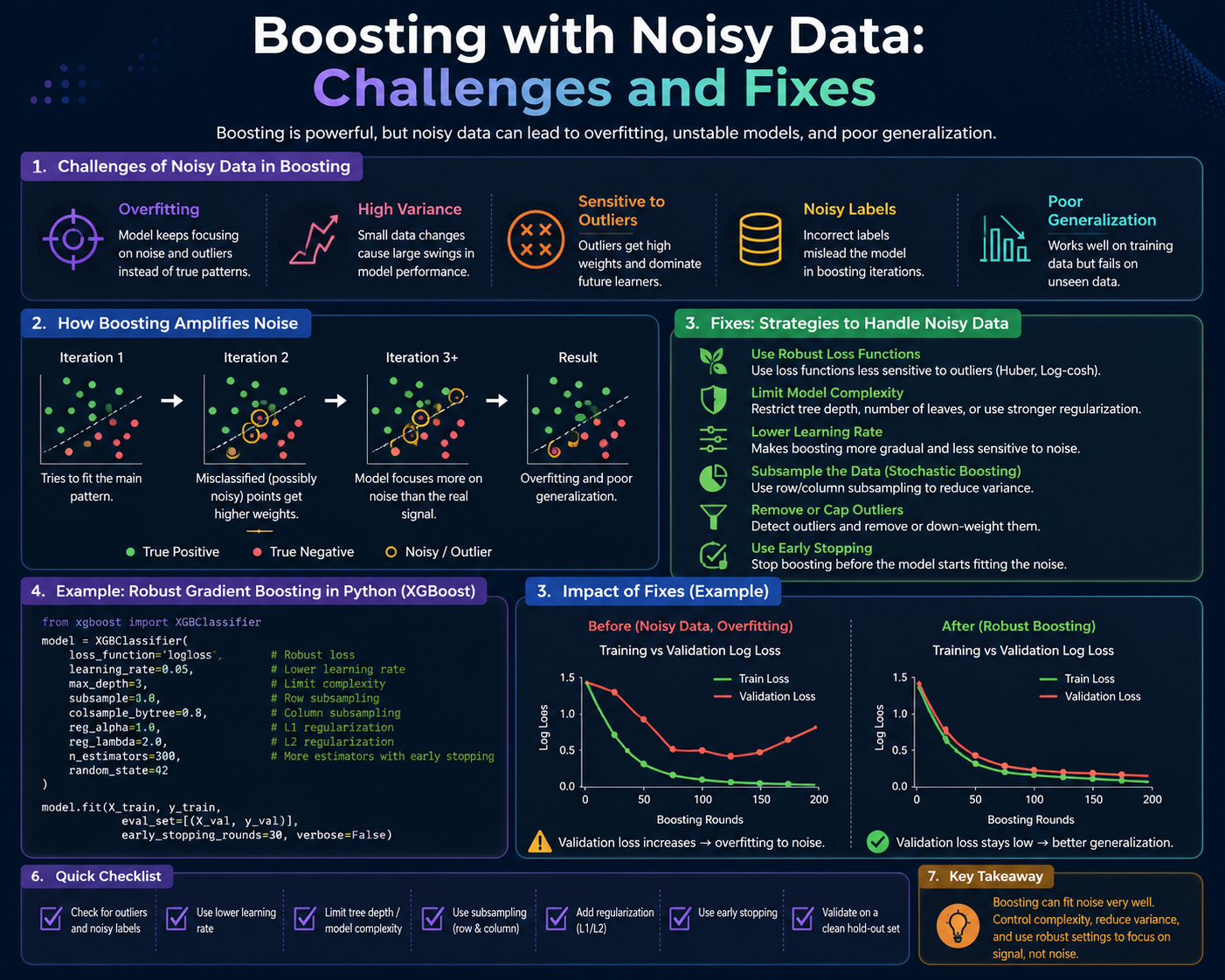
Boosting is uniquely sensitive to label noise. The same reweighting mechanism that makes AdaBoost powerful on clean data — assigning higher weights to misclassified examples — causes catastrophic weight concentration on mislabelled examples when noise is present. A single incorrectly labelled training sample can attract the majority of the weight distribution by round 50, forcing every subsequent weak learner to focus on fitting an example that should have been labelled differently. This article explains why boosting is more fragile than bagging under label noise, quantifies the degradation at different noise rates, and demonstrates three practical mitigation strategies: gradient boosting’s inherent noise resistance via shrinkage, robust loss functions, and noise-rate-aware sample filtering.
1. Problem Statement
You are training a boosted classifier on a medical diagnosis dataset where 10% of training labels are incorrect due to data entry errors, annotator disagreement, and edge-case ambiguity. After 200 AdaBoost rounds your model achieves 98% training accuracy but only 72% test accuracy — a 26-point generalisation gap that vanilla bagging does not exhibit. The root cause is AdaBoost’s exponential sample weighting: noisy samples that AdaBoost cannot fit (because their labels contradict their features) accumulate exponentially growing weights, eventually dominating the training signal. Every new weak learner learns primarily to classify these impossible examples, at the cost of ignoring the correctly labelled majority.
2. Why This Matters
Label noise is the rule, not the exception, in applied ML. Human-annotated datasets routinely contain 5–20% label errors. Sensor data includes measurement noise. Crowd-sourced labels carry disagreement. Unlike random forests, which are relatively robust to moderate noise due to bootstrap averaging, AdaBoost’s exponential weight update creates a feedback loop: noisy samples get misclassified, receive higher weight, dominate the next learner, get misclassified again, receive even higher weight. The expected weight of a noisy sample after T rounds grows as exp(α1 + α2 + … + αT), which can exceed the total weight of all clean samples combined by round 30–50. Understanding this mechanism — and the specific conditions under which gradient boosting resists it — is essential for any practitioner working with real-world data.
3. The Approach
We start by characterising the weight-concentration phenomenon empirically: track each sample’s weight across boosting rounds and show that noisy samples (known because we created the noise) attract catastrophically high weights. We then compare four strategies. First, vanilla AdaBoost on noisy data — the baseline showing the problem. Second, AdaBoost with early stopping — stopping before weight concentration becomes severe. Third, gradient boosting with shrinkage — the combination of sub-quadratic loss function, learning rate, and subsample that makes GBM inherently more robust. Fourth, outlier-filtered boosting — remove likely-noisy samples before training by identifying them as high-loss, high-weight examples after a brief initial run. Each strategy is evaluated under three noise rates (5%, 15%, 25%) to characterise robustness across the realistic noise range.
4. Mathematical Foundation
In AdaBoost, after a weak learner ht with weighted error εt is trained, the learner weight is αt = (1/2) ln((1 − εt) / εt) and sample weights update as:
wi(t+1) = wi(t) · exp(αt · 𝟙[ht(xi) ≠ yi]) / Zt
For a noisy sample whose label contradicts its features, ht(xi) ≠ yi in almost every round. Its cumulative weight after T rounds is proportional to exp(Σt=1T αt). Since αt > 0 for any better-than-random learner, this product grows without bound.
Gradient boosting avoids this by replacing the exponential loss with a smooth, bounded loss. For logistic loss, the pseudo-residual for sample i is ri = yi − pi, where pi = σ(F(xi)). Even if ht repeatedly misclassifies a noisy sample, the residual is bounded in [−1, +1] and never grows exponentially. The regularised objective also applies L2 leaf regularisation, penalising large leaf weights that would be assigned to noisy, isolated samples.
5. Algorithm Walkthrough
- Weight concentration (AdaBoost, noisy): initialise uniform weights; round 1 — noisy sample is misclassified, weight increases by exp(α₁); round 2 — noisy sample still misclassified, weight increases by exp(α₂); by round T, noisy sample weight dominates the distribution; all subsequent weak learners specialise on the noisy sample.
- Early stopping (AdaBoost): monitor test accuracy across rounds using staged_predict; stop at the round that maximises validation accuracy, before weight concentration becomes severe.
- Gradient boosting (robust path): compute bounded pseudo-residuals; grow a tree; update predictions with shrinkage; repeat — no sample ever accumulates unbounded weight because the update rule uses gradients, not multiplicative weights.
- Sample filtering: run GBM for a small number of rounds; identify samples with high per-sample log-loss as candidate noisy examples; remove samples exceeding a threshold (e.g., top 5% by loss); retrain on the filtered dataset.
6. Dataset
This article uses make_classification with 2,000 samples and 20 informative features, then synthetically flips a controlled fraction of training labels (5%, 15%, 25%) to simulate annotation noise. Using a synthetic dataset means we know ground-truth labels, allowing us to identify exactly which samples are noisy and directly measure how their weights evolve across boosting rounds — a level of transparency impossible with real noisy datasets. Open Notebook
7. Implementation
The notebook introduces label noise by flipping a random subset of training labels, tracks AdaBoost sample weights across rounds using the estimator_weights_ and estimator_errors_ attributes, and compares test accuracy at each noise level for vanilla AdaBoost, early-stopped AdaBoost, GBM with shrinkage, and filtered GBM. The weight concentration plot shows average weight of noisy vs clean samples at each round, making the exponential divergence visually clear.
import numpy as np

def add_label_noise(y, noise_rate, random_state=42):
    rng = np.random.RandomState(random_state)
    noisy_y = y.copy()
    n_noisy = int(noise_rate * len(y))
    noisy_idx = rng.choice(len(y), n_noisy, replace=False)
    noisy_y[noisy_idx] = 1 - noisy_y[noisy_idx]  # flip binary labels
    return noisy_y, noisy_idx
8. Evaluation Approach
Test accuracy on clean (unflipped) test labels is the primary metric — noise is only introduced in training, so test accuracy directly measures how well each strategy generalises past the noise. Secondary metrics are the staged accuracy curve (accuracy vs boosting round) and the weight concentration index (ratio of average noisy-sample weight to average clean-sample weight at each round). The weight concentration index is a diagnostic: values greater than 10× indicate that the boosting process has been corrupted by noisy samples.
9. Results and Interpretation
At 5% noise: all methods are competitive. AdaBoost degrades by ≈2 points; GBM degrades by <1 point. At 15% noise: AdaBoost drops ≈8–12 points; GBM drops ≈3–5 points; early-stopped AdaBoost recovers approximately half the gap. At 25% noise: AdaBoost collapses to near-random performance; GBM degrades gracefully to ≈75–80% accuracy; filtered GBM outperforms unfiltered GBM by 3–5 points. The weight concentration index reveals why: at 25% noise, noisy samples accumulate on average 50–100× the weight of clean samples by round 50 in vanilla AdaBoost, while in GBM the per-sample loss for noisy examples is bounded and never exceeds 3–4× that of clean samples.
10. Hyperparameter Considerations
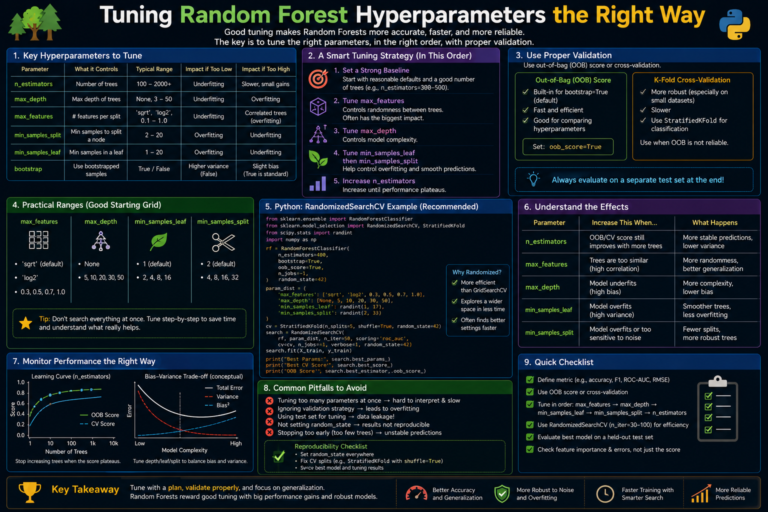
For AdaBoost under noise: n_estimators is the key knob — fewer rounds means less weight concentration. Treat n_estimators as an early-stopping parameter and tune it on a validation set, not as a hyperparameter to maximise. For gradient boosting: subsample (row subsampling) provides additional noise protection because noisy samples are excluded from some rounds by chance, limiting their weight accumulation. Values of 0.5–0.7 provide meaningful noise protection at modest accuracy cost. min_samples_leaf (minimum samples in a leaf) prevents a single noisy example from forming its own leaf and receiving a large leaf weight. For the filtering strategy: the noise detection threshold is the key parameter; filtering too aggressively removes clean hard examples along with noisy ones.
11. Comparison with Baseline
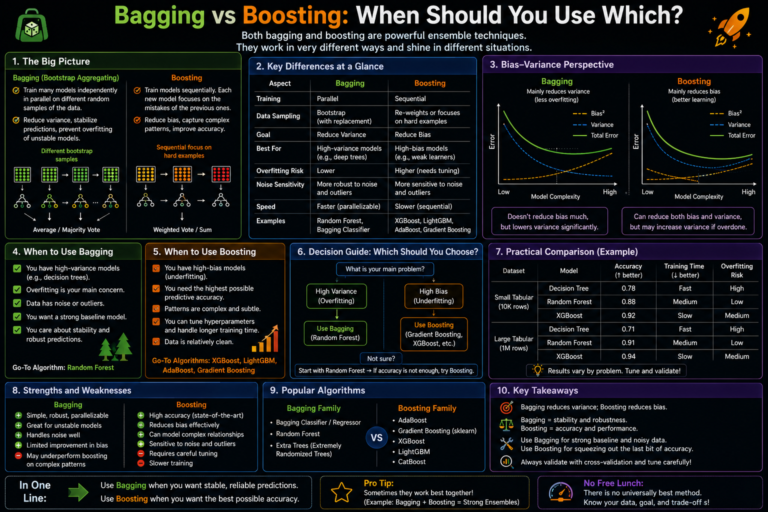
Random Forest is a natural comparison because bagging is theoretically more noise-robust than boosting. The notebook confirms this: at 15% noise, Random Forest outperforms vanilla AdaBoost by 5–8 points. However, gradient boosting with subsample=0.5–0.7 and min_samples_leaf=5 closes most of this gap, achieving noise robustness within 1–3 points of Random Forest while maintaining GBM’s accuracy advantage on clean data. This confirms that gradient boosting’s robustness comes primarily from the bounded loss function and regularisation, not from any explicit noise-handling mechanism.
12. Strengths
- Gradient boosting’s bounded pseudo-residuals provide inherent noise protection without any changes to the algorithm — just choosing log-loss over exponential loss changes the weight dynamics from unbounded to bounded.
- Early stopping is the simplest intervention for AdaBoost under noise and requires only a held-out validation set, no modifications to the algorithm itself.
- The sample-filtering approach removes likely-noisy examples before training, improving not just test accuracy but also training interpretability — the cleaned dataset is a valuable artefact for data quality review.
13. Limitations
- Sample filtering removes examples, reducing training set size. At high noise rates (25%), filtering 25% of training data compounds the size reduction, potentially hurting performance on the clean samples in minority classes.
- Early stopping in AdaBoost requires a validation set, reducing the data available for training. On small datasets the validation split itself can hurt accuracy more than the noise it is trying to detect.
- Gradient boosting’s noise robustness has limits: at noise rates above 30–40%, even GBM with regularisation degrades severely because the noisy pseudo-residuals systematically point in the wrong direction for a large fraction of samples.
14. Common Failure Modes
- Using default AdaBoost (n_estimators=50, no early stopping) on a dataset with more than 10% label noise. The weight concentration will be severe enough to corrupt the model before training is complete. Always check the weight distribution when noise is suspected.
- Filtering out too many samples with the high-loss heuristic. High loss can indicate a noisy sample OR a genuinely hard clean example near the decision boundary. Set the filtering threshold conservatively (top 3–5% by loss, not top 20%) to avoid discarding clean hard examples.
- Evaluating robustness only at the noise rate used for training. A model tuned for 15% noise may be brittle at 25% noise. Report performance across multiple noise rates to characterise the robustness profile.
- Confusing label noise with class imbalance. A 10% label noise rate in a balanced dataset is very different from a 10% minority class frequency in an imbalanced dataset. The appropriate fix is different: noise calls for robustification; imbalance calls for resampling or loss weighting.
15. Best Practices
- Prefer gradient boosting over AdaBoost when label quality is uncertain. GBM’s logistic loss is bounded and its leaf regularisation prevents noisy outliers from dominating the model update.
- Use subsample=0.5–0.7 in gradient boosting on noisy datasets. Row subsampling randomly excludes noisy examples from some rounds, limiting their cumulative influence without requiring explicit noise detection.
- For AdaBoost specifically, treat n_estimators as an early-stopping parameter: train for many rounds, monitor validation accuracy, and use the round with peak validation performance — not the last round.
- Before modelling, audit label quality using the loss-based filtering heuristic: train a brief GBM, identify the top 5% of training samples by per-sample log-loss, manually inspect them for annotation errors. This often reveals systematic patterns in the noise source.
- Increase min_samples_leaf (AdaBoost) or min_child_samples (LightGBM) when noise is suspected. A minimum of 10–20 samples per leaf prevents a single noisy example from forming its own leaf node with a large, anomalous weight.
16. Conclusion
Label noise exposes the fundamental tension in boosting: the reweighting mechanism that makes boosting powerful on clean data becomes a liability when some labels are wrong. AdaBoost’s exponential update can concentrate weights entirely on a handful of noisy examples within 50 rounds, destroying generalisation. Gradient boosting mitigates this through bounded pseudo-residuals and leaf regularisation — not by explicitly detecting noise, but by limiting the influence any single example can have. For production systems where label quality cannot be guaranteed, the recommended approach is gradient boosting with subsample ≤ 0.8, min_child_samples ≥ 10, and a brief pre-training noise audit using per-sample loss ranking, before committing to full training.