Uma Mahesh

Uma Mahesh

Author is working as an Architect in a reputed software company. He is having nearly 21+ Years of experience in web development using Microsoft Technologies.

Fairness Metrics in ML

Fairness metrics in machine learning are quantitative criteria used to assess whether a model’s predictions, decisions, or error patterns differ across groups in ways that may be unacceptable, harmful, or inconsistent with policy goals. These metrics are central to responsible…

Identifying and Mitigating Bias in AI

Bias in AI refers to systematic and undesirable patterns in data, models, decision rules, or deployment contexts that produce unfair, distorted, or harmful outcomes for individuals or groups. Identifying and mitigating bias is not a single algorithmic fix, but a…

Handling Large-Scale Data: Data Lakes vs Warehouses

Handling large-scale data is one of the foundational challenges in modern analytics, machine learning, and digital product engineering. As data volume, variety, velocity, and governance requirements increase, organizations must choose storage and processing architectures that support both flexibility and reliability.…

A/B Testing for ML

A/B testing is one of the most important methods for evaluating machine learning systems in production because offline metrics do not always predict real-world impact. A model that looks better on historical data may still underperform when exposed to live…

Monitoring ML Models in Production

Deploying a machine learning model is not the end of the ML lifecycle. Once a model enters production, its behavior can degrade because of changing data distributions, broken upstream pipelines, infrastructure instability, concept drift, feedback loops, delayed labels, or business…

CI/CD for ML Models

Continuous Integration and Continuous Delivery/Deployment (CI/CD) for machine learning extends software delivery practices into a domain where outputs depend not only on code, but also on data, features, and model behavior over time. In ML systems, CI/CD must validate not…

Containerization for ML: Docker, Kubernetes

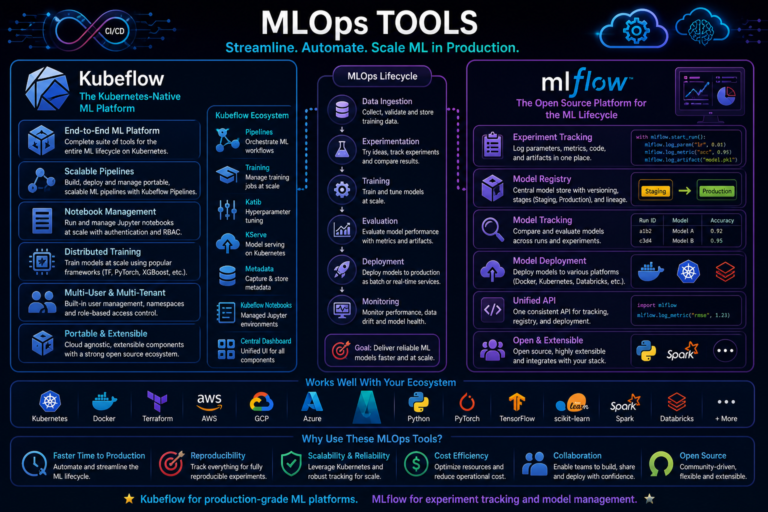
Containerization has become a foundational operational pattern for machine learning systems because it makes environments portable, reproducible, isolated, and deployable across heterogeneous infrastructure. In machine learning, where code depends on specific Python packages, system libraries, model artifacts, GPU runtimes, and…

Versioning Data and Models (DVC, MLflow)

Machine learning systems are not defined by code alone. They are defined by the combination of code, data, features, hyperparameters, environment, model artifacts, evaluation results, and deployment lineage. Versioning these components is essential for reproducibility, auditability, experimentation, rollback, and operational…