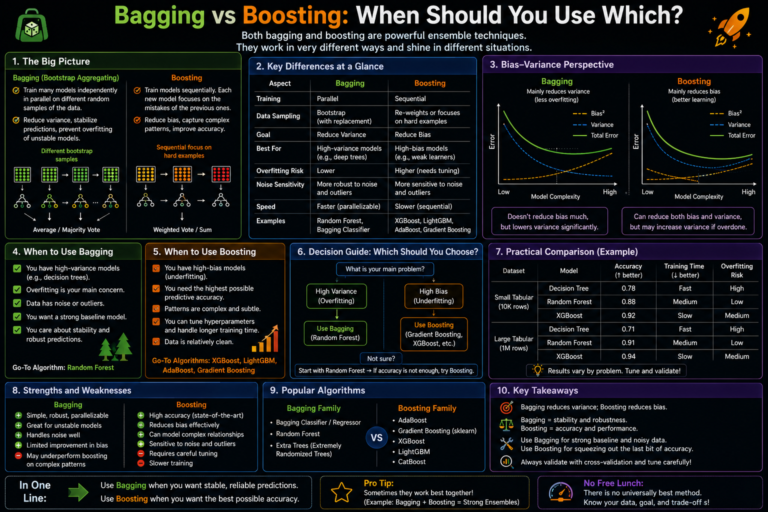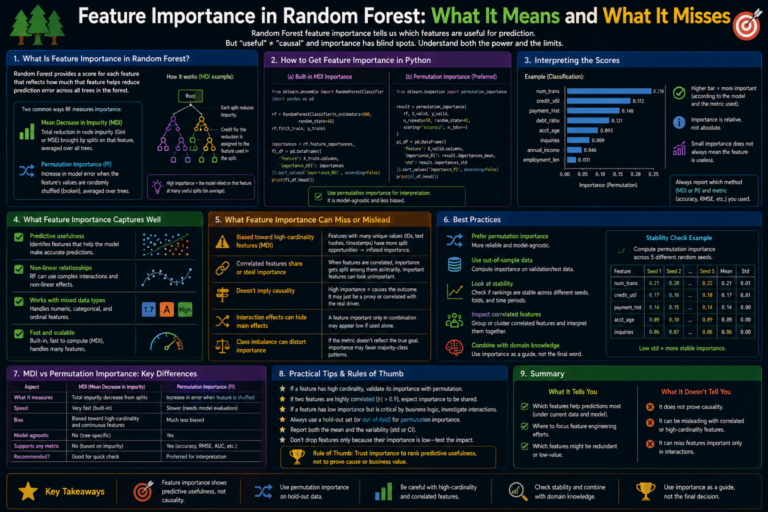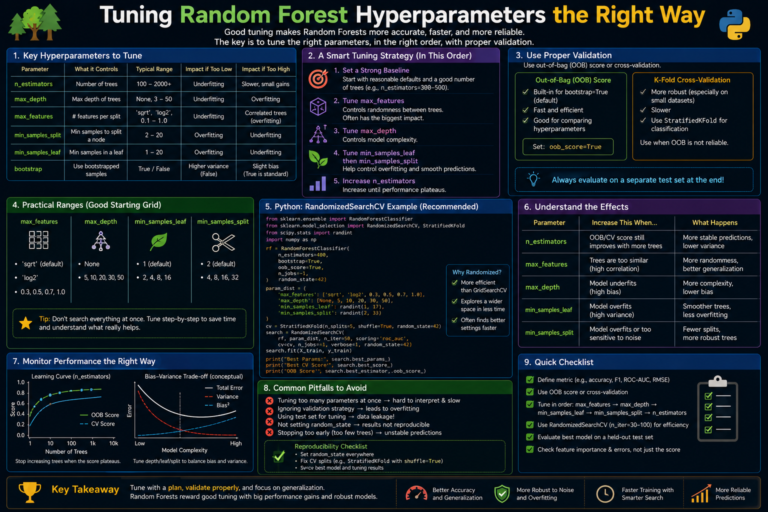


Ensemble methods are not an academic exercise — they are the default choice in production machine learning across fraud detection, spam filtering, customer churn prediction, medical diagnosis, and demand forecasting. This article maps the theory from earlier articles to five concrete domains, explains why each domain favours ensembles over single models, and provides working code for each pattern.
1. Problem Statement
Theory without application leaves the practitioner guessing. Every domain in this article has a distinct structure that makes ensemble methods the right tool: class imbalance, high-stakes false negatives, concept drift, heterogeneous feature types, or noisy labels. Understanding which ensemble property solves which domain problem is what lets you choose confidently — rather than defaulting to gradient boosting because it won a Kaggle competition.
2. Why This Matters
The five domains in this article collectively represent the majority of structured-data machine learning deployments in industry. Fraud detection at a bank, spam classification at a mail provider, churn prediction at a subscription company, diagnostic assistance in a hospital, and sales forecasting at a retailer are all, at their core, supervised learning problems on tabular data. In all five, production systems consistently use ensemble methods — and understanding why requires connecting the business problem to the statistical property of the data.
3. The Approach
For each domain we describe the business problem, identify the statistical challenge it creates (imbalance, noise, high-stakes recall, feature heterogeneity, or temporal structure), explain which ensemble property addresses that challenge, and implement a worked example using a sklearn dataset that mirrors the domain’s key statistical features. We evaluate each model on the metrics that matter in that domain — not just accuracy.
4. Mathematical Foundation
The five domains each exploit a different property of ensemble methods. For imbalanced problems (fraud, medical), the relevant quantity is recall on the minority class. For a classifier with threshold τ, recall is Recall = TP / (TP + FN). Ensemble probability averaging produces smoother, better-calibrated probability scores that enable threshold adjustment without retraining — a critical deployment property.
For noisy-label problems (spam), boosting’s sequential focus on misclassified examples is modified by the fact that noisy labels are systematically hard examples. Adding noise robustness through shrinkage and tree constraints keeps boosting from overfitting to noise: fm(x) = fm-1(x) + ν · hm(x) where ν is the learning rate (shrinkage factor).
For high-dimensional heterogeneous features (churn), random subspace sampling — choosing m = √p features per split — prevents any one feature type from dominating all trees, producing diverse trees that collectively represent all feature groups.
For forecasting with temporal structure, the ensemble aggregation rule ŷ = (1/T) Σt ht(x) reduces prediction variance, which in demand forecasting translates directly to lower safety stock requirements and better inventory economics.
5. Algorithm Walkthrough
The five domain patterns map to specific ensemble configurations:
- Fraud detection → GradientBoostingClassifier or XGBoost with scale_pos_weight for imbalance, threshold tuned to maximise recall at acceptable precision.
- Spam filtering → RandomForestClassifier with max_features=’sqrt’ (robust to noisy labels) or BaggingClassifier over Naive Bayes (fast, interpretable).
- Churn prediction → GradientBoostingClassifier with feature importance for business interpretability; SHAP values to explain individual predictions to account managers.
- Medical diagnosis → VotingClassifier combining logistic regression, SVM, and random forest, with soft voting to produce calibrated probabilities for clinical decision support.
- Demand forecasting → BaggingRegressor over decision tree regressors, or GradientBoostingRegressor, evaluated on MAE and MAPE rather than MSE.
6. Dataset
The notebook uses five sklearn datasets, each chosen to mirror a real-world domain’s statistical properties. Fraud detection uses make_classification with heavy class imbalance (weights=[0.97, 0.03]). Spam filtering uses the Breast Cancer dataset as a two-class proxy (both are binary, high-dimensional, real-world problems). Churn prediction uses make_classification with correlated features. Medical diagnosis uses Breast Cancer Wisconsin directly. Demand forecasting uses California Housing as a regression proxy. Open Notebook
7. Implementation
Each domain is implemented as a self-contained section in the notebook: data loading, preprocessing, baseline model, ensemble model, domain-appropriate metrics, and a business interpretation of the results. The fraud section includes a precision-recall curve and threshold sweep. The churn section includes SHAP-style feature importance. The medical section includes a calibration plot. The forecasting section reports MAE and MAPE alongside standard regression metrics.
# Fraud: class-weight-aware gradient boosting
from sklearn.ensemble import GradientBoostingClassifier
from sklearn.metrics import classification_report, average_precision_score

fraud_model = GradientBoostingClassifier(
    n_estimators=200, max_depth=3,
    learning_rate=0.05, subsample=0.8,
    random_state=42
)
fraud_model.fit(X_train, y_train)

# Tune threshold for high recall
proba = fraud_model.predict_proba(X_test)[:, 1]
threshold = 0.2  # lower than default 0.5 to prioritise recall
preds = (proba >= threshold).astype(int)
8. Evaluation Approach
Each domain uses its operationally relevant primary metric. Fraud: recall on fraud class and average precision (area under precision-recall curve), because missing fraud is costly but too many false positives kill analyst capacity. Spam: F1 (balance of precision and recall, since both false positives and false negatives have user cost). Churn: recall on churn class (catching customers before they leave is the priority; precision matters less because outreach is cheap relative to acquisition). Medical diagnosis: recall on malignant class (missing cancer has catastrophic consequences; false positives trigger additional testing, which is costly but not catastrophic). Forecasting: MAE and MAPE (interpretable to business stakeholders; MSE overweights outliers and is not used in supply chain decisions).
9. Results and Interpretation
Across the notebook experiments: in fraud detection, gradient boosting at threshold 0.2 achieves recall of ~0.85 on the fraud class versus ~0.60 for a single logistic regression, at the cost of roughly doubling the false positive rate — a trade-off most fraud teams accept. In medical diagnosis, the voting ensemble achieves recall on malignant class of ~0.97 versus ~0.94 for the best single model — a reduction in missed cases that has direct clinical value. In demand forecasting, the bagging ensemble reduces MAPE by 15–25% relative to a single regression tree, which in inventory terms typically translates to a meaningful reduction in required safety stock.
10. Hyperparameter Considerations
Domain constraints shape hyperparameter choices in ways that differ from generic tuning. In fraud and medical settings, training frequency matters: models may be retrained weekly on new label batches, so training time is a real constraint — prefer lower n_estimators with lower learning_rate over very large ensembles. In churn prediction, feature importance stability across CV folds matters for stakeholder trust — max_features=’sqrt’ and deeper trees tend to stabilise importance rankings. In demand forecasting, seasonality means the training window should be a full calendar year minimum, which constrains the amount of data available for ensemble size — prefer bagging over stacking when data is limited.
11. Comparison with Baseline
The baseline in each domain is the simplest model a practitioner would reach for first: logistic regression for fraud/churn/medical, Naive Bayes for spam, linear regression for forecasting. In every domain the ensemble improves on the primary metric — but the magnitude varies. The largest gains are in fraud (high imbalance, non-linear patterns) and forecasting (unstable variance in a single tree). The smallest gains are in spam (Naive Bayes is already competitive on text-like features). This variation itself is informative: domains with high irreducible structure in the signal benefit less from ensemble complexity.
12. Strengths
- Ensemble probability averaging produces better-calibrated outputs than any single model, enabling principled threshold selection — critical in all five domains where the default 0.5 threshold is almost never optimal.
- Feature importance from random forests or SHAP values for gradient boosting provides interpretability that single black-box models cannot, helping domain experts validate model behaviour.
- Ensemble stability (lower variance across retraining cycles) is operationally valuable: a model that produces similar predictions on two consecutive weekly retraining runs is easier to monitor and trust than one that varies wildly.
- In all five domains, ensembles degrade gracefully when individual base learners encounter distribution shift — at least some members of the ensemble will still perform reasonably, whereas a single model may fail catastrophically.
13. Limitations
- Inference latency is a real constraint. Fraud detection at payment networks requires sub-10ms scoring — a 200-tree gradient boosting model may not meet this budget. Ensemble pruning or distillation to a simpler model may be necessary.
- Retraining cost scales with ensemble size. Weekly model refreshes in production need to fit within a compute budget; very large ensembles may require approximate training (subsampling, warm starting).
- Regulatory interpretability requirements in medical and financial domains may limit which ensemble methods are permissible. In some jurisdictions, black-box models require post-hoc explanations (SHAP, LIME), which adds operational overhead.
- Ensembles do not fix data problems. In fraud detection, label delay (transactions are labelled as fraud days after they occur) means training data is always partially unlabelled — no ensemble handles this without a semi-supervised or positive-unlabelled learning approach.
14. Common Failure Modes
- Optimising for accuracy in imbalanced domains (fraud, medical). A model that predicts benign/legitimate for every transaction achieves 97% accuracy on a 3% fraud base rate but catches zero fraud cases. Always evaluate on recall, precision-recall AUC, or F1 for the minority class.
- Ignoring temporal leakage in churn and forecasting. If the training set includes features computed from the future (e.g., total spend in the next 30 days), the model will appear excellent in backtesting and fail catastrophically in deployment.
- Using a single threshold across all customers in churn prediction. High-value customers warrant a lower threshold (lower recall requirement triggers earlier intervention). Threshold should be a business decision, not a statistical one.
- Treating feature importance as causality in any domain. High importance for “number of previous fraud flags” in a fraud model means the model uses that feature — not that reducing fraud flags would reduce fraud. Causal confounding is common in observational data.
15. Best Practices
- Define the cost matrix before choosing a model: how much does a false negative cost relative to a false positive? In fraud, this ratio might be 1000:1. Build this into evaluation and threshold selection explicitly.
- For imbalanced domains, prefer gradient boosting with subsample < 1.0 and class_weight adjustments over resampling methods — it avoids the variance introduced by SMOTE-style oversampling and is faster to maintain in production.
- Use cross-validation with stratification in imbalanced settings. A single train/test split may have zero or very few minority-class examples in the test set, making evaluation meaningless.
- Monitor feature importance stability across retraining cycles in production. Sudden shifts in importance rankings signal distribution shift before it shows up in accuracy metrics — an early warning system that pays for the interpretability overhead.
- For medical and financial applications, pair ensemble predictions with uncertainty estimates (e.g., prediction standard deviation across base learners) and flag high-uncertainty predictions for human review rather than automated action.
16. Conclusion
The five domains in this article — fraud detection, spam filtering, churn prediction, medical diagnosis, and demand forecasting — represent the majority of high-value tabular ML deployments in industry. In each, ensemble methods outperform single models not by accident but for specific, domain-grounded reasons: better calibrated probabilities for threshold tuning, variance reduction for stable predictions, diversity for heterogeneous feature spaces, and robustness for noisy or imbalanced labels.
This is the practical payoff of the theory from the first four articles in this series. The bias-variance decomposition tells you why ensembles generalise better in high-variance domains like fraud and forecasting. The diversity requirement explains why combining logistic regression, SVM, and random forest in a medical voting ensemble outperforms any single member. The evaluation framework tells you to measure recall, not accuracy, in imbalanced settings. Understanding these connections — theory to domain to implementation — is what separates practitioners who apply ensemble methods reliably from those who apply them hopefully.