
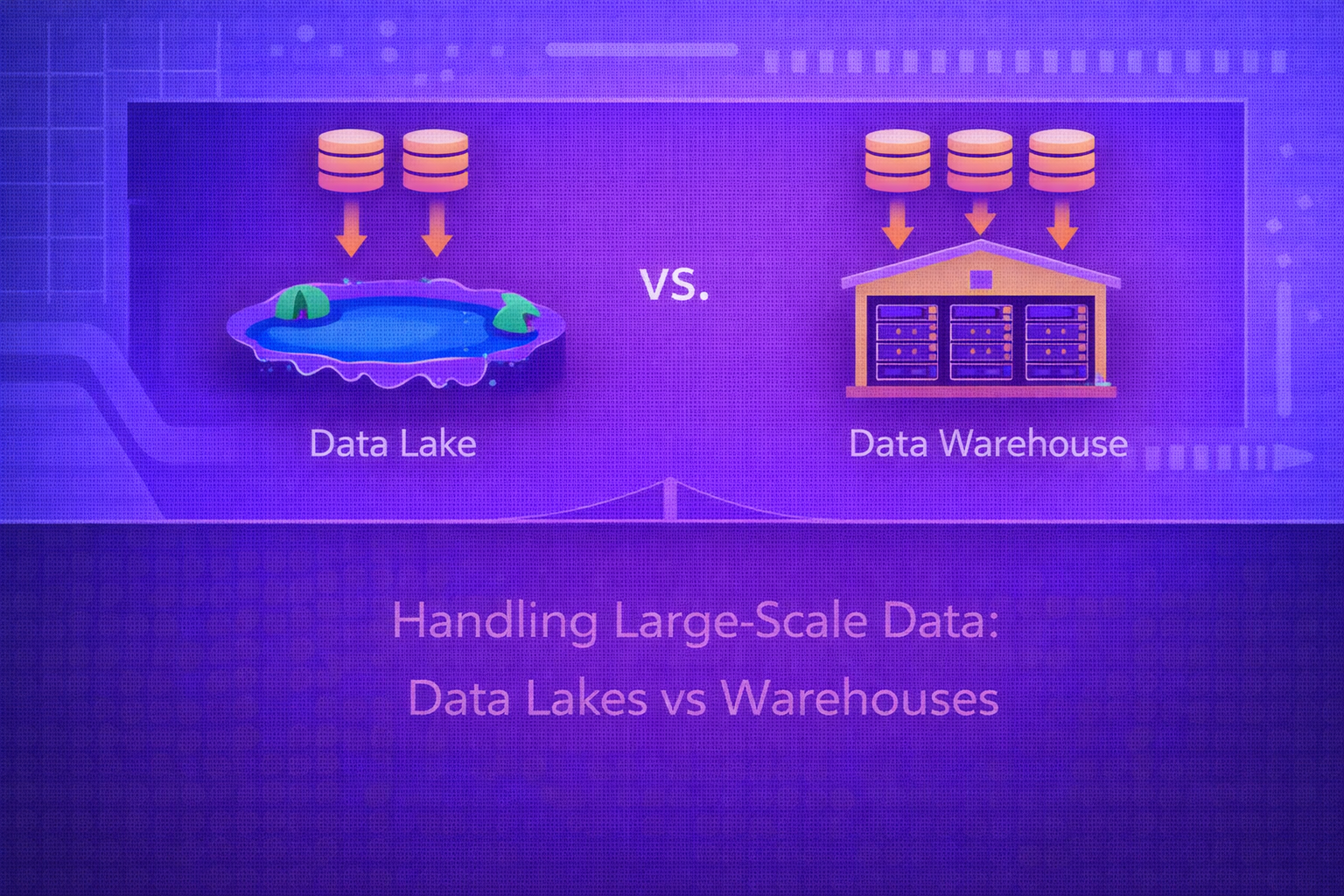
Handling large-scale data is one of the foundational challenges in modern analytics, machine learning, and digital product engineering. As data volume, variety, velocity, and governance requirements increase, organizations must choose storage and processing architectures that support both flexibility and reliability. Two of the most important architectural paradigms are data lakes and data warehouses. This whitepaper explains their principles, differences, trade-offs, and roles in modern data platforms.
Abstract
Organizations now ingest data from transactional systems, SaaS platforms, logs, IoT streams, media assets, clickstreams, documents, and machine-generated telemetry at massive scale. Managing such data requires storage systems that support durability, accessibility, governance, performance, and analytical usability. Data lakes and data warehouses represent two major approaches to large-scale data handling. A data lake emphasizes low-cost storage of raw and semi-structured data with schema flexibility and broad analytical reuse. A data warehouse emphasizes curated, structured, high-performance analytical querying over modeled datasets. This paper explains both paradigms in technical depth, including architecture, schema strategy, query behavior, workload fit, performance considerations, governance, metadata, cost, and modern hybrid patterns such as lakehouses. All formulas are embedded inline in HTML-friendly format for direct use in WordPress or similar editors.
1. Introduction
Let the total organizational data universe be represented as:
D = {d1, d2, ..., dN}.
Each di may originate from different systems and may differ in format,
structure, quality, arrival rate, and retention needs. A large-scale data platform must answer questions such as:
- where data should be stored
- when structure should be imposed
- how data should be queried
- how governance and lineage should be enforced
- how compute and storage costs should be balanced
Data lakes and data warehouses provide different answers to these questions.
2. The Problem of Large-Scale Data
Large-scale data handling becomes difficult because organizations face:
- high volume
- high ingestion velocity
- multiple data formats
- many producers and consumers
- compliance and governance requirements
- mixed workloads spanning BI, ML, and operational analytics
The classic “3 Vs” of big data are often written as:
Volume, Velocity, Variety,
though practical systems also care about veracity, value, and visibility.
3. Structured, Semi-Structured, and Unstructured Data
A useful distinction in large-scale platforms is the structure of the data:
- Structured: relational tables with fixed schema
- Semi-structured: JSON, Avro, XML, nested events
- Unstructured: images, audio, video, documents, binaries
Data warehouses are traditionally optimized for structured analytical data, while data lakes are better suited to retaining a broader range of raw data types.
4. What Is a Data Warehouse?
A data warehouse is a centralized analytical storage system designed for structured, curated, query-optimized data. It typically stores data modeled for reporting, BI, dashboards, and historical analysis.
Conceptually, one may think of a warehouse dataset as:
W = T1 ∪ T2 ∪ ... ∪ Tm,
where each Tk is a structured table designed for analytical access.
Warehouses are often associated with strong schema enforcement, SQL querying, performance optimization, and curated semantic models.
5. What Is a Data Lake?
A data lake is a large-scale storage system that retains raw or lightly processed data in native or near-native form. It usually supports a broad range of formats and is designed for flexible downstream processing.
Conceptually, a lake may be represented as:
L = {raw files, event logs, objects, snapshots, media, semi-structured records}.
Instead of requiring all data to be transformed into relational form before storage, a lake typically stores first and structures later when needed.
6. Schema-on-Write vs Schema-on-Read
One of the most fundamental differences between warehouses and lakes is when schema is applied.
6.1 Schema-on-Write
In schema-on-write, data must conform to a predefined schema before it is loaded. This is a defining pattern in many
warehouse systems. If the target schema is:
S = {(name1, type1), ..., (namem, typem)},
then incoming data is transformed to fit S before storage.
6.2 Schema-on-Read
In schema-on-read, raw data is stored first and interpreted later when queried or processed. This is common in data lakes. The same raw asset may be projected into different logical schemas depending on the consumer’s needs.
7. ETL vs ELT
Data warehouses are historically associated with ETL:
Extract → Transform → Load.
Data lakes are commonly associated with ELT:
Extract → Load → Transform.
In ETL, transformation happens before loading into the analytical store. In ELT, raw data is loaded first and transformed later inside the platform or adjacent compute engines.
8. Data Warehouse Architecture Characteristics
Warehouses typically emphasize:
- structured relational storage
- modeled schemas such as star or snowflake schemas
- high-performance SQL analytics
- data quality and consistency
- business-friendly semantic layers
These properties make warehouses especially useful for repeatable reporting and KPI-driven analytics.
9. Data Lake Architecture Characteristics
Data lakes typically emphasize:
- low-cost object or distributed file storage
- support for raw and diverse formats
- decoupling of storage and compute
- flexibility for ML, exploration, and data science
- retention of source-level fidelity
These properties make lakes especially valuable for exploratory, multi-format, and compute-intensive workloads.
10. Curated Data vs Raw Data
A warehouse usually stores curated, cleaned, modeled data intended for consistent analytical use. A lake often stores both raw and curated forms.
Many lake architectures use internal zones such as:
- raw/bronze: original ingested data
- refined/silver: cleaned and standardized data
- curated/gold: business-ready or analytics-ready outputs
This helps avoid the misconception that lakes must remain unstructured or chaotic.
11. Query Performance
Warehouses are optimized for analytical query performance through indexing strategies, columnar storage, execution engines, caching, and statistics-aware query planning.
A simplified analytical aggregate query might be:
Q = GROUP BY(dimensions) → aggregate(measures).
Warehouses are often better suited to high-concurrency BI workloads where many users run structured queries over modeled datasets.
12. Compute-Storage Separation
Modern data platforms increasingly separate compute from storage. In simplified terms:
Total Cost = Storage Cost + Compute Cost.
This allows independent scaling of storage capacity and query processing power. Many modern warehouses and lakes now share this principle, though they expose it differently.
13. Data Modeling in Warehouses
Warehouses commonly use dimensional modeling. A star schema contains:
- a fact table with measurable events
- dimension tables describing business entities
If fact table rows are indexed by keys
(k1, k2, ..., kr),
then measures such as revenue, volume, or count are aggregated across those keys and associated dimensions.
This structure supports fast reporting and understandable business logic.
14. File Formats in Data Lakes
Lakes often rely on file and object formats such as:
- CSV
- JSON
- Parquet
- ORC
- Avro
- images and media binaries
Columnar formats like Parquet and ORC improve scan efficiency for analytical workloads because queries often read only a subset of columns.
15. Metadata and Cataloging
Neither lakes nor warehouses are useful at scale without metadata. Metadata systems track:
- table or object definitions
- schema versions
- partitions
- owners
- lineage
- retention and classification policies
A large-scale data system without a usable catalog becomes difficult to govern, query, or trust.
16. Governance and Access Control
Large-scale data handling must support:
- role-based access control
- row- or column-level security
- data classification
- masking and tokenization
- audit trails
- compliance with regulatory obligations
Warehouses have traditionally offered strong governance out of the box, while data lakes historically required more external governance tooling, though this gap has narrowed.
17. Data Quality and Trust
A common criticism of poorly managed lakes is that they become “data swamps,” where data is stored but not well described, validated, or trusted.
If quality score is denoted by q(d) for dataset
d, then a useful enterprise data platform must maintain:
q(d) ≥ τ
for critical datasets, where τ is an acceptable quality threshold.
This means data quality engineering is just as important as raw storage choice.
18. Typical Use Cases for Data Warehouses
Warehouses are especially well-suited for:
- business intelligence dashboards
- financial reporting
- regulated analytical reporting
- high-concurrency SQL access
- historical KPI tracking
- semantic-model-driven analytics
19. Typical Use Cases for Data Lakes
Lakes are especially well-suited for:
- retaining raw source data
- machine learning feature generation
- data science exploration
- semi-structured event analytics
- log and telemetry storage
- multimodal or non-tabular datasets
- batch and distributed processing
20. Cost Considerations
Data lakes often offer lower raw storage cost because object storage is comparatively inexpensive and scales well. Warehouses often provide faster structured query performance but may cost more for heavily curated, performance-tuned analytical workloads.
A simplified cost expression may be:
Ctotal = Cstorage + Ccompute + Cingestion + Cgovernance.
The optimal architecture depends on workload shape, concurrency, freshness, and governance needs, not just storage price alone.
21. Performance Trade-Offs
Warehouses usually outperform lakes for highly structured SQL BI workloads because data is curated, modeled, and often execution-optimized. Lakes usually offer more flexibility for diverse compute engines and large-scale raw data retention, but interactive performance may depend heavily on file format, partitioning, indexing-like metadata, and the query engine layered on top.
22. Data Freshness and Streaming
Both lakes and warehouses can support fresh data ingestion, but their operational patterns may differ. Let record
arrival time be tarrive and query availability time be
tvisible. Freshness lag is:
Δfresh = tvisible - tarrive.
The architecture should match whether the business needs hourly reporting, near-real-time analytics, or long-term historical retention.
23. Machine Learning Workloads
ML workloads often favor lakes because training and feature engineering may require:
- raw historical events
- large file-based training corpora
- images, logs, and embeddings
- cheap large-scale retention
- flexible iterative transformations
However, warehouses can still play a major role in ML for:
- feature marts
- structured training tables
- scoring outputs and business integration
24. The Rise of the Lakehouse
Modern platforms increasingly blur the line between lakes and warehouses through the lakehouse pattern. A lakehouse attempts to combine:
- low-cost object storage and open formats from lakes
- transactionality, schema management, and analytical reliability from warehouses
The goal is to support both flexible data science and governed SQL analytics on a common substrate.
25. Transactions and Reliability
Warehouses have long emphasized strong transactional reliability for analytical table management. Modern lake architectures increasingly add table-layer capabilities such as:
- ACID-like transactions
- schema evolution
- time travel
- compaction and optimization
These capabilities reduce some of the historic reliability gap between lakes and warehouses.
26. Time Travel and Snapshotting
Large-scale data systems often benefit from versioned snapshots:
D(1), D(2), ..., D(t).
Snapshotting supports:
- reproducibility
- auditing
- rollback
- incremental processing
- ML training lineage
27. Data Lifecycle Management
Handling large-scale data requires lifecycle policies such as:
- retention windows
- archival tiers
- deletion policies
- cold vs hot storage strategies
- compaction and partition optimization
Without lifecycle discipline, storage costs and discoverability problems can grow rapidly.
28. Choosing Between a Lake and a Warehouse
The correct choice depends on workload requirements, not trend preference.
28.1 Prefer a Warehouse When
- the workload is structured BI and reporting
- query concurrency is high
- semantic consistency is critical
- business users need governed SQL access
- data is already curated and modeled
28.2 Prefer a Lake When
- raw data variety is high
- ML and data science need source-level retention
- semi-structured or unstructured data matters
- cheap large-scale storage is important
- schema needs to remain flexible initially
29. Hybrid Architectures
In practice, many enterprises use both. A common pattern is:
- land raw data in the lake
- refine and curate it
- publish selected modeled outputs into a warehouse for BI
This recognizes that different consumers need different data abstractions and performance characteristics.
30. Common Failure Modes
- using a lake without governance and creating a data swamp
- forcing all raw data into warehouse structures too early
- ignoring metadata and discoverability
- optimizing only for storage cost and neglecting query cost
- building duplicated silos instead of layered architecture
- misaligning platform design with BI, ML, and compliance needs
31. Strengths of Data Warehouses
- strong SQL analytics performance
- curated and modeled data
- good fit for dashboards and BI
- strong governance and semantic consistency
32. Strengths of Data Lakes
- flexible storage for many formats
- low-cost large-scale retention
- strong fit for ML and exploration
- good support for raw data preservation and future reuse
33. Limitations of Data Warehouses
- less natural for raw unstructured data retention
- can impose structure too early for exploratory workflows
- may be costlier for very large raw datasets
34. Limitations of Data Lakes
- governance can be weaker if poorly designed
- query performance may require more engineering
- discoverability and trust can degrade without metadata discipline
- business users may find raw lake data harder to consume directly
35. Best Practices
- Choose architecture based on workload, not slogans.
- Use strong metadata, cataloging, and lineage in both lakes and warehouses.
- Preserve raw data when future reuse and ML value are important.
- Curate and model data explicitly for BI and repeatable business reporting.
- Adopt layered zones or hybrid architectures instead of a single undifferentiated store.
- Align storage and query design with governance, performance, and cost objectives together.
36. Conclusion
Handling large-scale data requires more than simply choosing a storage technology. It requires making architectural decisions about structure, flexibility, cost, governance, performance, and downstream use cases. Data lakes and data warehouses represent two powerful but different responses to these needs.
Data warehouses excel at structured, curated, high-performance analytical workloads. Data lakes excel at flexible, large-scale, multi-format retention and computational reuse, especially for ML and data science. In modern practice, many organizations benefit from using both, often connected through layered or lakehouse-style architectures. The most effective large-scale data strategy is therefore not lake versus warehouse in isolation, but understanding which paradigm best serves each part of the enterprise data lifecycle.