
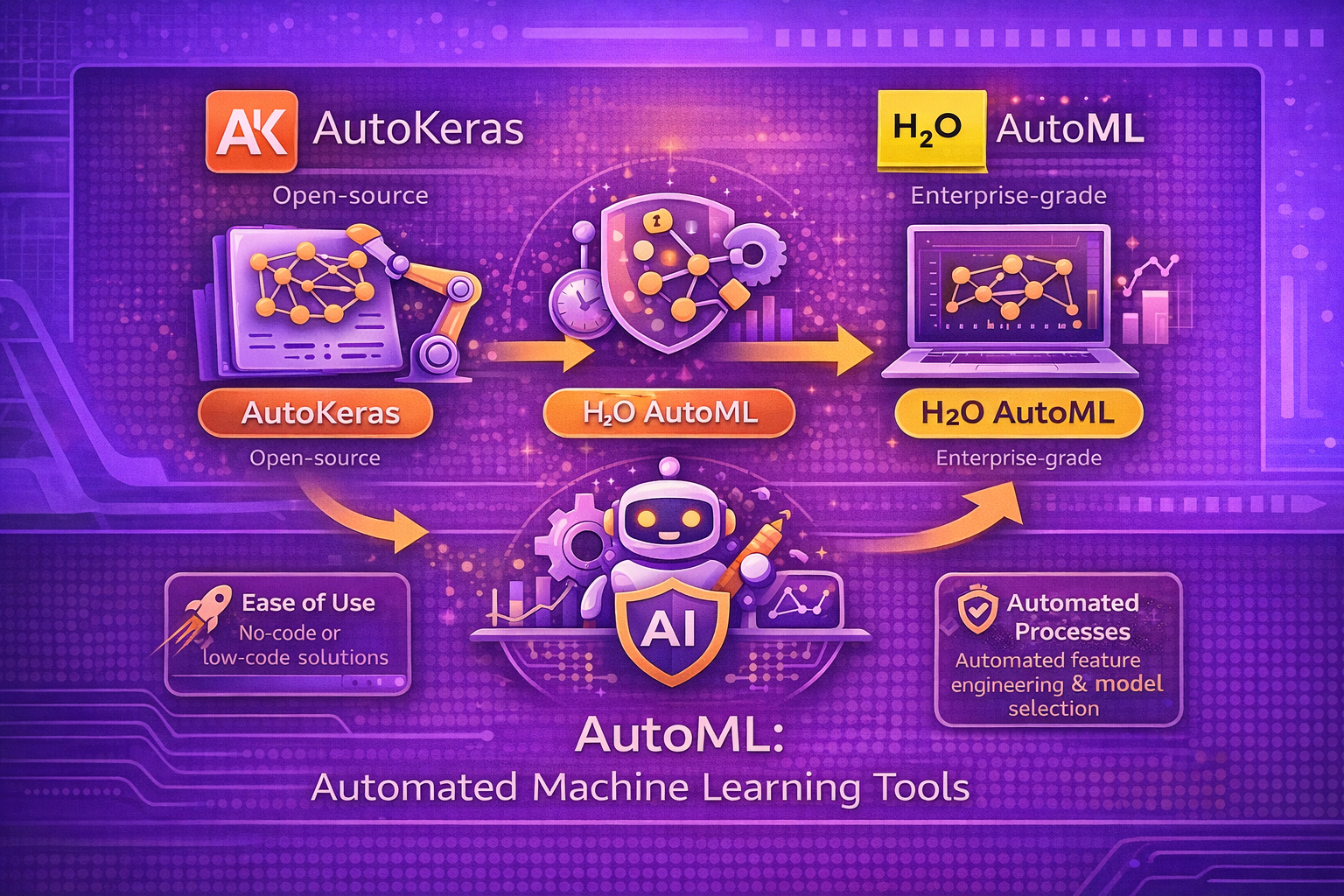
Automated Machine Learning, or AutoML, is the engineering discipline of automating major parts of the machine learning workflow so that useful models can be built with less manual trial-and-error. Instead of hand-crafting every algorithm choice, preprocessing step, and hyperparameter configuration, AutoML systems search over candidate pipelines and select strong-performing models under user-defined constraints. This whitepaper explains the technical foundations of AutoML and focuses on two important ecosystems: AutoKeras and H2O AutoML.
Abstract
Building strong machine learning systems usually requires choosing algorithms, handling preprocessing, tuning hyperparameters, validating performance, comparing candidates, and packaging results for deployment. These steps are expensive and often require significant expertise. AutoML reduces this burden by automating all or part of the modeling workflow. Depending on the system, AutoML may automate model-family search, neural architecture search, feature handling, hyperparameter optimization, model ensembling, leaderboard creation, explainability summaries, and export of the best model. This paper explains the architecture of AutoML, including search spaces, objective functions, validation strategy, ensembling, budget constraints, and risk trade-offs. It then examines AutoKeras as a neural-network-oriented AutoML system built around Keras workflows, and H2O AutoML as a broader supervised learning automation framework that trains multiple model families and produces a ranked leaderboard. All formulas are embedded inline in HTML-friendly format for direct use in WordPress or similar editors.
1. Introduction
Let a machine learning workflow be represented as:
W = (D, φ, A, λ, E, M),
where:
Dis the datasetφis preprocessing and feature logicAis the algorithm or model familyλis the hyperparameter configurationEis the evaluation protocolMis the resulting trained model
Traditional ML often requires a practitioner to choose and optimize all of these manually. AutoML aims to automate a large part of that decision process.
2. What AutoML Means
AutoML does not mean “no machine learning knowledge needed in every situation.” Rather, it means automating repeated, search-heavy, and error-prone tasks such as:
- algorithm selection
- hyperparameter tuning
- preprocessing choice
- model comparison
- ensemble creation
- resource-budgeted experimentation
The goal is to reduce manual tuning effort while still producing competitive models.
3. Why AutoML Matters
AutoML matters because strong model-building often depends on systematic experimentation. Without automation, practitioners may search only a tiny portion of the possible design space. AutoML systems help with:
- faster baselining
- reduced dependence on manual trial-and-error
- more reproducible exploration
- broader search over candidate models
- improved productivity for data teams
4. AutoML as an Optimization Problem
A simplified AutoML objective can be written as:
W* = argmax Score(D, φ, A, λ, E),
subject to constraints such as time, memory, latency, interpretability, or deployment environment.
This means AutoML is fundamentally a structured optimization and search problem over pipeline design choices.
5. Search Space
Every AutoML system defines a search space. The search space may include:
- candidate model families
- network architectures
- hyperparameter ranges
- preprocessing variants
- ensemble combinations
If candidate configurations are:
c1, c2, ..., cK,
then AutoML tries to identify the most useful configuration under the chosen evaluation metric and budget.
6. Search Strategy
AutoML systems differ in how they search. Common strategies include:
- grid search
- random search
- Bayesian optimization
- bandit-style early stopping
- greedy architecture search
- meta-learning-guided search
The search strategy determines how efficiently the system explores promising configurations.
7. Evaluation Objective
AutoML must optimize toward a clear evaluation metric. For classification, metrics may include:
Accuracy = (TP + TN)/(TP + TN + FP + FN),
Precision = TP/(TP + FP),
Recall = TP/(TP + FN),
and
F1 = 2(Precision × Recall)/(Precision + Recall).
For regression, common objectives include:
MAE = (1/n) Σ |yi - ŷi|
and
RMSE = √[(1/n) Σ (yi - ŷi)2].
The usefulness of AutoML depends heavily on whether the chosen objective actually reflects business value.
8. Validation Strategy
AutoML systems rely on validation to compare candidates. A basic split may be:
D = Dtrain ∪ Dval ∪ Dtest.
Some systems use holdout validation, while others use cross-validation. In
K-fold cross-validation, the average score is:
Score = (1/K) Σk=1K Scorek.
Validation strategy matters because AutoML can otherwise overfit to leaderboard comparisons.
9. AutoML and Budget Constraints
AutoML is usually constrained by one or more budgets:
- maximum wall-clock time
- maximum number of trials
- memory budget
- compute budget
- deployment or latency constraints
If total budget is B, then the search process must allocate that budget across many
candidate experiments instead of spending it all on one configuration.
10. AutoML Output
AutoML does not just train one model. It usually produces:
- a leaderboard of candidate models
- the best-performing model under the configured metric
- training logs and metrics
- sometimes ensembles or stacked models
- sometimes explainability summaries
In this sense, AutoML is both a search engine and a model selection engine.
11. Benefits of AutoML
- rapid baseline generation
- reduced manual tuning effort
- broader search than ad hoc experimentation
- increased reproducibility of exploration
- better accessibility for non-expert users
12. Limitations of AutoML
- can obscure modeling assumptions
- may optimize the wrong objective if the target metric is poorly chosen
- can be compute-intensive
- does not eliminate the need for data understanding and governance
- may produce strong benchmark models that are hard to operationalize or explain
13. AutoKeras Overview
AutoKeras describes itself as an AutoML system based on Keras. Its public documentation states that it supports a simple interface for tasks such as image classification, image regression, text classification, text regression, structured data classification, and structured data regression. It also exposes a more advanced AutoModel API for custom search spaces. The official installation guidance shows AutoKeras as a Python package, and the official tutorials also show newer examples using the Keras backend environment setting. citeturn578470search0turn578470search2turn578470search6turn578470search8turn578470search10turn578470search12turn578470search14turn578470search18
14. AutoKeras Design Philosophy
AutoKeras is oriented toward neural-network-based AutoML with a developer experience that resembles Keras. A central idea is that a user can specify a task at a high level while the system searches over architecture and hyperparameter choices under the hood. This makes it particularly appealing for users who want AutoML in a deep learning style workflow. citeturn578470search0turn578470search8turn578470search16
15. AutoKeras Task Abstractions
AutoKeras exposes task-oriented abstractions such as image, text, and structured-data predictors. Conceptually,
instead of manually defining:
(φ, A, λ),
the user selects a task wrapper and provides data, while AutoKeras searches over internal candidate architectures and
tuning choices. citeturn578470search2turn578470search12turn578470search14turn578470search18
16. AutoKeras Search Space
AutoKeras provides both high-level task APIs and a more customizable AutoModel path. Its documentation describes AutoModel as combining a HyperModel and a Tuner, and its block API shows that users can define search spaces from composable blocks such as image blocks and other model-building components. This means AutoKeras supports both simple task-driven usage and more advanced neural architecture search customization. citeturn578470search8turn578470search10turn578470search16
17. AutoKeras Workflow
A simplified AutoKeras workflow looks like:
input data → task wrapper or AutoModel → search/tuning → best Keras-compatible model.
This is attractive for teams already comfortable with TensorFlow/Keras-style workflows because the output remains close to familiar neural network abstractions. This is an inference based on the AutoKeras API structure and documentation. citeturn578470search0turn578470search8turn578470search10
18. Strengths of AutoKeras
- simple task-level interface for common supervised learning tasks
- natural fit for Keras-oriented users
- supports customizable search spaces through AutoModel and blocks
- useful for neural architecture and tuning automation in Python workflows
These strengths are supported by the official task tutorials and AutoModel/block documentation. citeturn578470search2turn578470search8turn578470search10turn578470search16
19. Limitations of AutoKeras
AutoKeras is not a universal solution for every enterprise AutoML use case. Compared with broad multi-algorithm tabular AutoML systems, it is more naturally associated with Keras-based search workflows and task abstractions. It can still be powerful, but users need to align expectations with its design center. This is an inference from its official positioning and documentation structure. citeturn578470search0turn578470search2turn578470search8
20. H2O AutoML Overview
H2O documents H2O AutoML as automating the supervised machine learning model training process. The official docs say it trains many models under a user-specified time limit, returns an H2OAutoML object containing a leaderboard ranked by a default model performance metric, and provides explainability methods for AutoML objects and individual models. H2O also positions AutoML across Python, R, and a web GUI, and states that the open source stack scales to cluster environments such as Hadoop, Spark, and Kubernetes. citeturn578470search1turn578470search3turn578470search7turn578470search9turn578470search13turn578470search19
21. H2O AutoML Design Philosophy
H2O AutoML is oriented toward broad supervised learning automation rather than only neural architecture search. It is especially strong as a tabular-modeling automation and leaderboard framework that can compare multiple model families and produce a practical best candidate within a bounded time budget. This is an inference supported by the official AutoML and algorithm overview documentation. citeturn578470search1turn578470search7turn578470search9turn578470search19
22. H2O AutoML Workflow
A simplified H2O AutoML workflow looks like:
training frame + response + time budget → train multiple candidate models → leaderboard → leader model / ensemble.
The user initializes the H2O environment, supplies a training frame and target, and the system automates repeated model training and tuning within the configured limits. citeturn578470search1turn578470search9turn578470search13
23. Leaderboards and Model Selection
One of H2O AutoML’s strongest practical features is the leaderboard abstraction. If candidate models are
m1, ..., mK and evaluation score is
Score(mk), then the leaderboard ranks models by that score and exposes a
“leader” model:
m* = argmax Score(mk)
or the appropriate minimization variant depending on the metric.
This makes model comparison operationally simple. citeturn578470search1turn578470search9
24. Time-Limited Search
H2O AutoML explicitly supports user-specified time limits for automation. This is important because AutoML search can
become expensive, and bounded search is often more useful in production than unconstrained tuning. Formally, if total
search budget is B, H2O AutoML allocates that budget across candidate model training
and ranking rather than leaving the exploration open-ended. citeturn578470search1turn578470search7turn578470search9
25. Explainability in H2O AutoML
The H2O documentation notes that explainability methods can be applied to AutoML objects and to individual models. This is operationally important because leaderboard automation without explainability can make model governance more difficult. H2O’s explainability support helps bridge AutoML performance with model understanding. citeturn578470search1
26. Strengths of H2O AutoML
- strong supervised-learning automation workflow
- leaderboard-driven model comparison
- Python, R, and GUI accessibility
- time-budgeted search behavior
- explainability support for AutoML outputs
- cluster-oriented scaling story in the broader H2O ecosystem
These points are supported directly by H2O’s official AutoML and platform documentation. citeturn578470search1turn578470search7turn578470search9turn578470search13turn578470search19
27. Limitations of H2O AutoML
Like any AutoML system, H2O AutoML does not remove the need for human judgment around target definition, leakage, fairness, deployment suitability, and governance. A strong leaderboard result is not automatically the right business model. This is a general operational inference rather than a claim from one specific source, though it follows from the documented role of AutoML as supervised-training automation rather than full problem understanding. citeturn578470search1turn578470search9
28. AutoKeras vs H2O AutoML
AutoKeras and H2O AutoML both automate machine learning, but they reflect different centers of gravity:
- AutoKeras is more naturally aligned with Keras-based, neural-network-style AutoML and customizable model blocks.
- H2O AutoML is more naturally aligned with broad supervised learning automation, multi-model leaderboards, and practical time-bounded search over model families.
This distinction is an inference grounded in each tool’s official documentation and product structure. citeturn578470search0turn578470search2turn578470search8turn578470search16turn578470search1turn578470search7turn578470search9
29. AutoML and Overfitting Risk
Because AutoML compares many candidates, overfitting to validation or leaderboard metrics is a real risk if evaluation is not designed carefully. If too many configurations are tested on the same validation structure, the chosen best model may reflect search bias rather than genuine generalization.
This is why holdout integrity, cross-validation discipline, and final test isolation remain essential.
30. AutoML and Governance
AutoML does not remove governance responsibilities. Organizations still need to evaluate:
- data quality
- leakage risk
- fairness by subgroup
- calibration
- latency and serving constraints
- interpretability requirements
- deployment and monitoring suitability
AutoML helps search models; it does not replace responsible lifecycle management.
31. When AutoML Works Best
AutoML is especially valuable when:
- a strong baseline is needed quickly
- the team wants systematic search rather than ad hoc tuning
- resource budgets can be clearly defined
- the problem is a common supervised learning task
- manual experimentation would otherwise be too slow
32. When AutoML Needs Extra Caution
AutoML requires extra caution when:
- the target variable may encode bias or leakage
- fairness or interpretability constraints are strict
- deployment latency is tightly bounded
- data is highly non-stationary
- regulatory or high-stakes decisions are involved
33. Common Failure Modes
- optimizing the wrong metric
- allowing leakage in the automated pipeline
- treating the leaderboard winner as automatically production-ready
- ignoring inference cost or model size
- overlooking subgroup fairness and calibration
- using AutoML without understanding the underlying data semantics
34. Best Practices
- Use AutoML to accelerate search, but keep humans responsible for problem framing and governance.
- Choose evaluation metrics that truly reflect deployment and business objectives.
- Keep a final untouched test set outside the AutoML search loop.
- Check model size, inference cost, and interpretability before operationalizing the winner.
- Use AutoKeras when you want Keras-oriented neural AutoML workflows.
- Use H2O AutoML when you want broad supervised model automation with leaderboard-style comparison and time-bounded search.
35. Conclusion
AutoML is a major shift in how machine learning systems are built because it turns repeated model-search work into a structured, automatable process. This can dramatically improve productivity, broaden experimentation, and generate strong baselines quickly.
AutoKeras and H2O AutoML illustrate two different but complementary visions of AutoML. AutoKeras brings automation into a Keras-native, neural-search-oriented workflow with both simple and customizable interfaces. H2O AutoML brings broader supervised-learning automation with ranked leaderboards, explainability support, and practical time-budgeted search. Understanding AutoML therefore means understanding not just automation itself, but what is being automated, what remains a human responsibility, and how the resulting models will be evaluated and governed in the real world.