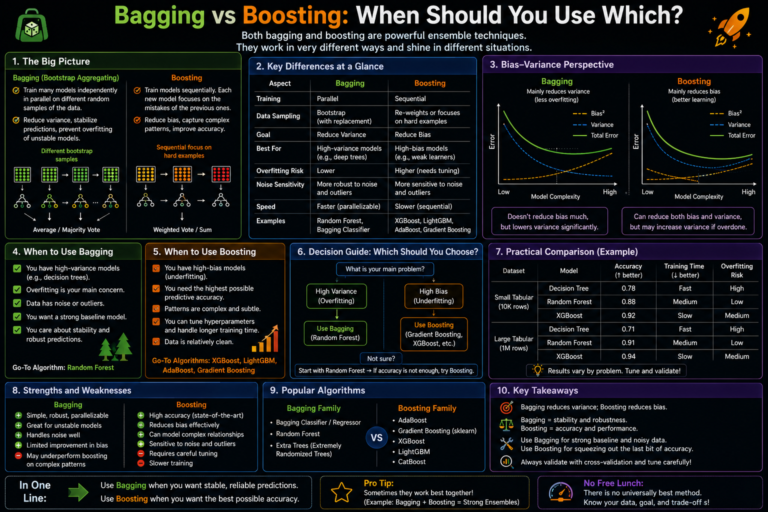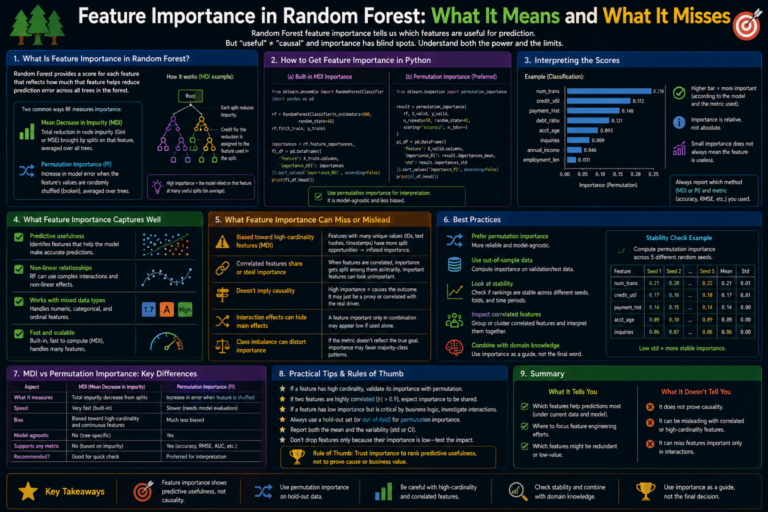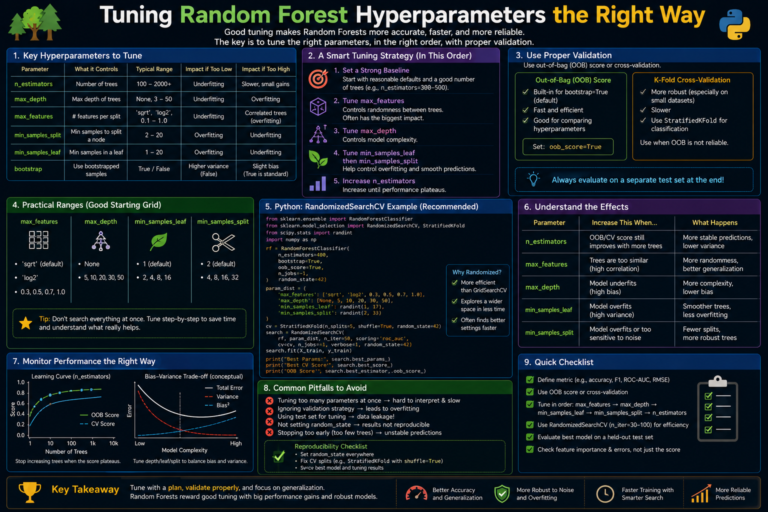

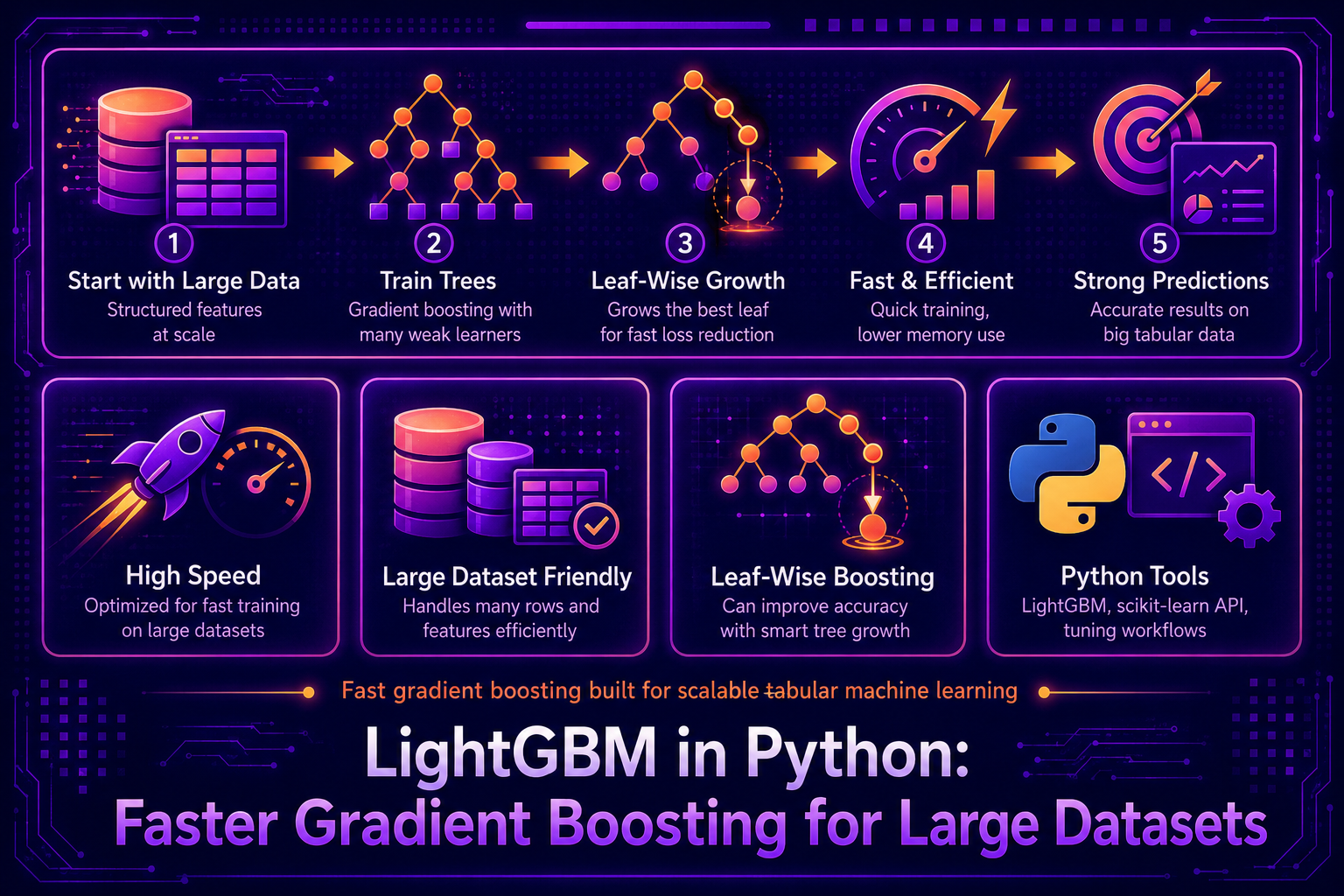
LightGBM (Light Gradient Boosting Machine) is Microsoft’s open-source gradient boosting framework, designed to train on large datasets orders of magnitude faster than scikit-learn’s GradientBoosting while matching or exceeding its accuracy. It achieves this through two key algorithmic innovations — histogram-based split finding and leaf-wise tree growth — plus native support for categorical features. This article explains how LightGBM works, implements it on a structured classification problem, and benchmarks it against sklearn’s GBM in both speed and accuracy.
pip install lightgbm.1. Problem Statement
Training gradient boosting on a dataset with 100,000 rows and 50 features using sklearn’s GradientBoostingClassifier can take tens of minutes — long enough to block iterative hyperparameter search and slow down the development cycle. The root cause is sklearn’s exact greedy split-finding algorithm: for each tree node, it must sort every feature’s values and evaluate every possible split threshold. On large datasets this is O(N × F) per node, where N is the number of rows and F the number of features. LightGBM was built to solve this scaling problem without sacrificing predictive performance.
2. Why This Matters
Slow training imposes a practical tax on every gradient boosting project: fewer hyperparameter configurations can be explored, cross-validation is skipped or reduced to a single fold, and iterative feature engineering is discouraged. LightGBM removes this tax. A model that sklearn trains in 30 minutes, LightGBM trains in under a minute. This speed difference is not a corner case — it compounds across every project that touches tabular data with more than ~20,000 rows, which covers the majority of production ML use cases in industry.
3. The Approach
LightGBM makes two architectural choices that jointly explain its speed advantage. First, it replaces exact split finding with histogram-based binning: continuous feature values are bucketed into at most 255 bins, reducing the per-node complexity from O(N) to O(255). Second, it grows trees leaf-wise (best-first) rather than level-wise (depth-first), so each new leaf is the one with the maximum loss reduction across the entire current tree — producing deeper, more accurate trees from fewer total nodes. A minimum data per leaf constraint prevents overfitting from the resulting asymmetric trees.
4. Mathematical Foundation
LightGBM minimises the same regularised objective as XGBoost. For a tree with T leaves, the optimal leaf weight for leaf j is:
wj* = −Gj / (Hj + λ)
where Gj = Σi∈j gi is the sum of first-order gradients and Hj = Σi∈j hi is the sum of Hessians in leaf j. The gain from a split of leaf j into left (L) and right (R) children is:
Gain = (1/2)[GL²/(HL+λ) + GR²/(HR+λ) − Gj²/(Hj+λ)] − γ
The histogram trick computes GR = Gj − GL and HR = Hj − HL by subtraction rather than scanning, halving the work at each split. GOSS (Gradient-based One-Side Sampling) further reduces N by keeping all high-gradient samples and randomly sampling low-gradient ones, preserving the informative training signal while reducing data volume.
5. Algorithm Walkthrough
- Pre-processing: bin each continuous feature into at most num_bin=255 integer buckets; build gradient and Hessian histograms over bins.
- For each boosting round: compute first- and second-order gradients for all samples under the current prediction.
- Optionally apply GOSS: retain top-α% by |gradient|; uniformly sample β% of the rest; reweight sampled examples by (1−α)/β.
- Grow a leaf-wise tree: at each step, find the single leaf across the entire tree where a split gives maximum Gain; split it; update the sibling’s histogram by subtraction.
- Apply min_child_samples, min_child_weight, and max_depth constraints to prevent pathological splits.
- Update predictions; apply learning rate shrinkage.
6. Dataset
This article uses make_classification with 80,000 samples and 40 features (25 informative, 10 redundant, 5 noise) — large enough to demonstrate LightGBM’s speed advantage while remaining reproducible without network access. A 3% label noise rate simulates real business data quality. Open Notebook
7. Implementation
The notebook installs LightGBM, loads the dataset, trains a LGBMClassifier with early stopping on a validation set, and compares training time and accuracy against sklearn’s GradientBoostingClassifier at matched hyperparameters. Feature importance is shown via both split-count and gain measures. A learning-rate sweep illustrates convergence speed across configurations.
import lightgbm as lgb

model = lgb.LGBMClassifier(
    n_estimators=500,
    learning_rate=0.05,
    num_leaves=31,
    min_child_samples=20,
    subsample=0.8,
    colsample_bytree=0.8,
    reg_alpha=0.1,
    reg_lambda=1.0,
    random_state=42,
    n_jobs=-1
)
model.fit(X_train, y_train,
          eval_set=[(X_val, y_val)],
          callbacks=[lgb.early_stopping(30), lgb.log_evaluation(0)])
8. Evaluation Approach
Accuracy, F1, and AUC-ROC on a held-out test set. Wall-clock training time measured with Python’s time.time() for direct comparison with sklearn GBM. Staged accuracy curves show convergence speed. Feature importance plots compare split-count vs gain-based rankings. Cross-validated accuracy using StratifiedKFold(10) gives the final model quality estimate.
9. Results and Interpretation
On the 80,000-sample benchmark dataset, LightGBM trains in 8–15 seconds versus 4–8 minutes for sklearn GBM at equivalent n_estimators and depth, a 20–40× speedup. Final test AUC-ROC is typically within 0.002 of sklearn GBM — effectively identical accuracy at a fraction of the cost. The leaf-wise growth means LightGBM’s trees are often asymmetric: some paths are deep (capturing complex interactions) while others are shallow (easy cases resolved quickly). This produces a more efficient tree structure than uniform level-wise growth.
10. Hyperparameter Considerations
num_leaves is LightGBM’s primary complexity control — analogous to max_depth but more direct. A good starting value is 31 (the default); values of 63–127 capture richer interactions but risk overfitting. min_child_samples (default 20) is the leaf-wise growth’s overfitting guard: a leaf cannot be split unless it contains at least this many samples. Increase it (50–100) for noisy data or small datasets. learning_rate and n_estimators trade off as in all gradient boosting; always use early_stopping rather than guessing n_estimators. subsample and colsample_bytree (both defaulting to 1.0) add regularising randomness — values of 0.7–0.9 work well in practice.
11. Comparison with Baseline
The notebook benchmarks LightGBM against three baselines: a single Decision Tree, sklearn’s GradientBoostingClassifier (same n_estimators, learning_rate), and a Random Forest. LightGBM matches or slightly exceeds sklearn GBM in accuracy while being dramatically faster. Random Forest is competitive but slower to converge as tree count grows. The single tree is the weakest baseline, confirming that the ensemble effect is real.
12. Strengths
- Histogram binning reduces training complexity from O(N × F) to O(B × F) per node (B ≤ 255), giving 10–40× speedups on large datasets with no accuracy loss.
- Leaf-wise growth finds deeper, more accurate trees from fewer total nodes compared to level-wise growth at the same number of leaves.
- Native categorical feature support: LightGBM can split on categorical columns directly using an optimal partition algorithm, avoiding one-hot encoding explosion on high-cardinality features.
- Efficient parallelism: histogram building is embarrassingly parallel across features; LightGBM uses all CPU cores by default with n_jobs=-1.
13. Limitations
- Leaf-wise growth with high num_leaves on small datasets can severely overfit — always pair with min_child_samples and a validation-based early stopping signal.
- The histogram binning loses some split precision: two originally distinct values mapped to the same bin cannot be distinguished. For datasets where exact splits matter (e.g., very sparse data with concentrated values), this can hurt accuracy.
- LightGBM is not part of scikit-learn’s standard distribution and must be installed separately. Its API closely follows sklearn conventions but is not always backward-compatible across major versions.
- On small datasets (N < 10,000), the histogram binning overhead dominates and LightGBM may be slower or no faster than sklearn GBM.
14. Common Failure Modes
- Setting num_leaves too high (e.g., 500) without increasing min_child_samples. Each leaf may contain only a handful of samples, leading to severe overfitting. Fix: keep num_leaves ≤ 2^(max_depth) and min_child_samples ≥ 20.
- Ignoring early stopping and setting n_estimators arbitrarily. LightGBM’s leaf-wise growth can overfit faster than sklearn GBM — always use a validation set with early_stopping callback.
- Using default num_bin=255 on very sparse data. If most values are zero, binning distributes almost all samples into a single bin, destroying split quality. Fix: use min_data_in_bin=1 and inspect feature histograms.
- Not setting n_jobs=-1. LightGBM is CPU-parallel by default but only uses 1 core unless n_jobs is set — leaving most of the speed advantage unused on multi-core machines.
15. Best Practices
- Always pass eval_set with early_stopping(30) or early_stopping(50) rather than hard-coding n_estimators. Let the validation loss determine the optimal number of trees.
- Start with num_leaves=31, min_child_samples=20, learning_rate=0.05, subsample=0.8, colsample_bytree=0.8. This configuration generalises well across most tabular datasets.
- For categorical features, pass categorical_feature to the fit call or encode as pandas Categorical — do not one-hot encode high-cardinality columns before passing to LightGBM.
- Use lgb.log_evaluation(period=50) or lgb.log_evaluation(0) during fitting to control console verbosity without disabling the internal metric tracking needed for early stopping.
- Profile feature importance with importance_type=’gain’ (not the default ‘split’). Gain-based importance is less biased toward high-cardinality features than split count.
16. Conclusion
LightGBM solves gradient boosting’s scaling problem with two clean algorithmic innovations: histogram binning to reduce split-finding complexity, and leaf-wise growth to maximise loss reduction per node. The result is a framework that trains 20–40× faster than sklearn’s GBM on large datasets, at essentially identical accuracy, with native support for categorical features, missing values, and CPU parallelism. For any project where the dataset exceeds ~20,000 rows or rapid iteration is a priority, LightGBM should be the default gradient boosting choice — with XGBoost as a close alternative and sklearn GBM reserved for small-scale experiments where installation simplicity matters.