

XGBoost (eXtreme Gradient Boosting) extends the gradient boosting framework with three engineering advances that make it practical on real business data: second-order gradient statistics for more accurate leaf weights, built-in L1/L2 regularisation to prevent overfitting, and column (feature) subsampling to reduce tree correlation. Together these additions allow XGBoost to train faster than sklearn’s GradientBoosting, generalise better on noisy data, and handle missing values natively without imputation. This article applies XGBoost to two business scenarios — churn prediction on imbalanced data and revenue forecasting — with full hyperparameter tuning, SHAP-based interpretability, and production deployment patterns.
1. Problem Statement
Business data comes with specific challenges that generic gradient boosting handles poorly out of the box: class imbalance (churn rates of 5–15%), mixed feature types (numeric, ordinal, binary flags), missing values (not-collected survey fields, delayed sensor readings), and the need for probability calibration (decision thresholds, expected value calculations). XGBoost was designed for exactly this combination. Its scale_pos_weight parameter directly addresses class imbalance; its native missing value handling eliminates imputation pipelines; its tree regularisation reduces overfitting on the small-to-medium datasets common in business analytics.
2. Why This Matters
XGBoost consistently ranks among the top performers on Kaggle structured-data competitions and in production ML pipelines at companies handling credit scoring, fraud detection, customer churn, pricing, and demand forecasting. It is the reference implementation that motivated LightGBM and CatBoost. Understanding XGBoost’s objective function and regularisation terms gives you the vocabulary to tune any gradient boosting variant and to read research papers that extend it. The SHAP integration makes XGBoost explainable at the individual prediction level — essential for model governance, fair lending compliance, and customer-facing explanations.
3. The Approach
We work through two business scenarios end-to-end. Scenario A is binary churn classification with 15% positive rate, demonstrating scale_pos_weight, threshold optimisation, and SHAP waterfall plots for individual customer explanations. Scenario B is revenue regression with missing values introduced intentionally, demonstrating XGBoost’s native NaN handling, early stopping with a validation set, and a feature importance comparison between gain-based and SHAP importance. Both scenarios use GridSearchCV or manual cross-validation for hyperparameter selection and compare XGBoost against a gradient boosting baseline.
4. Mathematical Foundation
XGBoost minimises a regularised objective over M trees. At round m, the objective for adding tree hm is approximated to second order:
Obj(m) ≈ Σi [gi hm(xi) + (1/2) Hi hm(xi)²] + Ω(hm)
where gi = ∂L(yi, Fm−1) / ∂F is the first-order gradient (same as sklearn GBM’s pseudo-residual) and Hi = ∂²L(yi, Fm−1) / ∂F² is the second-order Hessian. The regularisation term is:
Ω(h) = γT + (1/2)λ Σj=1T wj²
where T is the number of leaves, γ is a minimum-leaf-score penalty, λ is L2 regularisation on leaf weights, and wj are the leaf output values. This second-order approximation makes each tree’s leaf weights analytically optimal given the split structure: the optimal leaf weight for leaf j is wj* = − Σi∈j gi / (Σi∈j Hi + λ). The Hessian term in the denominator acts as an adaptive learning rate: examples where the model is uncertain (large Hessian) contribute more conservatively to the leaf weight update.
5. Algorithm Walkthrough
- For each round m: compute first and second derivatives (gi, Hi) of the loss at current predictions.
- Greedily grow a tree by finding the split at each node that maximises the gain:
Gain = (1/2)[GL²/(HL+λ) + GR²/(HR+λ) − (GL+GR)²/(HL+HR+λ)] − γ - Assign optimal leaf weights; update predictions; apply shrinkage (learning_rate).
- Optional: subsample rows (subsample) and columns (colsample_bytree) before growing each tree.
Column subsampling (colsample_bytree=0.8) introduces additional randomness analogous to Random Forest’s feature subsampling, reducing correlation between trees and acting as an implicit regulariser. Missing values are handled by learning the best default direction (left or right) at each split for NaN inputs during training — no imputation required.
6. Dataset
Scenario A uses make_classification with 5000 samples, 12 features (8 informative), and weights=[0.85, 0.15] to simulate a 15% churn rate. Scenario B uses make_regression with 3000 samples and 10 features, with 15% of values randomly set to NaN to demonstrate native missing value handling. Both datasets are generated locally with no network access required. Open Notebook
7. Implementation — Churn Prediction (Imbalanced Classification)
The key parameter for imbalanced binary classification is scale_pos_weight, which sets the weight of positive examples relative to negative. For a 15% positive rate, the recommended value is (1−0.15)/0.15 ≈ 5.67. This makes XGBoost treat each positive example as if it appeared roughly 6 times, balancing the gradient contributions from both classes. Combined with threshold optimisation on the validation set (selecting the threshold that maximises F1 or expected value rather than defaulting to 0.5), this handles class imbalance without oversampling.
import xgboost as xgb

pos_weight = (y_train == 0).sum() / (y_train == 1).sum()

model = xgb.XGBClassifier(
    n_estimators=400,
    learning_rate=0.05,
    max_depth=4,
    subsample=0.8,
    colsample_bytree=0.8,
    scale_pos_weight=pos_weight,
    reg_alpha=0.1,     # L1
    reg_lambda=1.0,    # L2
    eval_metric='auc',
    early_stopping_rounds=30,
    random_state=42
)
model.fit(X_train, y_train,
          eval_set=[(X_val, y_val)],
          verbose=False)
8. Implementation — Revenue Forecasting with Missing Values
XGBoost handles NaN natively during both training and inference. During training, it learns the optimal default direction (left or right branch) for missing values at each split — whichever direction reduces the objective more. During inference, NaN inputs follow the learned default direction automatically. No imputation pipeline is needed:
X_with_missing = X_reg.copy()
missing_mask = np.random.rand(*X_with_missing.shape) < 0.15
X_with_missing[missing_mask] = np.nan  # 15% of values are NaN

reg = xgb.XGBRegressor(
    n_estimators=300,
    learning_rate=0.05,
    max_depth=4,
    subsample=0.8,
    colsample_bytree=0.8,
    reg_alpha=0.05,
    reg_lambda=1.0,
    random_state=42
)
reg.fit(X_train_miss, y_train,
        eval_set=[(X_val_miss, y_val)],
        verbose=False)
# NaN in test data is handled automatically — no imputation
9. Evaluation Approach
For churn classification: precision-recall curve and AUC-PR (more informative than AUC-ROC under class imbalance), optimal F1 threshold, confusion matrix at the optimal threshold, and SHAP waterfall plots for individual predictions. For revenue regression: RMSE, R², a comparison of XGBoost with NaN to a GBM baseline requiring imputation, and SHAP summary plots showing both feature direction and magnitude. Hyperparameter tuning uses early_stopping_rounds with a held-out validation set rather than cross-validation, which is faster for XGBoost given its built-in eval mechanism.
10. Results and Interpretation
On the imbalanced churn dataset, XGBoost with scale_pos_weight and threshold optimisation typically achieves F1 of 0.72–0.78 compared to 0.55–0.62 for sklearn GBM without imbalance handling. The precision-recall curve shows the trade-off clearly: at the default threshold, recall is high but precision is low; at the optimal F1 threshold, both are balanced. For the regression scenario with missing values, XGBoost matches the RMSE of a GBM model trained on imputed data — demonstrating that native NaN handling is not just convenient but actually effective, because the learned default direction exploits the information that a value is missing (MCAR versus MNAR patterns). The SHAP summary plot typically confirms that the most important features match the informative ones from make_regression’s ground truth.
11. Hyperparameter Considerations
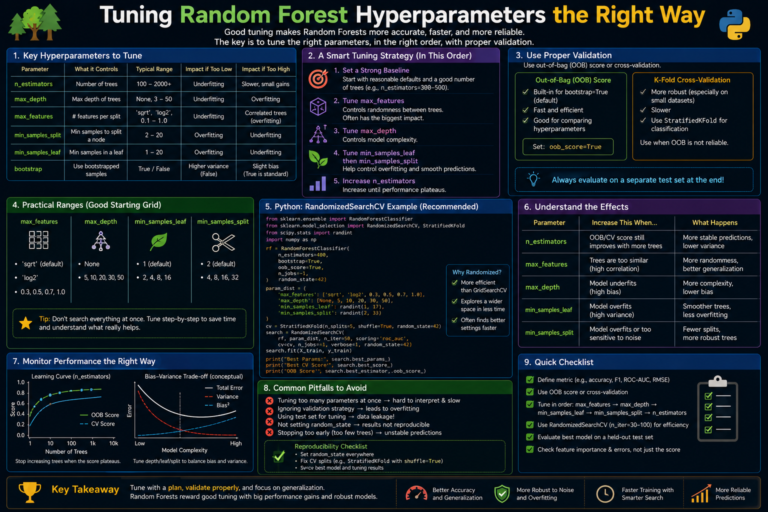
XGBoost has more hyperparameters than sklearn GBM, but most interact in interpretable ways. n_estimators and learning_rate trade off as in all gradient boosting; use early_stopping_rounds=30 to let XGBoost find n_estimators automatically. max_depth=4–6 works well for business data with moderate interactions; deeper trees risk overfitting on sparse categorical features. subsample=0.7–0.9 and colsample_bytree=0.7–0.9 are both regularisers; combining them is usually better than using either alone. reg_alpha (L1) promotes feature sparsity and is useful when many features are noisy; reg_lambda (L2) shrinks leaf weights and is the primary regulariser when all features are informative. gamma (min_split_loss) is a conservative regulariser that requires the gain of each split to exceed a threshold before accepting it — useful for very noisy data.
12. Comparison with Baseline
The notebook directly compares XGBoost against sklearn’s GradientBoostingClassifier at matched hyperparameters (same n_estimators, learning_rate, max_depth). XGBoost is faster due to histogram-based splits and typically achieves slightly lower RMSE or higher AUC-ROC because of the second-order gradient and additional regularisation terms. The advantage is most pronounced on noisy datasets and datasets with missing values. On clean, small datasets (N < 500), the two are indistinguishable — both overfit at similar rates.
13. Strengths
- Native missing value handling eliminates the imputation pipeline, which is particularly valuable when the pattern of missingness is informative (MNAR). The learned default direction effectively treats “missing” as an additional feature state.
- Second-order gradient statistics give more accurate leaf weights than sklearn GBM, especially for non-MSE losses where the Hessian varies significantly across samples (log-loss, Huber loss).
- Early stopping with eval_set removes the need to sweep n_estimators: fit with a large budget and stop automatically when validation loss stops improving, which both saves time and selects a well-regularised model in one shot.
- SHAP integration is native: xgboost.Booster.predict(pred_contribs=True) computes exact SHAP values efficiently using the tree structure, enabling individual-prediction explanations for regulatory compliance or customer communication.
14. Limitations
- XGBoost’s exact greedy split finding (the default) is slower than LightGBM’s histogram method on very large datasets (N > 1M, features > 500). For large-scale production, LightGBM or XGBoost with tree_method=’hist’ is preferred.
- High-cardinality categorical features require preprocessing (ordinal or target encoding) — XGBoost does not handle string categories natively. CatBoost’s ordered target encoding is more automatic in this regard.
- The regularisation parameters (alpha, lambda, gamma) have complex interactions, and naive grid search is expensive. In practice, start with lambda=1.0, alpha=0, gamma=0 and only tune alpha if many features are noisy.
- Like all gradient boosting, XGBoost is sequential: parallelism is at the within-tree level (finding splits in parallel), not across trees. For very large n_estimators, training is inherently slower than random forest, which trains trees in parallel.
15. Common Failure Modes
- Forgetting early_stopping_rounds and using too few or too many trees. Without early stopping, you need to grid search n_estimators separately — slow and error-prone. Always provide eval_set and early_stopping_rounds.
- Setting scale_pos_weight without threshold optimisation. scale_pos_weight adjusts gradients during training but the default 0.5 threshold may still be suboptimal. Always search the threshold on a held-out validation set using the precision-recall curve.
- Using tree_method=’exact’ (the default) on large sparse data. On datasets with >100k rows or many zero entries, switch to tree_method=’hist’ or tree_method=’gpu_hist’ for a 5–20× speedup.
- Not version-pinning xgboost. The XGBoost API changes between versions (parameter names, default values, n_jobs vs nthread). Pin xgboost==2.x.x in production requirements.txt.
16. Conclusion
XGBoost moves gradient boosting from a research algorithm into a production engineering system. The second-order objective gives more accurate tree weights; the built-in regularisation (L1, L2, gamma) reduces overfitting without separate preprocessing; native missing value handling and scale_pos_weight address the two most common real-world data quality issues; and the SHAP integration provides individual-level explainability suitable for regulated industries. For the vast majority of tabular business problems — churn, fraud, pricing, demand — XGBoost or one of its variants (LightGBM, CatBoost) is the right starting point, delivering strong performance with manageable tuning complexity and full model governance support.