
Real-time inference systems are production architectures that execute machine learning predictions with strict latency, availability, consistency, and operational reliability requirements. They are the runtime layer that turns trained models into live decision services for applications such as recommendation, fraud detection, ranking, personalization, conversational systems, anomaly detection, and industrial control. This whitepaper explains the technical foundations, architecture, and performance trade-offs of real-time inference systems.
Abstract
Inference is the stage at which a trained model produces predictions for new inputs. In many applications, those predictions must be delivered within milliseconds or tightly bounded seconds while handling large request volumes, fluctuating traffic, partial failures, evolving model versions, and business-critical reliability constraints. Real-time inference systems therefore require far more than loading a model and exposing an endpoint. They require disciplined design around request validation, feature retrieval, low-latency preprocessing, model execution, postprocessing, caching, concurrency control, autoscaling, rollback, observability, and online safety controls. This paper explains the architecture of real-time inference systems, including request paths, latency budgeting, synchronous versus asynchronous execution, online feature access, batching, throughput, tail latency, reliability engineering, canary rollout, monitoring, and operational best practices. All formulas are embedded inline in HTML-friendly format for direct use in WordPress or similar editors.
1. Introduction
Let a trained model be represented as:
ŷ = f(x; θ),
where x is the input feature vector,
θ is the parameter state, and
ŷ is the output prediction.
In a real-time inference system, the full production response usually includes more than model execution alone.
If raw request input is r, preprocessing is
φ, model inference is f, and postprocessing is
ψ, then the response path is:
response = ψ(f(φ(r); θ)).
The challenge is that this full path must satisfy operational constraints under live traffic.
2. What “Real-Time” Means
Real-time does not always mean hard real-time in the embedded-systems sense. In production ML, it usually means that predictions are returned quickly enough for interactive or operational decisions. Typical examples include:
- sub-100 ms recommendation ranking
- fraud checks during transaction authorization
- autocomplete or semantic search response generation
- chat and assistant response scoring
- industrial anomaly flagging during active process execution
The exact latency target depends on the application’s tolerance and service-level objectives.
3. Why Real-Time Inference Systems Matter
A model can be accurate offline yet useless in production if it cannot respond quickly, reliably, and consistently. Real-time systems matter because they enable AI to participate directly in live workflows where delayed predictions lose value or cause operational failure.
They are especially important when:
- the user is waiting interactively
- the system must act before a transaction completes
- streaming events need immediate scoring
- downstream systems are tightly chained to inference completion
4. Core Architecture of a Real-Time Inference System
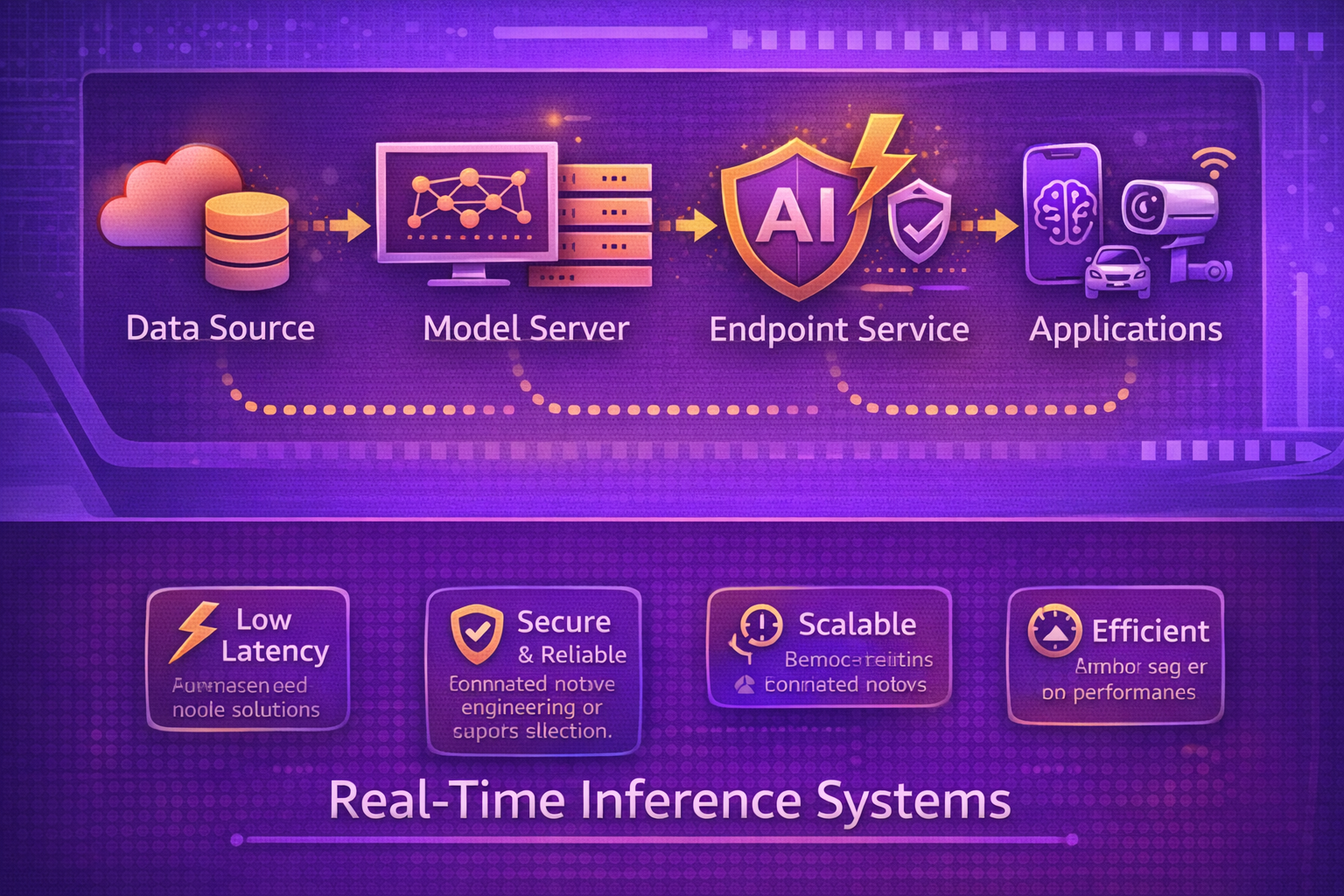
A typical real-time inference architecture includes:
- request gateway or API layer
- authentication and authorization
- schema and request validation
- online feature retrieval or enrichment
- preprocessing logic
- model execution runtime
- postprocessing and business rule layer
- logging, metrics, and tracing
- model version routing and control plane
This architecture must be designed as a low-latency distributed system, not just as a model invocation wrapper.
5. Latency Budgeting
A central design practice in real-time systems is latency budgeting. If total end-to-end latency target is
Lmax, then the system must allocate a budget across stages such as:
Ltotal = Lnet + Lauth + Lfeat + Lprep + Linfer + Lpost + Lresp.
The system is acceptable only if:
Ltotal ≤ Lmax.
This makes it clear that model execution is only one component of response time.
6. Mean Latency vs Tail Latency
It is not enough to monitor average latency alone. Production systems often care deeply about tail latency such as P95 or P99 because user experience and SLA violations are usually driven by slow outliers.
If latency random variable is L, then:
E[L]is mean latencyP95(L)is the 95th percentile latencyP99(L)is the 99th percentile latency
A real-time system can have good averages and still perform badly at the tail.
7. Throughput
Throughput is the number of requests completed per unit time. If completed requests in interval
Δt equal N, then throughput is approximately:
T = N / Δt.
Real-time systems must balance throughput against latency because optimizing one can worsen the other.
8. Synchronous Request-Response Inference
In a synchronous system, the caller waits while inference is executed. This is the most common architecture for:
- recommendation APIs
- search ranking
- content moderation checks
- user-facing prediction services
Synchronous systems require strict low-latency engineering because the caller is blocked until a prediction arrives.
9. Asynchronous Real-Time Patterns
Some systems still need near-real-time behavior but use asynchronous components. For example:
- event arrives into a queue
- consumer performs feature retrieval and inference
- downstream action is triggered within a bounded time window
This is useful when direct request blocking is undesirable or when event streams must be processed continuously.
10. Online Feature Retrieval
Many real-time systems need features that are not fully contained in the request payload. They may need to look up:
- user state
- session history
- inventory attributes
- risk history
- aggregated counters
- recent behavior windows
If online feature store lookup takes latency Lfeat, it becomes part of the
end-to-end budget and can dominate the inference path if not engineered carefully.
11. Feature Freshness
In real-time systems, features must often be fresh. If feature value was last updated at time
tupdate and request occurs at
treq, freshness lag is:
Δfresh = treq - tupdate.
For some use cases, stale features can degrade model quality more than small model errors.
12. Request Validation
Every real-time inference system should validate input shape, type, and semantics before model invocation.
If expected schema is:
S = {(name1, type1), ..., (namem, typem)},
incoming payloads should be checked against S.
Validation is important because malformed requests can create downstream instability, not just incorrect predictions.
13. Training-Serving Consistency
A common failure mode is training-serving skew. If training used transformation
φtrain and serving uses
φserve, then model quality is preserved only if:
φtrain(x) = φserve(x)
or they remain semantically equivalent.
This makes reusable feature definitions and shared preprocessing logic very important.
14. Model Execution Path
The inference core may be executed using:
- a Python runtime
- a native model server
- ONNX-style execution runtimes
- accelerated Tensor runtimes
- custom C++ or hardware-specific inference engines
The execution path must be chosen based on latency, model type, ecosystem fit, and operational maturity.
15. Batching in Real-Time Systems
Batching can improve throughput by grouping multiple requests into one model execution. If requests are
x1, ..., xn, batched inference computes:
Ŷ = f([x1, ..., xn]; θ).
This can reduce per-request compute overhead, but if the system waits too long to form batches, latency may increase.
16. Dynamic Batching Trade-Off
Dynamic batching is often used in GPU or high-throughput serving. The system waits briefly to combine incoming
requests. If wait time is w, then total latency becomes:
Ltotal = w + Linfer-batch + other stages.
The tuning challenge is to find whether the throughput gains justify the added waiting time.
17. Caching
Some real-time systems can cache repeated results or intermediate features. Useful cache targets include:
- feature lookups
- model outputs for repeated identical requests
- heavy postprocessing artifacts
- embedding retrieval results
Caching can reduce latency significantly, but only if staleness and cache invalidation are handled properly.
18. Concurrency and Worker Design
Real-time inference systems must handle concurrent load. If concurrent requests are
n, the runtime must maintain acceptable tail latency as
n grows.
Design considerations include:
- worker process count
- threading model
- async vs sync request handling
- GPU sharing or partitioning
- request queue behavior
19. Queueing Effects
Under load, requests may wait in queues before inference begins. If arrival rate is
λ and service rate is μ, queueing pressure increases as
λ approaches or exceeds μ.
In simple terms, real-time performance collapses when the system is consistently asked to do more than it can serve.
20. Autoscaling and Replication
Production systems usually run multiple replicas of the inference service behind a load balancer. If one replica
sustains throughput T1 and the system has
R replicas, idealized throughput may scale toward:
T ≈ R · T1.
In practice, scaling is limited by shared dependencies such as feature stores, databases, or network bottlenecks.
21. Availability and Graceful Degradation
Real-time inference systems should not fail catastrophically when dependencies degrade. Common resilience strategies include:
- fallback rules when the model service is unavailable
- stale-feature fallback with warnings
- default recommendations or scores
- circuit breakers
- partial functionality modes
Graceful degradation is important because prediction unavailability can be worse than lower model quality in many production systems.
22. Model Versioning and Routing
Real-time inference systems often support multiple model versions:
M(1), M(2), ..., M(t).
Routing patterns include:
- single active production model
- shadow deployment
- canary rollout
- A/B traffic split
If new-model traffic fraction is p, then:
Trafficnew = p · Traffictotal.
23. Canary and Shadow Evaluation
Shadow mode lets a new model see live inputs without affecting the production decision. Canary mode sends a small portion of live traffic to the new model. These strategies are essential for safe upgrades because they reveal runtime performance and quality changes before full rollout.
24. Observability
A real-time inference system should expose:
- request rate
- latency distribution
- error rate
- timeout rate
- resource usage
- feature retrieval latency
- model version used
- prediction drift summaries where policy allows
Without observability, failures are difficult to diagnose and safe evolution becomes unreliable.
25. Monitoring Output Behavior
Even when labels arrive late, teams can still monitor output distributions. If prediction score is
p, useful signals include:
- mean score
- score histogram shift
- rate above decision threshold
- subgroup-specific score behavior
These can detect hidden operational changes before fully labeled performance metrics become available.
26. Security Controls
Real-time inference endpoints should be protected with:
- authentication and authorization
- request rate limiting
- payload size restrictions
- schema validation
- transport encryption
- audit logging
This matters because inference services can expose sensitive decision logic or process sensitive user data.
27. Cost Efficiency
A high-quality real-time inference system must also be economically sustainable. If cost per replica is
Cr and required replica count is
R, a simplified infrastructure cost view is:
Ctotal ≈ R · Cr + dependency costs.
This is why architecture choices such as batching, model compression, and feature caching can affect not only performance but also cloud spend.
28. GPU vs CPU Inference Trade-Off
Some real-time systems benefit from GPU acceleration, especially for large neural models. Others are better served by CPUs due to lower overhead, simpler scaling, or smaller models. The right choice depends on:
- model size
- batching behavior
- request volume
- latency target
- cost structure
29. Common Use Cases
Real-time inference systems are central to:
- recommendation engines
- ad ranking and personalization
- fraud and abuse detection
- search ranking
- voice assistants and chat systems
- stream anomaly detection
- instant pricing and decision support
30. Common Failure Modes
- ignoring feature-store latency in the serving budget
- optimizing mean latency while tail latency remains poor
- training-serving feature mismatch
- weak fallback logic during dependency outages
- rolling out a new model without shadow or canary testing
- missing observability on model version or request path stages
31. Strengths of a Well-Designed Real-Time Inference System
- enables live AI-driven product decisions
- supports low-latency user experiences
- maintains operational reliability under changing traffic
- creates controlled model rollout and rollback capability
- supports monitoring and continuous improvement
32. Limitations and Trade-Offs
- system complexity is much higher than offline inference
- latency, throughput, freshness, and cost often compete with each other
- upstream dependency performance can dominate model performance
- strict SLAs can restrict model size or architecture choices
- real-time systems require strong operational maturity, not only modeling skill
33. Best Practices
- Design the full latency budget explicitly and measure each stage separately.
- Keep training and serving feature logic aligned through shared definitions or reusable pipelines.
- Monitor tail latency, not just average latency.
- Use canary or shadow deployment before promoting major model changes.
- Prepare graceful fallback paths for dependency failure or model unavailability.
- Evaluate architecture choices in terms of both user experience and total cost of operation.
34. Conclusion
Real-time inference systems are where machine learning becomes an operational decision engine. They are not merely model endpoints, but performance-critical distributed systems that must balance latency, freshness, throughput, reliability, security, observability, and cost.
Understanding real-time inference therefore requires both machine learning knowledge and systems engineering discipline. The most successful deployments are those that treat inference as an end-to-end production architecture, not just as a single model invocation step. When designed well, real-time inference systems enable AI capabilities that are fast, dependable, and valuable in live applications.