
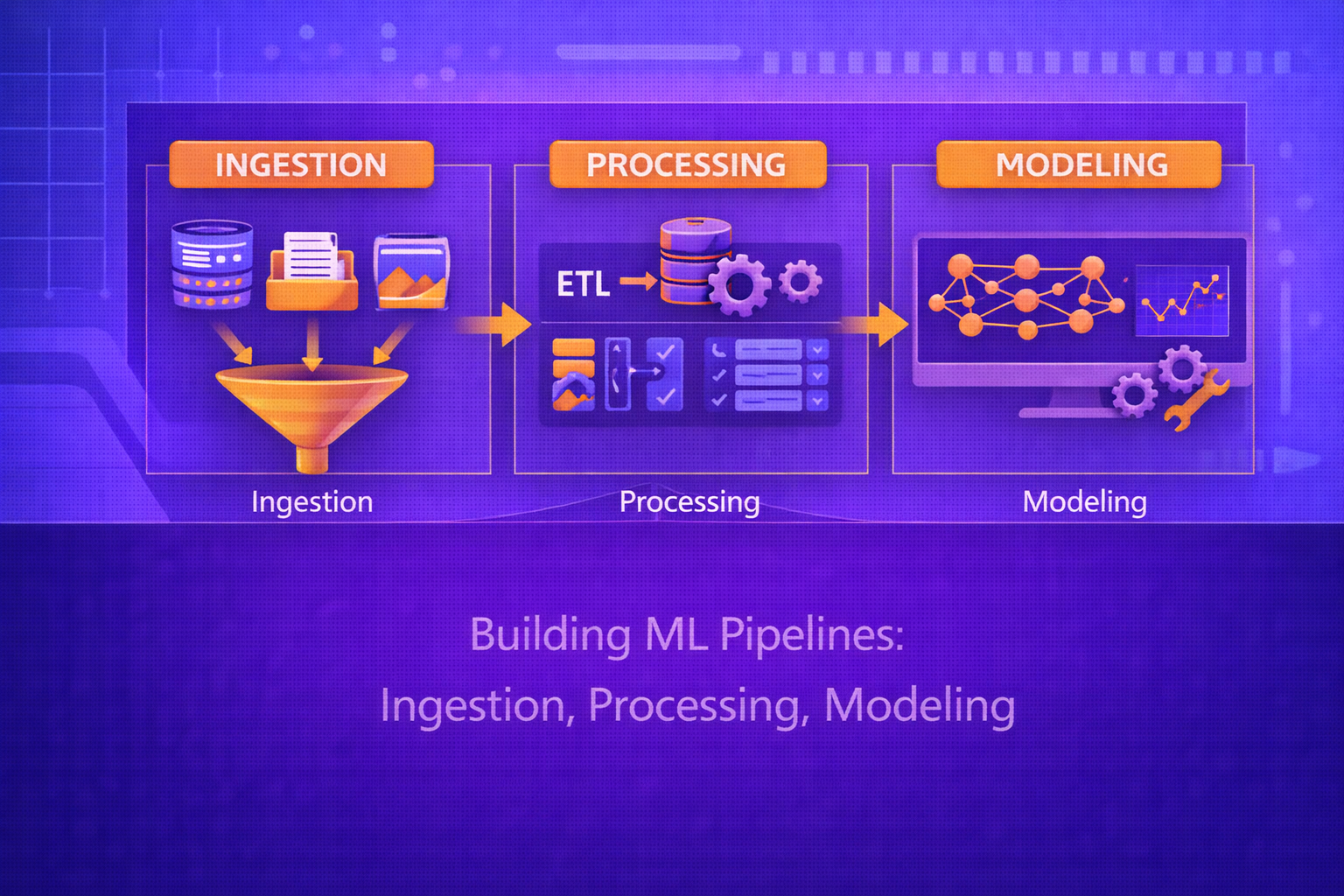
Machine learning systems do not begin with model training. They begin with data acquisition, validation, transformation, feature construction, reproducibility controls, and deployment-oriented orchestration. A production-grade ML pipeline is an end-to-end system that converts raw data into trustworthy model outputs through repeatable, testable, monitorable stages. This whitepaper explains the architecture and technical foundations of ML pipelines, with emphasis on ingestion, processing, and modeling.
Abstract
In real-world machine learning, the model is only one component of a broader computational workflow. Raw data must be collected from source systems, cleaned and normalized, transformed into analytical datasets, split correctly, turned into features, and passed into reproducible training and evaluation procedures. Downstream, models must be versioned, validated, registered, deployed, and monitored. This paper focuses on three foundational stages of ML pipelines: ingestion, processing, and modeling. It explains pipeline objectives, data contracts, batch and streaming ingestion, schema enforcement, missing-value handling, normalization, categorical encoding, feature engineering, dataset splitting, leakage prevention, training orchestration, hyperparameter tuning, model evaluation, and reproducibility principles. All formulas are embedded inline in HTML-friendly format for direct use in WordPress or similar editors.
1. Introduction
Let the raw input data universe be denoted by
Draw. An ML pipeline applies a sequence of transformations:
Draw → Dingested → Dprocessed → X, y → model → predictions.
The pipeline is not merely a convenience wrapper around model code. It is a formalized computational graph that controls data movement, transformation logic, training procedures, and output artifacts.
A robust ML pipeline should be:
- repeatable
- traceable
- testable
- scalable
- observable
- resilient to data and environment changes
2. Why ML Pipelines Matter
Ad hoc notebooks may work for experimentation, but production ML requires stable workflows. Without a formal pipeline, organizations often face:
- data inconsistency between training and inference
- hidden leakage
- non-reproducible results
- manual operational overhead
- fragile retraining processes
- unclear lineage of datasets and models
Pipelines address these problems by turning ML into a structured engineering process rather than a sequence of disconnected scripts.
3. High-Level Structure of an ML Pipeline
A typical ML pipeline contains the following broad stages:
- data ingestion
- data validation and quality checks
- data processing and feature engineering
- dataset splitting
- model training
- evaluation and selection
- artifact storage and versioning
- deployment and monitoring
This whitepaper focuses mainly on ingestion, processing, and modeling, because these three stages form the core of most ML workflows.
4. Data Ingestion
Data ingestion is the process of acquiring raw data from source systems and loading it into the analytical or ML environment. Sources may include:
- transactional databases
- APIs
- event streams
- data lakes and object stores
- CSV or parquet files
- application logs
- sensor streams
- third-party vendor feeds
4.1 Ingestion Objective
Formally, one may view ingestion as a mapping:
I : Dsource → Dingested,
where Dingested is the pipeline-accessible dataset after extraction,
loading, and schema reconciliation.
5. Batch vs Streaming Ingestion
5.1 Batch Ingestion
In batch ingestion, data is collected periodically, such as hourly, daily, or weekly. This is common in analytics, retraining pipelines, and offline feature generation.
5.2 Streaming Ingestion
In streaming ingestion, records arrive continuously or near real time. This is common for:
- fraud detection
- IoT telemetry
- clickstream analytics
- real-time recommendation
Streaming systems often require windowing, event-time handling, deduplication, and late-arrival logic.
6. Data Contracts and Schema Enforcement
A critical part of ingestion is ensuring that incoming data conforms to expectations. If the expected schema is
S = {(name1, type1), ..., (namem, typem)},
then each ingested record should satisfy that schema or be rejected, quarantined, or transformed.
Schema enforcement prevents silent errors such as:
- column renaming
- type drift
- unit mismatch
- unexpected missing fields
- malformed timestamps
7. Data Validation During Ingestion
Validation checks often include:
- row count expectations
- null-rate checks
- range constraints
- uniqueness constraints
- referential integrity checks
- distribution drift checks
If a numeric field x must lie in a valid interval, one may assert:
a ≤ x ≤ b.
Such constraints are often part of data quality gates before downstream modeling proceeds.
8. Raw Zone, Staging Zone, Curated Zone
Many organizations structure ingestion storage into layers:
- Raw zone: original extracted data, preserved for traceability
- Staging zone: lightly standardized intermediate data
- Curated zone: validated, normalized, analytics-ready data
This layering supports lineage, replay, debugging, and rollback.
9. Incremental Ingestion
In large systems, re-reading all source data each time may be inefficient. Incremental ingestion loads only new or
changed data. If the source has an update timestamp
t, one may ingest only records satisfying:
t > tlast_success.
This improves efficiency but requires careful handling of late arrivals, upserts, and replay semantics.
10. Data Processing
After ingestion, raw records must usually be transformed into processed, model-ready datasets. Processing is the stage where the pipeline converts operational data into analytical structure.
Let the processing function be:
P : Dingested → Dprocessed.
Typical processing operations include:
- cleaning
- joining
- deduplication
- type conversion
- imputation
- feature scaling
- encoding categorical variables
- windowing and aggregation
- feature generation
11. Missing Data Handling
Missing values are common in real datasets. Let feature
xj contain missing entries. Processing strategies include:
- dropping rows or columns
- mean or median imputation
- mode imputation
- model-based imputation
- adding missingness indicator variables
Mean imputation for feature xj may use:
x̂j = (1/n) Σi=1n xij
over observed values.
12. Outlier Handling
Outliers can distort model training, especially for scale-sensitive algorithms. Common strategies include:
- winsorization
- capping at percentile thresholds
- robust scaling
- removal based on domain rules
- modeling them explicitly when they are meaningful
Processing should distinguish true anomalies from simple data errors.
13. Feature Scaling
Many models benefit from normalized or standardized features. Standardization transforms a numeric feature as:
x' = (x - μ) / σ,
where μ is the mean and σ is the standard deviation
computed on the training set.
Min-max scaling uses:
x' = (x - xmin) / (xmax - xmin).
These transformations must be fit on training data only and reused consistently during inference.
14. Categorical Encoding
Categorical variables must usually be converted to numeric representations. Common methods include:
- one-hot encoding
- ordinal encoding
- target encoding
- learned embeddings
If category set size is K, one-hot encoding maps a category to a vector in
{0,1}K.
The encoding strategy should match model type, cardinality, and leakage risk.
15. Temporal Processing
Time-aware data often requires feature extraction from timestamps, such as:
- hour of day
- day of week
- month or season
- lagged variables
- rolling aggregates
- recency and frequency metrics
A lagged feature may be written as:
xt-1, xt-2, ..., xt-k.
A rolling mean over window size w may be:
mt = (1/w) Σi=0w-1 xt-i.
16. Joining and Entity Resolution
Real pipelines often combine multiple data sources. If datasets
A and B share entity key
k, the processing stage may construct:
Djoined = A ⨝ B.
This step must handle:
- duplicate keys
- missing matches
- stale dimensions
- slowly changing entities
- one-to-many or many-to-many relationships
17. Feature Engineering
Feature engineering transforms processed data into representations more useful for modeling. Let raw processed
features be x, and engineered features be
φ(x). Then modeling uses:
z = φ(x).
Common engineered features include:
- interaction terms
- aggregates
- ratios
- binning
- domain heuristics
- embeddings
An interaction term may be:
z = x1 · x2.
18. Feature Stores and Reuse
In mature ML systems, reusable features may be managed through a feature store. This allows the same feature logic to be applied consistently for:
- offline training
- batch scoring
- online inference
This helps avoid training-serving skew, where the model sees different feature computation logic in production than during training.
19. Data Splitting
Before modeling, data must be split into training, validation, and test sets. A basic partition is:
D = Dtrain ∪ Dval ∪ Dtest,
with disjoint subsets.
The training set fits parameters, the validation set supports model selection and tuning, and the test set estimates final generalization performance.
19.1 Random Splits
Random splits are common for IID tabular problems.
19.2 Time-Based Splits
For temporal data, random splitting can leak future information. In such cases, one should use chronological splits:
ttrain < tval < ttest.
19.3 Group-Based Splits
If multiple records belong to the same entity, group-aware splitting may be necessary to prevent identity leakage between train and test sets.
20. Data Leakage Prevention
Leakage occurs when information unavailable at true prediction time influences training features or labels. This leads to unrealistically optimistic performance estimates.
Leakage may arise through:
- future information in temporal problems
- target-aware transformations before splitting
- duplicate entities across train and test
- label leakage from operational fields
Preventing leakage is one of the most important responsibilities of pipeline design.
21. Modeling Stage
After ingestion and processing, the modeling stage fits a predictive function:
f : X → y.
Let the training data be:
{(xi, yi)}i=1n.
Training solves:
θ* = argminθ (1/n) Σi=1n L(yi, f(xi; θ)).
The model type may be linear, tree-based, probabilistic, deep neural, or hybrid depending on the problem.
22. Model Selection
The choice of model should reflect:
- data size
- feature type
- interpretability requirements
- latency constraints
- robustness needs
- deployment environment
For example, boosted trees are often strong for tabular data, while deep models are often preferred for image, text, audio, and high-dimensional representation learning.
23. Training Losses
23.1 Regression
A common regression objective is mean squared error:
MSE = (1/n) Σi=1n (yi - x̂i)2.
23.2 Classification
For multiclass classification, if logits are z, then:
ŷk = ezk / Σj=1K ezj,
and the cross-entropy loss is:
L = - Σk=1K yk log ŷk.
24. Hyperparameter Tuning
Most models require hyperparameter selection, such as tree depth, regularization strength, learning rate, batch size,
or network width. If hyperparameter configuration is
λ, model selection aims to find:
λ* = argmaxλ Score(fλ, Dval).
Common search strategies include:
- grid search
- random search
- Bayesian optimization
- successive halving and bandit-based methods
25. Cross-Validation
When data volume is limited, cross-validation can estimate model stability more reliably. In
K-fold cross-validation, the data is partitioned into
K folds, and the model is trained
K times, each time holding out one fold for validation.
The average validation score is:
Score = (1/K) Σk=1K Scorek.
26. Evaluation Metrics
The modeling stage must use evaluation metrics aligned with the business objective.
26.1 Classification Metrics
Common classification metrics include:
Accuracy = (TP + TN)/(TP + TN + FP + FN),
Precision = TP/(TP + FP),
Recall = TP/(TP + FN),
and
F1 = 2(Precision × Recall)/(Precision + Recall).
26.2 Regression Metrics
Common regression metrics include:
MAE = (1/n) Σ |yi - x̂i|
and
RMSE = √[(1/n) Σ (yi - x̂i)2].
27. Reproducibility and Artifact Tracking
A serious ML pipeline must track:
- dataset version
- feature definition version
- code version
- hyperparameters
- training environment
- model artifacts
- evaluation outputs
Reproducibility means that given the same pipeline version and same data snapshot, the system can regenerate the same or traceably equivalent model artifacts.
28. Pipeline Orchestration
In production environments, pipeline stages are orchestrated as dependencies in a DAG-like workflow. If task
T3 depends on outputs of
T1 and T2, then the orchestrator
ensures:
T1, T2 → T3.
This supports scheduling, retries, lineage, backfills, and failure handling.
29. Batch Inference vs Online Inference
Modeling pipelines often produce models for two different scoring regimes:
- batch inference: score many records periodically
- online inference: score one or a few records with low latency
The feature computation path must be consistent across both regimes to avoid training-serving skew.
30. Monitoring and Drift
A pipeline does not end when the model is trained. Post-deployment monitoring should track:
- input schema drift
- feature distribution drift
- prediction distribution shifts
- label-performance degradation when labels arrive later
- latency and infrastructure health
If the training distribution is Ptrain(x) and production distribution is
Pprod(x), drift corresponds broadly to:
Ptrain(x) ≠ Pprod(x).
31. Pipeline Testing
ML pipelines should be tested at multiple layers:
- unit tests for transformations
- schema validation tests
- data quality tests
- integration tests across stages
- reproducibility tests
- performance threshold tests
This reduces silent failures and makes retraining safer.
32. Common Failure Modes
- schema drift during ingestion
- target leakage in processing
- train-inference feature mismatch
- using statistics fit on full data rather than train split only
- stale models due to missing retraining triggers
- untracked changes in source data semantics
33. Best Practices
- Separate raw, processed, and model-ready data layers clearly.
- Validate schema and data quality at ingestion boundaries.
- Fit all processing statistics on training data only.
- Design features once and reuse them consistently across training and inference.
- Track data, code, model, and hyperparameter lineage together.
- Choose evaluation metrics that reflect the actual business objective.
- Monitor drift and pipeline failures continuously after deployment.
34. Conclusion
Building ML pipelines is fundamentally an engineering discipline that connects data systems, feature logic, training procedures, and operational reliability. Ingestion ensures that source data enters the ML ecosystem in a controlled and validated form. Processing transforms messy operational data into trustworthy model inputs. Modeling turns those inputs into predictive functions through reproducible training and evaluation.
A high-performing model without a reliable pipeline is not a production ML system. True production readiness requires a full lifecycle architecture that manages lineage, consistency, validation, and drift across all stages. Understanding ingestion, processing, and modeling as a unified pipeline is therefore essential to building machine learning systems that are not only accurate, but dependable, scalable, and maintainable.