
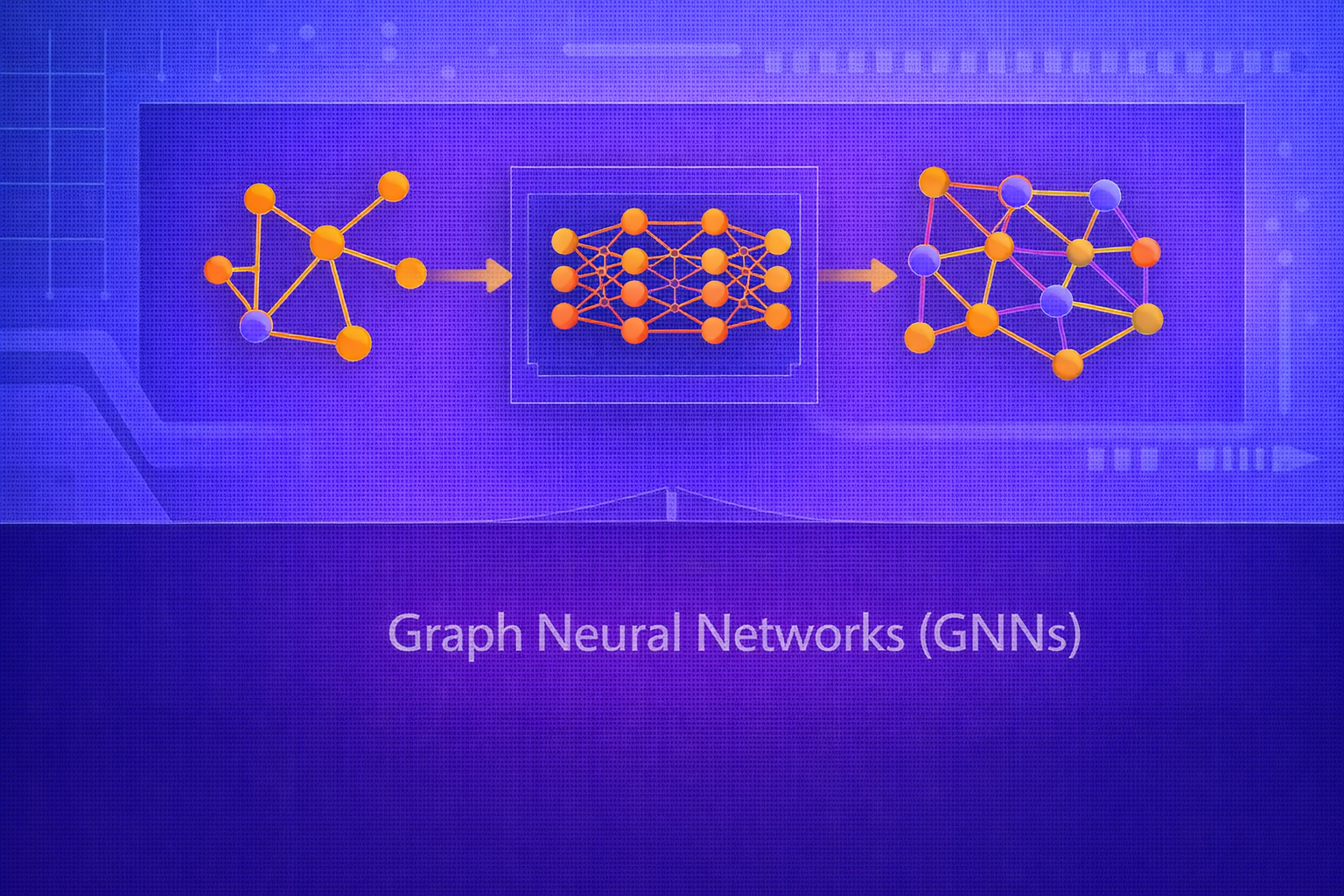
Graph Neural Networks (GNNs) are a family of neural architectures designed to operate on graph-structured data. Unlike standard machine learning models that assume independent samples or regular Euclidean grids, GNNs explicitly model entities and their relationships using nodes, edges, neighborhoods, and message passing. This whitepaper presents a technical introduction to GNNs, including graph representations, spectral and spatial perspectives, message-passing formulations, common GNN architectures, training tasks, limitations, and major applications.
Abstract
Many real-world systems are naturally represented as graphs: social networks, molecular structures, transportation systems, recommendation graphs, knowledge graphs, citation networks, and biological interaction networks. Classical machine learning methods struggle to exploit these relational structures directly. GNNs address this by learning node, edge, and graph representations through iterative neighborhood aggregation. This paper explains the mathematical foundations of graphs, adjacency and Laplacian representations, the general message-passing neural network (MPNN) framework, graph convolution, graph attention, pooling, inductive and transductive learning, training objectives, oversmoothing, over-squashing, and practical design considerations. All formulas are embedded inline in HTML-friendly format for direct use in WordPress or similar editors.
1. Introduction
A graph is a mathematical structure consisting of nodes and edges. Formally, a graph can be written as
G = (V, E), where
V is the set of nodes and
E is the set of edges.
If the graph has N nodes, one may index nodes as
V = {1, 2, ..., N}. Edges may be directed or undirected, weighted or unweighted,
typed or untyped, static or dynamic.
Many machine learning problems naturally live on graphs because the entities being modeled are not independent: their interactions are central to the task.
2. Why Graph Data Is Different
Traditional machine learning assumes one of two common input types:
- tabular data, where rows are often treated as independent
- grid-structured data such as images, where local neighborhoods are regular and fixed
Graphs differ in several fundamental ways:
- the number of neighbors per node can vary
- there is no canonical ordering of neighbors
- connectivity structure itself carries information
- long-range dependencies may propagate through multi-hop connections
Therefore, graph learning requires models that are permutation-invariant over neighborhoods and able to aggregate relational structure flexibly.
3. Adjacency Matrix Representation
A graph with N nodes can be represented by an adjacency matrix
A ∈ ℝN×N, where:
Aij = 1 if there is an edge from node i to
node j, and 0 otherwise, in the unweighted case.
For weighted graphs, Aij may store edge weights. For undirected graphs,
A is symmetric.
4. Node Features
In many graph learning problems, nodes also have features. These can be represented by a matrix:
X ∈ ℝN×F,
where F is the number of node features. The
i-th row xi contains the feature vector of
node i.
Depending on the problem, graphs may also have edge features or graph-level features.
5. Degree Matrix and Graph Laplacian
The degree of node i is the number or total weight of its neighbors:
di = Σj Aij.
The degree matrix is:
D = diag(d1, d2, ..., dN).
A fundamental matrix in spectral graph theory is the graph Laplacian:
L = D - A.
A normalized Laplacian is often written as:
Lnorm = I - D-1/2 A D-1/2.
These matrices are central to spectral formulations of graph convolution.
6. Learning Tasks on Graphs
GNNs support several important task types:
- Node classification: predict a label for each node
- Link prediction: predict whether an edge exists between two nodes
- Graph classification/regression: predict a label or value for an entire graph
- Node regression: predict continuous node-level values
- Graph generation or completion: generate or infer graph structure
7. Core Idea of Graph Neural Networks
The fundamental idea of GNNs is that node representations should be updated by combining information from local neighbors. If a node is surrounded by informative neighbors, its representation should reflect them.
This is achieved through iterative neighborhood aggregation or message passing. After one layer, a node incorporates
one-hop neighbor information. After k layers, it may incorporate information from
k-hop neighborhoods.
8. General Message Passing Framework
A broad formulation of GNNs is the Message Passing Neural Network (MPNN) framework. At layer
ℓ, each node representation
hi(ℓ) is updated using neighbor messages:
Message computation:
mi(ℓ+1) = AGGREGATE({ M(hi(ℓ), hj(ℓ), eij) : j ∈ 𝒩(i) })
Node update:
hi(ℓ+1) = UPDATE(hi(ℓ), mi(ℓ+1)).
Here:
𝒩(i)is the neighborhood of nodeiMis a message functionAGGREGATEis a permutation-invariant operator such as sum, mean, or maxUPDATEis often a neural transformation
9. Permutation Invariance
Because graph neighborhoods have no canonical ordering, aggregation must be permutation-invariant. This means that rearranging neighbor order should not change the result. Common invariant aggregators include:
- sum
- mean
- max
This property is essential for graph learning to be well-defined.
10. Graph Convolutional Networks (GCNs)
One of the most influential GNN models is the Graph Convolutional Network (GCN). A simplified GCN layer is:
H(ℓ+1) = σ(Ã H(ℓ) W(ℓ)),
where:
H(ℓ)is the matrix of node embeddings at layerℓW(ℓ)is the trainable weight matrixσis a nonlinearityÃis a normalized adjacency-like operator
10.1 Normalized GCN Propagation
A standard normalized operator includes self-loops:
à = D̃-1/2 à D̃-1/2,
where
à = A + I
and D̃ is the degree matrix of Ã.
The full layer becomes:
H(ℓ+1) = σ(D̃-1/2 Ã D̃-1/2 H(ℓ) W(ℓ)).
The self-loop ensures that each node also retains its own previous representation.
11. Spectral View of Graph Convolution
In the spectral perspective, convolution on graphs is defined in terms of the graph Laplacian eigenbasis.
If L = UΛUT is the eigendecomposition of the Laplacian, then a graph signal
x can be filtered as:
gθ * x = U gθ(Λ) UT x.
Early graph convolution methods were motivated by this spectral formulation, but practical GCN layers often use simplified localized approximations.
12. GraphSAGE
GraphSAGE introduced an inductive framework for generating node embeddings by sampling and aggregating neighbors.
A simplified update is:
hi(ℓ+1) = σ(W · CONCAT(hi(ℓ), AGGREGATE({hj(ℓ) : j ∈ 𝒩(i)}))).
Unlike purely transductive methods, GraphSAGE can generate embeddings for unseen nodes by applying the learned aggregation function to their neighborhoods.
13. Graph Attention Networks (GAT)
Graph Attention Networks use attention to weight neighbor importance adaptively. Instead of averaging all neighbors
uniformly, GAT computes attention coefficients:
αij = softmaxj(eij),
where
eij = a(W hi, W hj).
The updated node representation is:
hi(ℓ+1) = σ(Σj ∈ 𝒩(i) αij W hj(ℓ)).
Attention allows the model to focus more strongly on informative neighbors.
14. Node Embedding Propagation Depth
Each message-passing layer expands the receptive field by one hop. After
k layers, a node can incorporate information from nodes up to
k hops away.
This can be useful for capturing structural context, but too much depth introduces problems such as oversmoothing and over-squashing.
15. Oversmoothing
Oversmoothing occurs when repeated neighborhood aggregation causes node representations to become increasingly similar. After many layers, distinct nodes may collapse toward nearly indistinguishable embeddings, harming discrimination.
Intuitively, if every node repeatedly averages with its neighbors, information diffuses until local distinctions fade.
16. Over-Squashing
Over-squashing occurs when information from a large, expanding neighborhood must be compressed into a fixed-size node embedding through narrow bottlenecks. Important signals from distant parts of the graph may be compressed too aggressively and lost.
This is especially problematic in graphs with long-range dependencies and limited communication bandwidth per layer.
17. Readout and Graph-Level Representations
For graph-level tasks, node embeddings must be aggregated into a single graph representation. A readout function is:
hG = READOUT({hi(L) : i ∈ V}).
Common readout functions include:
- sum pooling
- mean pooling
- max pooling
- attention-based pooling
This graph embedding can then be passed into a classifier or regressor.
18. Training Objectives
18.1 Node Classification
If node i has class label yi, the prediction
may be:
ŷi = softmax(W hi(L) + b).
Cross-entropy loss is:
L = - Σi ∈ 𝒱train Σk=1K yik log ŷik.
18.2 Link Prediction
For link prediction, one often computes a score from node embeddings:
score(i,j) = σ(hiT hj)
or another pairwise scoring function.
The objective then distinguishes observed edges from non-edges.
18.3 Graph Classification
For graph-level tasks, after readout one predicts:
ŷ = softmax(W hG + b)
or a regression output depending on the problem.
19. Transductive vs Inductive Learning
In transductive graph learning, the full graph is available during training, and predictions are made for nodes already present in that graph. In inductive learning, the model must generalize to unseen nodes or entirely new graphs.
Some architectures, such as GraphSAGE, were explicitly designed to support inductive generalization.
20. Homogeneous vs Heterogeneous Graphs
A homogeneous graph has one node type and one edge type. A heterogeneous graph contains multiple types of nodes, edges, or relations. Examples include knowledge graphs, academic graphs, and e-commerce interaction graphs.
Heterogeneous GNNs often require type-specific message functions or relation-aware attention mechanisms.
21. Dynamic and Temporal Graphs
Some graphs evolve over time, with nodes, edges, or features changing dynamically. Temporal GNNs extend the graph learning framework to capture these changes, often combining message passing with sequence modeling.
22. Expressivity of GNNs
The expressive power of message-passing GNNs is related to their ability to distinguish graph structures. Many standard GNNs are bounded in expressivity by variants of the Weisfeiler–Lehman graph isomorphism test.
This means that some non-isomorphic graph structures may still be indistinguishable to certain GNN architectures.
23. Graph Pooling and Hierarchical Representations
Some GNNs use pooling to reduce graph size and build hierarchical representations, analogous to downsampling in CNNs. Pooling may:
- cluster nodes
- drop less informative nodes
- coarsen the graph iteratively
This is useful for graph classification and multiscale reasoning.
24. Applications of GNNs
GNNs have been applied in:
- social network analysis
- molecular property prediction
- drug discovery
- fraud detection
- recommendation systems
- knowledge graph completion
- traffic forecasting
- protein interaction modeling
- code and program analysis
25. GNNs for Molecules
Molecules are naturally graphs where atoms are nodes and bonds are edges. Message passing is well-suited here because chemical properties often depend on local and multi-hop structural interactions.
Graph-level readouts can then be used to predict toxicity, solubility, binding affinity, or other molecular properties.
26. GNNs in Recommendation Systems
Recommendation problems often involve user-item interaction graphs. GNNs can propagate preference information across these bipartite or heterogeneous graphs to improve embedding quality and personalized ranking.
27. Practical Challenges
GNNs face several practical difficulties:
- scalability on massive graphs
- neighbor explosion in deep or sampled message passing
- oversmoothing and over-squashing
- sensitivity to graph quality and edge construction
- difficulty in handling long-range dependencies
28. Mini-Batching and Sampling
Large graphs may not fit entirely in memory. Practical systems often use neighborhood sampling, subgraph sampling, or cluster-based batching so that training can proceed on manageable substructures.
29. Strengths of GNNs
- explicit modeling of relational structure
- permutation-invariant neighborhood aggregation
- support for node-, edge-, and graph-level tasks
- strong performance on non-Euclidean structured data
- natural fit for molecules, social graphs, and recommendation systems
30. Limitations of GNNs
- limited long-range expressivity in standard message-passing forms
- oversmoothing and over-squashing in deep stacks
- scaling challenges on web-scale graphs
- dependence on graph construction quality
- difficulty handling certain global structural properties
31. Best Practices
- Choose the architecture according to the task: GCN, GraphSAGE, GAT, or specialized variants.
- Use normalization and residual connections when training deeper GNNs.
- Monitor oversmoothing when increasing the number of message-passing layers.
- Use sampling or subgraph batching for large-scale graphs.
- Match the readout function to the graph-level prediction target.
- Pay attention to graph construction, because a poor graph can limit model quality more than architecture choice.
32. Conclusion
Graph Neural Networks extend neural learning to relational domains by treating nodes and edges as first-class computational structures. Their central mechanism — iterative message passing — allows representations to be refined using local graph context, making them powerful for node classification, link prediction, and graph-level reasoning.
At the same time, GNNs are not simply “CNNs for graphs.” They require careful handling of irregular neighborhoods, permutation invariance, graph-scale computation, and structural bottlenecks such as oversmoothing and over-squashing. Understanding GNNs therefore means understanding both graph mathematics and neural representation learning. As relational data continues to grow in importance, GNNs remain one of the most important architectures for structured AI.