
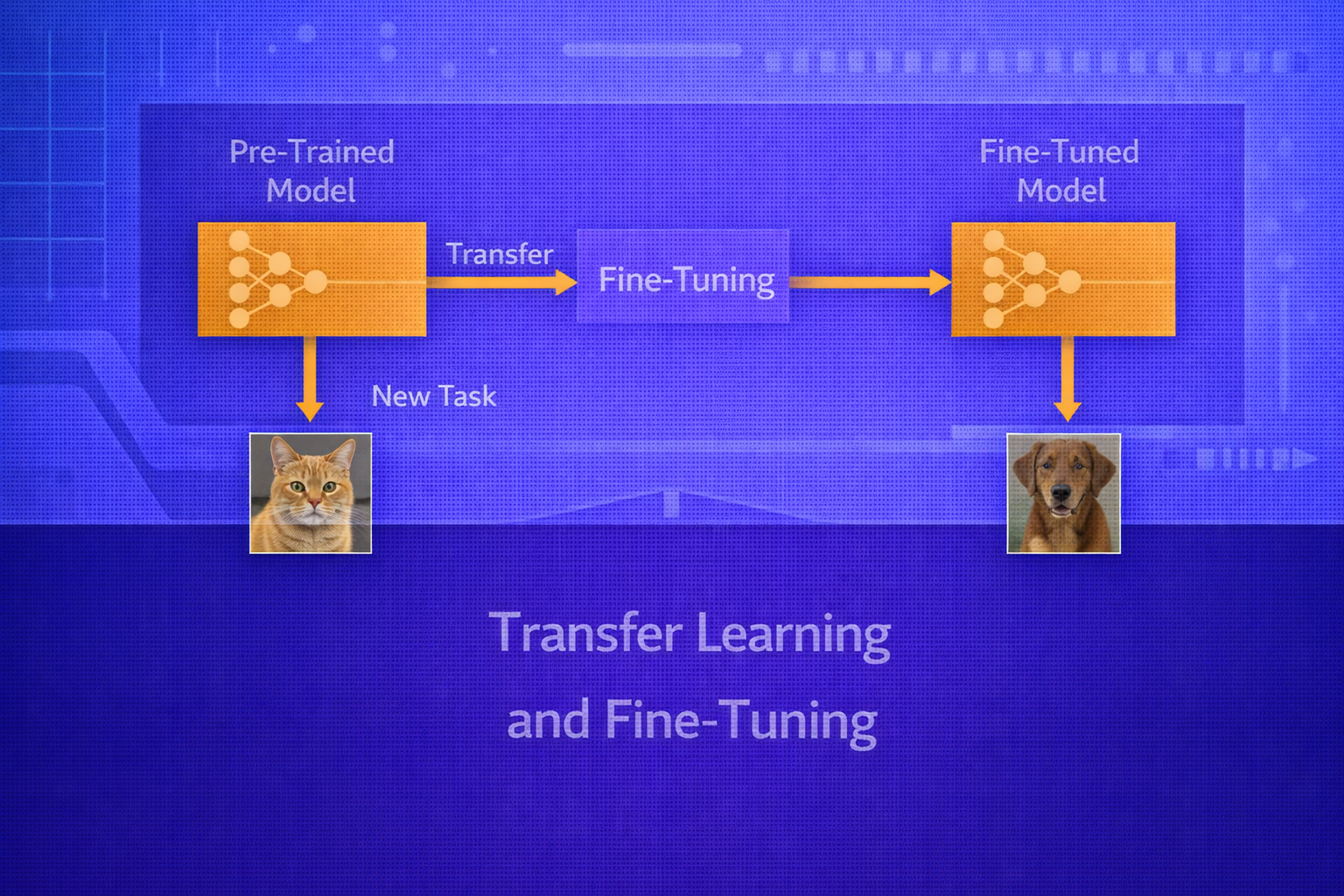
Transfer learning is one of the most important practical ideas in modern machine learning. Rather than training a model from scratch for every new task, transfer learning reuses knowledge learned from a source task to improve learning on a target task. Fine-tuning is the most common operational form of transfer learning in deep learning: a pretrained model is adapted to a new dataset or objective by updating some or all of its parameters. This whitepaper explains the mathematical intuition, methodological variants, optimization dynamics, regularization concerns, and practical trade-offs of transfer learning and fine-tuning.
Abstract
Deep learning models often require large amounts of data and compute to train effectively from random initialization. Transfer learning addresses this by starting from a model that has already learned useful representations from a related source domain or task. In computer vision, pretrained CNN backbones from ImageNet are reused for downstream tasks. In NLP, large pretrained language models are adapted through fine-tuning or parameter-efficient methods. This paper presents a technical treatment of transfer learning and fine-tuning, including source-target formulation, representation reuse, freezing and unfreezing strategies, feature extraction versus end-to-end fine-tuning, catastrophic forgetting, domain shift, parameter-efficient adaptation, regularization, and evaluation practices. All formulas are embedded inline in HTML-friendly format for direct use in WordPress or similar editors.
1. Introduction
Suppose there is a source task with dataset
Ds = {(xis, yis)}i=1ns
and a target task with dataset
Dt = {(xit, yit)}i=1nt.
The core idea of transfer learning is to use knowledge gained from the source task to improve performance or learning efficiency on the target task. The source and target may differ in label space, domain, data volume, or objective, but still share useful structure.
In modern deep learning, this often means starting from pretrained parameters
θpre and then adapting them to the target task rather than initializing
randomly.
2. Why Transfer Learning Matters
Training deep neural networks from scratch can be data-hungry, compute-intensive, and unstable when the target dataset is small. Transfer learning provides several practical benefits:
- faster convergence
- better generalization on limited data
- reduced compute cost
- improved stability of optimization
- stronger performance in low-resource regimes
In many applications, transfer learning is not merely helpful — it is the default starting point.
3. Formal View of Transfer Learning
Let a model be represented as f(x; θ). In standard learning from scratch, one solves:
θ* = argminθ Jt(θ),
where Jt(θ) is the target-task loss.
In transfer learning, instead of initializing θ randomly, one begins from pretrained
weights θpre, which were obtained by solving:
θpre = argminθ Js(θ)
on the source task.
Fine-tuning then solves:
θ̂ = argminθ Jt(θ)
with initialization θ = θpre.
The key hypothesis is that θpre encodes useful features or inductive biases
for the target domain.
4. Representation Learning Intuition
In deep networks, early and intermediate layers often learn reusable representations. In vision, lower layers of a CNN may learn edges, color contrasts, and textures; deeper layers may learn object parts and semantic motifs. In NLP, pretrained transformers learn lexical, syntactic, semantic, and contextual information. These learned features can often transfer well to related tasks.
Transfer learning works because not all task knowledge is task-specific. Some structure is general across many domains and can serve as a useful starting point for downstream adaptation.
5. Feature Extraction vs Fine-Tuning
5.1 Feature Extraction
In feature extraction, the pretrained model is used as a fixed backbone. Its parameters are frozen, and only a new task-specific head is trained.
If the backbone produces representation h = g(x; θpre) and the new head is
ŷ = φ(h; ψ), then training optimizes only
ψ:
ψ̂ = argminψ Jt(φ(g(x; θpre); ψ)).
This is computationally cheap and reduces overfitting risk when the target dataset is small.
5.2 Fine-Tuning
In fine-tuning, some or all pretrained parameters are updated on the target task:
(θ̂, ψ̂) = argminθ,ψ Jt(φ(g(x; θ); ψ)),
initialized with θ = θpre.
Fine-tuning gives the model more flexibility to adapt to target-specific structure, but it also increases the risk of overfitting and catastrophic forgetting.
6. Freezing and Unfreezing Strategies
Fine-tuning is not necessarily all-or-nothing. Common strategies include:
- freeze the entire backbone and train only the head
- freeze early layers and fine-tune later layers
- gradually unfreeze layers from top to bottom
- fine-tune the full model end-to-end
Early layers often contain generic features, while later layers are more task-specific. This is why later layers are often adapted first.
7. Optimization Dynamics in Fine-Tuning
Fine-tuning usually uses gradient-based optimization starting from pretrained weights:
θ := θ - η ∇θJt(θ).
Because the model already starts in a meaningful region of parameter space, optimization often converges faster than from random initialization. However, the learning rate must be chosen carefully. Too large a learning rate can destroy useful pretrained structure.
7.1 Differential Learning Rates
A common strategy is to use smaller learning rates for pretrained backbone layers and larger learning rates for the
new task head. For example:
ηbackbone < ηhead.
This preserves learned representations while allowing the head to adapt quickly.
8. Catastrophic Forgetting
Catastrophic forgetting occurs when fine-tuning on a target task causes the model to lose useful knowledge learned
during pretraining. In parameter space, large updates may move the model far from the source solution
θpre, erasing transferable structure.
This is especially problematic when the target dataset is small, noisy, or substantially different from the source task.
8.1 Regularized Fine-Tuning
One way to reduce catastrophic forgetting is to penalize deviation from the pretrained weights:
Jreg(θ) = Jt(θ) + λ ||θ - θpre||22.
This encourages the fine-tuned model to remain close to the source solution unless target evidence strongly suggests otherwise.
9. Domain Shift and Transferability
Transfer works best when the source and target tasks share structure. If the source domain distribution is
ps(x, y) and the target domain distribution is
pt(x, y), then transfer quality depends heavily on how related these
distributions are.
Large domain shift can make transfer less effective or even harmful, a phenomenon sometimes called negative transfer.
9.1 Negative Transfer
Negative transfer occurs when using source knowledge degrades target performance compared with training from scratch. This may happen when source features are misleading for the target domain or when adaptation is poorly controlled.
10. Transfer Learning in Computer Vision
In computer vision, transfer learning often starts from backbones pretrained on large-scale datasets such as ImageNet. A model such as ResNet, EfficientNet, or ViT learns general visual features during pretraining. The final classification layer is then replaced with a new task head for the downstream problem.
If the backbone produces feature vector h = g(x), the target classifier may be:
ŷ = softmax(Wh + b).
Depending on the dataset size and similarity to ImageNet, one may freeze the backbone or fine-tune some or all of it.
11. Transfer Learning in NLP
In NLP, pretrained language models such as BERT, GPT-style models, and encoder-decoder transformers are first trained on massive corpora using self-supervised objectives. The resulting model learns contextual representations that can be adapted to tasks such as sentiment classification, question answering, summarization, and named entity recognition.
For example, a pretrained transformer produces contextual states
H = Transformer(x; θpre),
and a task head maps these states into labels or outputs.
12. Fine-Tuning Objectives
The loss used during fine-tuning depends on the target task.
12.1 Classification
For multiclass classification, if the model outputs logits z, then:
ŷk = ezk / Σj=1K ezj,
and the cross-entropy loss is
L = - Σk=1K yk log ŷk.
12.2 Regression
For regression, common choices include
MSE = (1/n) Σ (yi - ŷi)2
or MAE-like objectives.
12.3 Sequence Objectives
For sequence tasks, the fine-tuning objective may sum token-level losses:
L = - Σt=1T log p(yt | y<t, x).
13. Full Fine-Tuning vs Parameter-Efficient Fine-Tuning
Full fine-tuning updates all model parameters. This can be expensive for large modern models. Parameter-efficient fine-tuning (PEFT) methods adapt the model using a small number of additional or selectively trainable parameters, leaving most pretrained weights frozen.
13.1 Adapters
Adapters insert small trainable modules inside the pretrained network. The base model remains mostly frozen while the adapters capture task-specific changes.
13.2 LoRA
Low-Rank Adaptation (LoRA) modifies weight updates through a low-rank decomposition. If a pretrained weight matrix is
W, instead of updating W directly, one learns:
W' = W + ΔW,
where
ΔW = BA
and A and B are low-rank matrices.
This greatly reduces the number of trainable parameters while preserving much of the benefit of fine-tuning.
13.3 Prompt Tuning and Prefix Tuning
For large language models, task adaptation can also be performed by learning soft prompts or prefix vectors that condition the frozen pretrained model without changing most of its parameters.
14. When to Freeze and When to Fine-Tune
A practical rule of thumb:
- if the target dataset is small and close to the source domain, feature extraction or light fine-tuning may be enough
- if the target dataset is moderate and somewhat related, partial fine-tuning is often effective
- if the target dataset is large and/or significantly different, full fine-tuning may be preferable
However, these are heuristics rather than strict rules. Empirical validation remains essential.
15. Fine-Tuning Schedules
A common training schedule is:
- initialize the target head randomly
- train the head alone while the backbone is frozen
- unfreeze some or all backbone layers
- continue training with a smaller learning rate
This staged strategy stabilizes early optimization and reduces the risk of damaging pretrained features too quickly.
16. Regularization During Fine-Tuning
Fine-tuning often benefits from regularization because target datasets may be smaller than pretraining datasets. Common regularizers include:
- weight decay
- dropout
- data augmentation in vision
- early stopping
- label smoothing in classification
- parameter anchoring toward
θpre
17. Evaluation Considerations
Transfer learning should be evaluated on properly separated target-domain validation and test sets. Standard metrics such as accuracy, precision, recall, F1-score, ROC-AUC, RMSE, or task-specific sequence metrics may apply.
It is also useful to compare:
- training from scratch
- feature extraction only
- partial fine-tuning
- full fine-tuning
This reveals whether transfer is genuinely beneficial and whether more adaptation actually helps.
18. Sample Efficiency
One of the most important benefits of transfer learning is sample efficiency. Let
Escratch(n) denote target performance when training from scratch using
n examples, and Etransfer(n) the performance
with transfer. In many practical cases:
Etransfer(n) > Escratch(n)
especially when n is small.
This is often the primary business reason to use transfer learning.
19. Fine-Tuning Risks
Fine-tuning is powerful but carries risks:
- overfitting on small target data
- catastrophic forgetting of useful source knowledge
- negative transfer from poorly matched source tasks
- instability if learning rates are too large
- excessive compute cost for full-model updates
20. Domain Adaptation Relation
Transfer learning overlaps with domain adaptation, but the emphasis differs. Domain adaptation typically focuses on handling distribution shift explicitly between source and target domains, especially when label availability differs. Fine-tuning is one practical adaptation mechanism, but broader domain adaptation may include feature alignment, adversarial methods, or distribution matching.
21. Multitask Learning Relation
Transfer learning is sequential: first pretrain, then adapt. Multitask learning trains multiple tasks jointly:
J(θ) = Σk=1K αk Jk(θ).
Both approaches aim to share useful representations, but transfer learning emphasizes reuse from an already-trained source model.
22. Practical Applications
Transfer learning and fine-tuning are widely used in:
- medical image classification with limited labeled data
- defect detection in manufacturing
- custom object detection and segmentation
- document classification and sentiment analysis
- question answering and summarization
- speech adaptation to domain-specific vocabulary
- recommendation and personalization systems
23. Strengths of Transfer Learning
- reduces data requirements
- speeds up convergence
- often improves performance in low-resource settings
- reuses expensive source training investments
- supports efficient adaptation across related tasks
24. Limitations
- depends on source-target relatedness
- can cause negative transfer if the source is poorly matched
- fine-tuning can be compute-intensive for large models
- full-model adaptation may be memory-prohibitive
- requires careful optimization and regularization choices
25. Best Practices
- Start with a strong pretrained model relevant to the target domain.
- Use feature extraction first as a baseline, then compare with fine-tuning.
- Use smaller learning rates for pretrained layers than for new heads.
- Unfreeze progressively when target data is limited.
- Monitor validation performance closely to avoid overfitting or forgetting.
- Consider parameter-efficient methods for very large models.
- Benchmark against training from scratch to verify positive transfer.
26. Conclusion
Transfer learning and fine-tuning have fundamentally changed the practice of machine learning by turning pretraining into a reusable source of representational knowledge. Instead of solving every task from scratch, practitioners can start from models that already encode useful structures from large-scale source domains. This dramatically improves efficiency, especially when target data is scarce or expensive to label.
Fine-tuning is the operational bridge between broad pretrained capability and task-specific performance. Understanding how and when to freeze, adapt, regularize, and evaluate transferred models is therefore essential for modern deep learning practice. As models continue to grow and adaptation methods become more parameter-efficient, transfer learning will remain one of the central design principles of practical AI systems.