
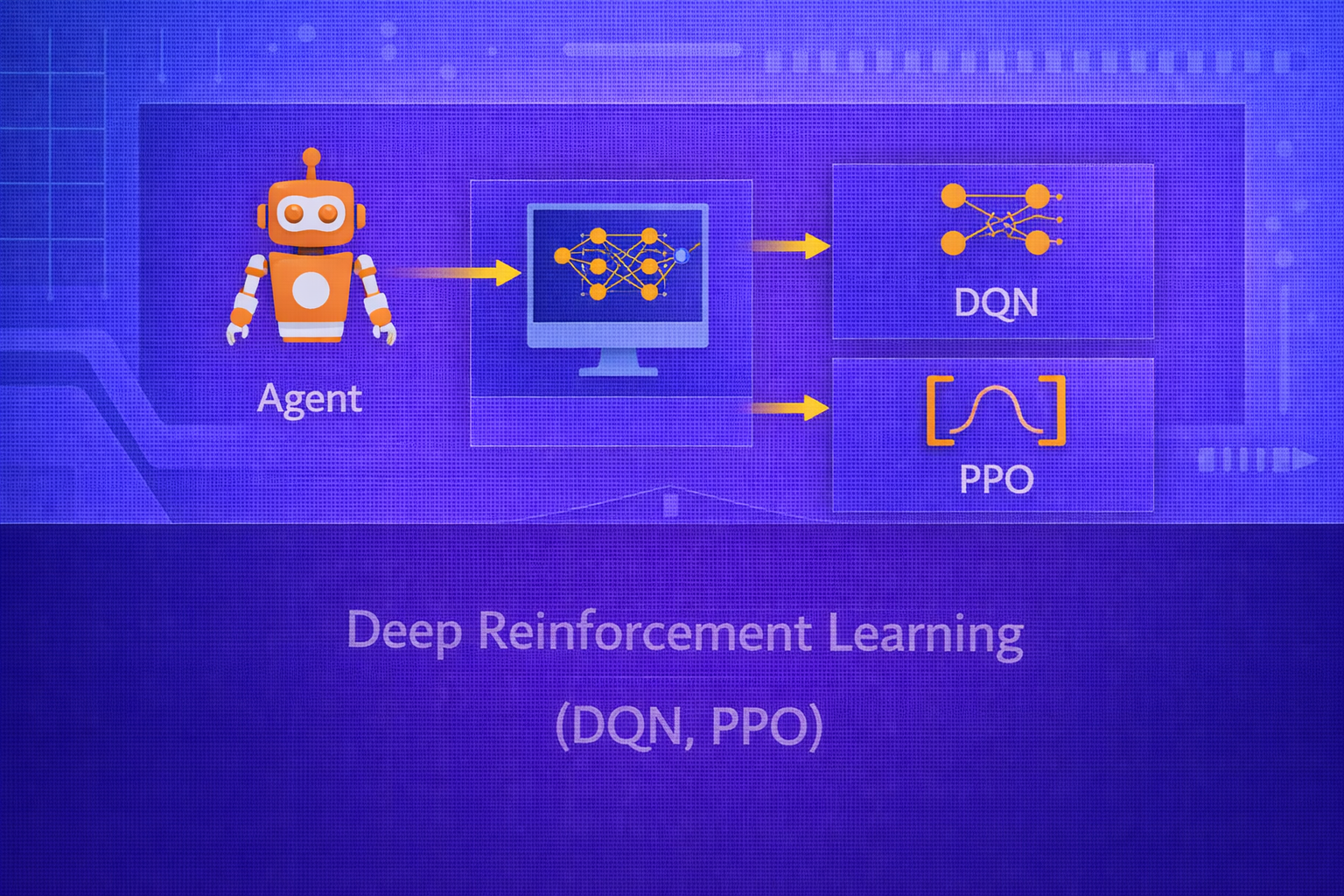
Deep Reinforcement Learning (Deep RL) combines reinforcement learning with deep neural networks to solve sequential decision-making problems in high-dimensional state spaces. It enables agents to learn directly from complex observations such as images, sensor streams, and structured feature vectors. This whitepaper explains the foundations of Deep RL and provides a detailed technical treatment of two landmark algorithms: Deep Q-Networks (DQN) and Proximal Policy Optimization (PPO).
Abstract
Classical reinforcement learning methods often assume tabular state-action representations, which become impractical in large or continuous environments. Deep RL replaces explicit tables with neural function approximators that learn policies, value functions, or both. DQN was a major breakthrough that used deep neural networks to approximate the Q-function for discrete-action environments, introducing stabilization techniques such as replay buffers and target networks. PPO later emerged as a widely adopted policy-gradient method that improves stability and simplicity by constraining policy updates through clipped surrogate objectives. This paper explains the mathematical formulation of both algorithms, their optimization logic, exploration and stability mechanisms, practical training considerations, and their strengths and limitations. All formulas are embedded inline in HTML-friendly format for direct use in WordPress or similar editors.
1. Introduction
Reinforcement learning studies how an agent should act in an environment to maximize cumulative reward. Let the
environment be modeled as a Markov Decision Process (MDP)
(𝒮, 𝒜, P, R, γ), where
𝒮 is the state space,
𝒜 is the action space,
P(s'|s,a) defines transitions,
R defines rewards, and
γ ∈ [0,1] is the discount factor.
The goal is to find a policy π that maximizes expected return:
π* = argmaxπ E[Gt | π],
where
Gt = Σk=0∞ γk rt+k+1.
In large or continuous environments, exact tabular methods are not feasible. Deep RL addresses this by using neural networks as function approximators.
2. Why Deep Reinforcement Learning Was Needed
Classical RL methods such as tabular Q-learning store values for each state-action pair:
Q(s,a). This works only when the state and action spaces are small enough to enumerate.
In many practical tasks, states may be:
- high-dimensional images
- continuous sensor vectors
- long temporal observations
- large combinatorial configurations
Storing exact values for all possibilities becomes impossible. Neural networks provide a way to generalize from seen states to unseen ones by learning a parameterized approximation.
3. Function Approximation in RL
In Deep RL, one typically approximates:
- a value function
V(s; θ) - an action-value function
Q(s,a; θ) - a policy
π(a|s; θ)
Here, θ denotes neural network parameters. The challenge is that RL targets depend on
the model’s own evolving predictions, making optimization less stable than in supervised learning.
4. Value-Based vs Policy-Based Deep RL
Deep RL methods are often grouped into:
- Value-based methods: learn value or Q-functions and derive policies from them
- Policy-based methods: directly optimize the policy
- Actor-critic methods: combine both approaches
DQN is primarily value-based. PPO is a policy-gradient actor-critic method.
5. Deep Q-Networks (DQN)
DQN extends Q-learning by using a neural network to approximate the action-value function:
Q(s,a; θ).
The Bellman optimality equation for Q-values is:
Q*(s,a) = E[r + γ maxa' Q*(s',a') | s,a].
DQN attempts to learn a neural approximation that satisfies this recursive consistency condition.
5.1 Q-Learning Recap
Tabular Q-learning updates are:
Q(s,a) := Q(s,a) + α [r + γ maxa' Q(s',a') - Q(s,a)].
The bracketed term is the temporal-difference (TD) error:
δ = r + γ maxa' Q(s',a') - Q(s,a).
DQN replaces the table with a neural network and minimizes this TD error over sampled transitions.
5.2 DQN Objective
For a transition (s,a,r,s'), the target is:
y = r + γ maxa' Q(s',a'; θ-),
where θ- are target-network parameters.
The DQN loss is:
L(θ) = E[(y - Q(s,a; θ))2].
The network is trained by gradient descent to minimize this mean squared TD error.
6. Why Naive Deep Q-Learning Is Unstable
Simply plugging a neural network into Q-learning leads to instability because:
- successive samples are highly correlated
- the target depends on the same network being updated
- small changes in Q-values can alter future targets and exploration behavior
DQN addressed these problems through two major innovations: experience replay and target networks.
7. Experience Replay
Instead of learning from sequential transitions immediately, DQN stores transitions in a replay buffer:
𝔅 = {(s,a,r,s')}.
Training then samples random minibatches from this buffer. This has several benefits:
- breaks temporal correlations in training data
- improves data efficiency by reusing past experience
- makes updates more similar to standard supervised learning
8. Target Networks
DQN uses a separate target network with parameters θ- to compute the target:
y = r + γ maxa' Q(s',a'; θ-).
The target network is updated less frequently, for example by copying the online network parameters every fixed
number of steps:
θ- := θ.
This stabilizes the target and reduces feedback loops that can cause divergence.
9. DQN Training Procedure
- Initialize Q-network parameters
θ - Initialize target-network parameters
θ- = θ - Collect transitions using an exploration policy
- Store transitions in replay buffer
- Sample minibatches from replay buffer
- Compute TD targets using the target network
- Minimize squared TD loss with respect to
θ - Periodically update
θ-
10. Exploration in DQN
DQN commonly uses epsilon-greedy exploration:
- with probability
1 - ε, chooseargmaxa Q(s,a; θ) - with probability
ε, choose a random action
Typically ε is annealed over time so that training begins with more exploration and
gradually becomes more exploitative.
11. DQN Output Structure
For discrete action spaces, a DQN often takes the state as input and outputs one Q-value per action:
Q(s; θ) = [Q(s,a1; θ), ..., Q(s,aK; θ)].
This makes action selection efficient because the model evaluates all discrete actions in a single forward pass.
12. DQN Limitations
DQN has important limitations:
- primarily suited to discrete action spaces
- can still suffer from instability and overestimation bias
- sample efficiency may be limited in complex environments
- performance depends strongly on replay and exploration design
13. Important DQN Extensions
13.1 Double DQN
Standard DQN can overestimate Q-values because the same maximization operator both selects and evaluates actions.
Double DQN addresses this by separating action selection and evaluation:
y = r + γ Q(s', argmaxa' Q(s',a'; θ), θ-).
13.2 Dueling DQN
Dueling DQN decomposes the Q-function into a state value and an advantage term:
Q(s,a) = V(s) + A(s,a),
with architectural adjustments to avoid redundancy. This can improve learning efficiency in some settings.
13.3 Prioritized Replay
Instead of sampling transitions uniformly from the replay buffer, prioritized replay samples transitions with higher TD error more frequently. This focuses learning on more informative experiences.
14. Policy Gradient Methods
DQN is value-based, but another major approach is to optimize the policy directly. If the policy is parameterized as
π(a|s; θ), then the goal is to maximize:
J(θ) = Eπθ[Gt].
Policy gradient methods update parameters in the direction of
∇θJ(θ).
14.1 REINFORCE Idea
A classic result is the policy gradient theorem, which in simplified Monte Carlo form gives:
∇θJ(θ) = E[∇θ log π(at|st; θ) · Gt].
This means actions that led to high return should become more likely, and actions that led to poor return should become less likely.
15. Actor-Critic Structure
Policy gradient methods often use a critic to estimate value and reduce variance. In actor-critic methods:
- Actor: learns the policy
π(a|s; θ) - Critic: estimates value, such as
V(s; w)
The critic helps the actor judge whether an action was better or worse than expected.
16. Advantage Function
A key concept in actor-critic methods is the advantage:
A(s,a) = Q(s,a) - V(s).
If A(s,a) > 0, the action was better than the state’s average expectation. If
A(s,a) < 0, it was worse. PPO uses advantage estimates extensively.
17. Proximal Policy Optimization (PPO)
PPO is a policy-gradient algorithm designed to provide stable and efficient policy updates. It belongs to the family of actor-critic methods and is widely used because it is simpler than trust-region methods while still being robust.
17.1 Motivation for PPO
Pure policy-gradient updates can change the policy too much in one step, causing performance collapse. PPO addresses this by discouraging overly large policy updates.
18. Probability Ratio in PPO
Suppose the old policy is πθ_old and the new policy is
πθ. PPO defines the probability ratio:
rt(θ) = πθ(at|st) / πθ_old(at|st).
This ratio measures how much the new policy increases or decreases the probability of the sampled action relative to the old policy.
19. PPO Clipped Objective
PPO’s most famous objective is the clipped surrogate:
LCLIP(θ) = E[min(rt(θ) At, clip(rt(θ), 1-ε, 1+ε) At)].
Here:
Atis the advantage estimateεis a small clipping threshold, often around0.1or0.2
The clipping prevents the optimizer from changing the policy ratio too aggressively in one update.
19.1 Why the Clipped Objective Helps
If the new policy makes a beneficial action much more likely, the unclipped objective would keep increasing. PPO
limits this incentive once the change exceeds the trust-like interval
[1-ε, 1+ε]. This stabilizes training and prevents destructive policy jumps.
20. PPO Value Function Loss
PPO usually trains a value function alongside the policy. A common value loss is:
LV(w) = E[(V(st; w) - Vtarget,t)2].
The total PPO objective often combines:
- the clipped policy objective
- the value loss
- an entropy bonus for exploration
A common combined form is:
L(θ,w) = LCLIP(θ) - c1LV(w) + c2H(πθ),
where H(πθ) is policy entropy.
21. Entropy Bonus
Entropy regularization encourages exploration by preventing the policy from becoming too deterministic too early.
For a discrete policy:
H(π(·|s)) = - Σa π(a|s) log π(a|s).
Higher entropy means more randomness in action choice, which can be useful during learning.
22. Advantage Estimation in PPO
PPO often uses Generalized Advantage Estimation (GAE) to trade off bias and variance. Temporal-difference residuals
are:
δt = rt+1 + γV(st+1) - V(st).
Then GAE computes:
AtGAE(γ,λ) = Σl=0∞ (γλ)l δt+l,
where λ controls the bias-variance trade-off.
23. PPO Training Procedure
- collect trajectories using current policy
πθ_old - compute returns and advantage estimates
- optimize the clipped surrogate objective for several epochs on the collected batch
- update the value function and entropy-regularized policy jointly
- set
θ_old := θand repeat
24. On-Policy Nature of PPO
PPO is on-policy, meaning it learns from data collected by the current or very recent policy. This contrasts with DQN, which is off-policy and can reuse older experience from the replay buffer. On-policy methods are often more stable conceptually but less sample efficient because old data becomes stale quickly.
25. DQN vs PPO
25.1 Type of Method
DQN is value-based. PPO is policy-gradient actor-critic.
25.2 Action Space
DQN is mainly suited to discrete action spaces because it uses
maxa Q(s,a).
PPO handles both discrete and continuous action spaces naturally by parameterizing a policy distribution directly.
25.3 Data Usage
DQN is off-policy and reuses experience through replay. PPO is on-policy and usually discards old trajectories after a limited number of update epochs.
25.4 Stability
DQN needs replay buffers and target networks for stability. PPO uses clipped policy updates and advantage estimation to maintain more controlled policy improvement.
25.5 Typical Use Cases
DQN is strong for Atari-style discrete control tasks. PPO is widely used in robotics, continuous control, game AI, and large-scale policy learning due to its relative simplicity and robustness.
26. Deep RL Training Challenges
Both DQN and PPO face practical difficulties:
- sample inefficiency
- high variance in returns
- sensitivity to reward design
- instability from function approximation
- difficulty of exploration in sparse-reward settings
27. Reward Scaling and Normalization
In Deep RL, reward magnitude can strongly affect optimization. Extremely large or sparse rewards can destabilize learning. Normalizing returns or scaling rewards can help keep gradients and value estimates in a more manageable range.
28. Exploration in Deep RL
Exploration remains one of the hardest parts of Deep RL. DQN often uses epsilon-greedy exploration. PPO relies on stochastic policies and entropy bonuses. More advanced strategies include curiosity, count-based bonuses, intrinsic rewards, or uncertainty-driven exploration, though those are beyond the basic scope here.
29. Function Approximation Risks
Deep RL inherits all the optimization difficulties of deep learning and all the bootstrapping difficulties of RL. Errors in value estimates can feed back into future targets, and policy updates change the data distribution the model sees. This feedback loop makes Deep RL fundamentally less stable than standard supervised learning.
30. Practical Applications
Deep RL has been applied to:
- game playing
- robot control
- resource allocation
- autonomous navigation
- recommendation and personalization
- portfolio optimization and operations research
- simulated strategy learning
31. Best Practices
- Use DQN for discrete-action problems when replay-based value learning is appropriate.
- Use PPO when action spaces are continuous or when policy optimization stability is a priority.
- Monitor both reward curves and value-loss behavior during training.
- Pay close attention to reward design and scaling.
- Use advantage normalization, entropy bonuses, and clipping carefully in PPO.
- Use replay buffers and target updates carefully in DQN.
32. Conclusion
Deep Reinforcement Learning extends RL to high-dimensional and complex environments by replacing tabular structures with neural function approximators. DQN demonstrated that deep networks could learn value functions effectively in discrete-action settings when stabilized with replay buffers and target networks. PPO showed that policy-gradient methods could be made practical and robust through clipped policy updates and actor-critic structure.
Together, DQN and PPO represent two of the most important paradigms in Deep RL: value-based approximation and stabilized policy optimization. Understanding them provides a foundation for interpreting many modern RL methods and for appreciating the central challenges of Deep RL — function approximation, exploration, sample efficiency, and long-horizon optimization under uncertainty.