
Computer vision workflows span image acquisition, preprocessing, geometric transformation, feature extraction, classical image analysis, video processing, object detection, instance segmentation, keypoint estimation, and deployment in real-time or large-scale systems. Two important libraries in this ecosystem are OpenCV and Detectron2. Although both are used in computer vision, they are built for different layers of the stack and different kinds of problems. This whitepaper explains their technical roles, architectural differences, and practical fit.
Abstract
Modern computer vision systems combine multiple components: image and video I/O, low-level pixel operations, filtering, geometry, calibration, tracking, deep learning inference, region proposal models, segmentation heads, and deployment logic. OpenCV and Detectron2 occupy very different but complementary places in this stack. OpenCV is a broad, open-source computer vision library with hundreds to thousands of algorithms and modules spanning image processing, video analysis, calibration, 3D reconstruction, and deep learning support. Detectron2 is a model-centric platform focused on object detection, segmentation, and related visual recognition tasks. This paper explains the computational roles, workflow strengths, limitations, and ecosystem fit of both libraries, and shows how they can be combined in practical systems rather than treated as direct substitutes. All formulas are embedded inline in HTML-friendly format for direct use in WordPress or similar editors.
1. Introduction
Let an image be represented as a tensor:
I ∈ ℝH×W×C,
where H is height, W is width, and
C is the number of channels.
A computer vision system maps image or video inputs into outputs such as:
- processed images
- feature descriptors
- bounding boxes
- masks
- keypoints
- class labels
- tracking states
Different libraries support different layers of this computation pipeline. OpenCV and Detectron2 represent two important but distinct approaches to solving vision problems.
2. Why CV Libraries Differ
Computer vision is not one single computational problem. It includes:
- low-level image processing
- geometry and calibration
- video decoding and streaming
- feature detection and matching
- classical vision algorithms
- deep object detection
- instance and semantic segmentation
- end-to-end recognition models
Because these needs differ, libraries are optimized for different abstractions rather than trying to solve every visual task in exactly the same way.
3. A Common Mathematical View
At a high level, a vision model can be written as:
ŷ = f(I; θ),
where I is an image or frame input, θ is model state, and
ŷ is an output such as boxes, masks, labels, or transformed pixels.
For detection, the output may be:
ŷ = {(bk, ck, sk)}k=1K,
where each bk is a bounding box,
ck is a class, and
sk is a confidence score.
For segmentation, outputs may additionally include masks
mk.
OpenCV and Detectron2 both participate in workflows around
f,
but they do so at very different levels of abstraction.
4. OpenCV Overview
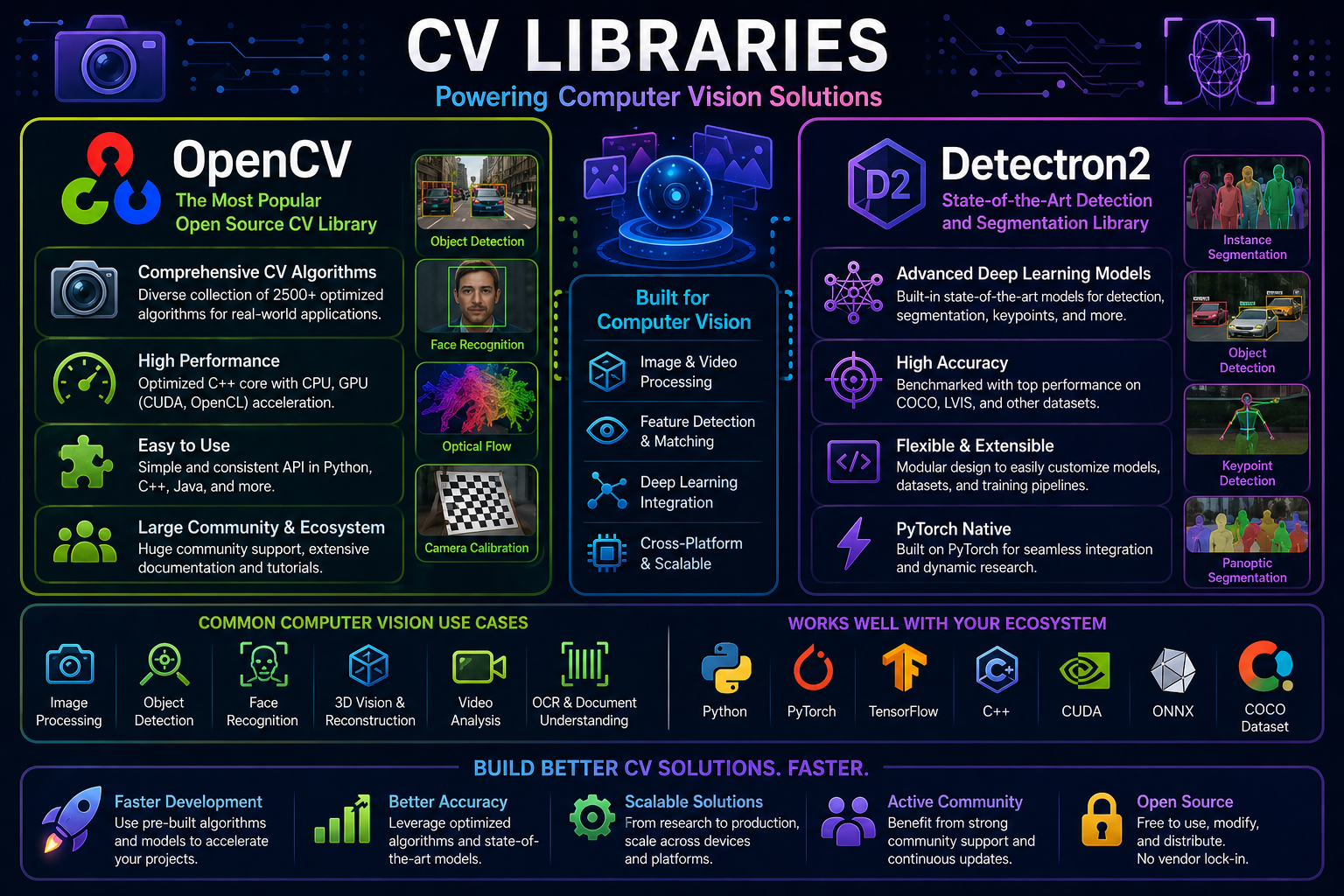
The OpenCV site describes OpenCV as a real-time optimized computer vision library and as the world’s biggest computer vision library. The official documentation introduction describes OpenCV as an open-source library that includes several hundreds of computer vision algorithms, and the main documentation pages list modules for core functionality, image processing, image I/O, video I/O, video analysis, camera calibration, and 3D reconstruction.
5. OpenCV Design Philosophy
OpenCV is best understood as a broad computer vision toolkit rather than a single-model framework. Its value comes from its breadth: it supports image and video handling, low-level computer vision operations, classical algorithms, geometry, and deployment-oriented utilities in a unified library.
Because OpenCV is designed as a foundational vision library, it is useful across many parts of the CV pipeline rather than only in one model family.
6. Breadth of OpenCV Modules
The official module pages list areas such as:
- core functionality
- image processing
- image codecs
- video I/O
- video analysis
- camera calibration and 3D reconstruction
- high-level GUI
This breadth is one of OpenCV’s defining characteristics. It means OpenCV is often used before, around, or after ML models rather than only as the model layer itself.
7. OpenCV in Python Workflows
The OpenCV-Python tutorials describe learning paths for image processing, feature detection, and video analysis. In Python workflows, OpenCV is commonly used for:
- reading images and video streams
- resizing and color conversions
- geometric transformations
- thresholding and filtering
- classical feature detection
- frame-by-frame preprocessing before model inference
8. OpenCV and Real-Time Vision
OpenCV’s official site explicitly emphasizes real-time optimization. This matters because many CV pipelines are
latency-sensitive. If frame processing latency is L and a system must sustain
F frames per second, then a rough requirement is:
L ≤ 1/F.
OpenCV is often chosen because its lower-level operations can be integrated into such pipelines efficiently.
9. Strengths of OpenCV
- broad computer vision coverage beyond one task family
- strong support for image and video I/O
- useful classical CV operations and geometry utilities
- good fit for preprocessing and postprocessing around ML models
- real-time-oriented computer vision workflows
10. Limitations of OpenCV
OpenCV is not primarily a state-of-the-art object detection and instance segmentation research platform in the way Detectron2 is. It can support deep learning inference and many CV operations, but its center of gravity is broad computer vision functionality rather than specialized model architecture research for detection and segmentation.
11. Detectron2 Overview
The official Detectron2 repository describes Detectron2 as a platform for object detection, segmentation, and other visual recognition tasks and as the successor of Detectron and maskrcnn-benchmark. The Meta AI page further describes Detectron2 as including implementations of algorithms such as Mask R-CNN, RetinaNet, Faster R-CNN, and RPN.
12. Detectron2 Design Philosophy
Detectron2 is best understood as a model-centric vision platform focused on modern detection and segmentation architectures. It is not a generic image processing library. Its center of gravity is training, evaluating, and deploying deep models for visual recognition tasks such as:
- object detection
- instance segmentation
- related region-based or proposal-based tasks
13. Detectron2 Input-Output Model
The Detectron2 tutorials describe calling a model with a list of dictionaries as input, and for basic inference the
documentation notes that existing models expect at least the
image
key, with optional size metadata. This reflects Detectron2’s model-driven inference interface.
Conceptually, inference may be viewed as:
outputs = model(inputs),
where outputs contain predicted instances, classes, masks, or other task-specific structures.
14. Detectron2 and Custom Datasets
The Detectron2 documentation explicitly explains dataset registration through
DatasetCatalog
and
MetadataCatalog
for custom datasets. This matters because real-world detection and segmentation workflows often depend on custom
domain-specific data rather than only built-in benchmarks.
15. Model Zoo and Baselines
Detectron2’s official repository includes a model zoo with baseline models and documented results for supported architectures. This makes Detectron2 especially attractive for users who need a strong starting point for detection and segmentation research or application development.
16. Typical Detectron2 Use Cases
Detectron2 is especially appropriate for:
- object detection
- instance segmentation
- region proposal workflows
- custom detection dataset training
- research and engineering work around state-of-the-art visual recognition models
17. Strengths of Detectron2
- strong focus on modern detection and segmentation tasks
- implementations of major visual recognition architectures
- support for custom datasets and model-zoo workflows
- good fit for model-centric computer vision research and engineering
- clear inference and training pathways for visual recognition models
18. Limitations of Detectron2
Detectron2 is not a general-purpose image processing or video I/O toolkit like OpenCV. If a workflow needs camera access, frame decoding, filtering, geometric transforms, calibration, or other classical CV utilities, Detectron2 is not designed to replace those layers. Its strength is concentrated around model-based detection, segmentation, and related recognition tasks.
19. OpenCV vs Detectron2: Core Orientation
A practical distinction is:
- OpenCV is a broad computer vision library for image/video handling, classical CV operations, and real-time processing utilities.
- Detectron2 is a model-centric platform for object detection, segmentation, and related visual recognition tasks.
This is one of the most useful ways to understand the relationship between the two libraries.
20. Pipeline Layering: Why They Are Complementary
In practice, these libraries are often combined. A common pattern is:
- use OpenCV to read frames, resize images, convert color spaces, crop regions, or render outputs
- use Detectron2 to run object detection or segmentation models on prepared tensors or images
- use OpenCV again for drawing boxes, masks, overlays, or feeding results into video pipelines
This layered design works because the libraries solve different problems in the same overall system.
21. Classical Vision vs Deep Recognition
OpenCV is strongest when the problem emphasizes:
- image transformations
- classical vision methods
- camera and video operations
- low-level processing or deployment utilities
Detectron2 is strongest when the problem emphasizes:
- deep object detection
- instance segmentation
- benchmark-oriented visual recognition
- custom dataset training for these tasks
22. Real-Time and Production Considerations
OpenCV’s official positioning around real-time optimization makes it especially useful in live camera and video pipelines. Detectron2, by contrast, is more naturally associated with the model layer of such systems rather than the full real-time media-handling stack.
In production, this often means OpenCV handles ingestion and media transformations while Detectron2 handles the neural recognition stage.
23. Choosing the Right Library
A practical selection guide is:
- Choose OpenCV when you need image/video processing, classical CV, real-time camera pipelines, or broad CV utility functions.
- Choose Detectron2 when you need deep object detection, instance segmentation, or custom training for modern visual recognition models.
- Use both together when the system needs real-world image/video handling plus state-of-the-art detection or segmentation.
24. Common Failure Modes
- trying to use Detectron2 as a full replacement for image I/O and low-level CV processing
- using only OpenCV when the task really requires modern detector or segmenter architectures
- ignoring the media-processing layer when designing recognition pipelines
- treating the libraries as direct substitutes rather than complementary layers
- underestimating real-time throughput constraints in video-based applications
25. Best Practices
- Choose the library based on the layer of the computer vision stack you actually need.
- Use OpenCV for image/video handling and preprocessing around model inference.
- Use Detectron2 for detection and segmentation tasks where model quality is central.
- Design CV systems as layered pipelines rather than assuming one library should handle everything.
- Evaluate not only model accuracy, but also video throughput, latency, preprocessing cost, and deployment fit.
26. Conclusion
OpenCV and Detectron2 are both important computer vision libraries, but they solve different classes of problems. OpenCV is a broad, foundational computer vision library with real-time-oriented image and video capabilities, classical vision operations, and extensive utility coverage. Detectron2 is a model-centric platform focused on deep object detection, segmentation, and related visual recognition tasks.
The most useful question is not which library is better in the abstract, but which one is better suited to the role required in the system. In many mature CV architectures, the right answer is both: OpenCV for media handling, preprocessing, and classical operations, and Detectron2 for powerful detection and segmentation models. When used together thoughtfully, they form a strong practical stack for modern computer vision systems.