
Natural Language Processing in Python spans a broad range of tasks, from tokenization and linguistic annotation to representation learning, large language models, sequence labeling, information extraction, and production text pipelines. Two of the most important libraries in this ecosystem are Hugging Face Transformers and spaCy. Although both are used for NLP, they are built around different abstractions, different strengths, and different workflow priorities. This whitepaper explains their technical roles, architectural differences, and practical fit.
Abstract
Modern NLP systems rely on multiple layers of tooling: text preprocessing, tokenization, linguistic analysis, pretrained representation learning, model fine-tuning, inference pipelines, deployment, and workflow integration. Hugging Face Transformers and spaCy both address important parts of this stack, but they do so from different design centers. Transformers is a model-definition and pretrained-model ecosystem for state-of-the-art machine learning across text and other modalities, with interoperability across major deep learning backends and a very large pretrained model ecosystem. spaCy is an industrial-strength NLP library in Python focused on fast, production-ready language processing pipelines, linguistic annotations, and practical workflow ergonomics. This paper explains the computational role, workflow strengths, limitations, and ecosystem fit of both libraries, and shows how they complement rather than replace each other in real NLP systems. All formulas are embedded inline in HTML-friendly format for direct use in WordPress or similar editors.
1. Introduction
Let a text input be represented as a token sequence:
x = (t1, t2, ..., tn).
An NLP system may transform x into one or more outputs such as:
- token boundaries
- part-of-speech tags
- dependency arcs
- named entities
- sentence labels
- dense representations or embeddings
- generated continuations
Different libraries support different layers of this pipeline. Hugging Face Transformers and spaCy occupy distinct, though overlapping, positions in the NLP stack.
2. Why NLP Libraries Differ
NLP is not one single computational problem. It includes:
- linguistic preprocessing
- statistical sequence labeling
- document classification
- semantic representation learning
- question answering
- machine translation
- text generation
- production pipeline orchestration
Because these needs differ, libraries are optimized for different abstractions and operating models rather than trying to solve every aspect of NLP in exactly the same way.
3. A Common Mathematical View
At a high level, an NLP model can be written as:
ŷ = f(x; θ),
where x is a text input, θ is model state, and
ŷ is an output such as a tag sequence, class label, span set, embedding, or generated
text.
For token-level tasks, outputs may be:
ŷ = (ŷ1, ŷ2, ..., ŷn).
For classification tasks, training typically seeks:
θ* = argminθ (1/n) Σ L(yi, f(xi; θ)).
The difference between libraries is not whether they support models of this kind, but what abstractions they expose, what pretrained ecosystems they support, and what production assumptions they make.
4. Hugging Face Transformers Overview
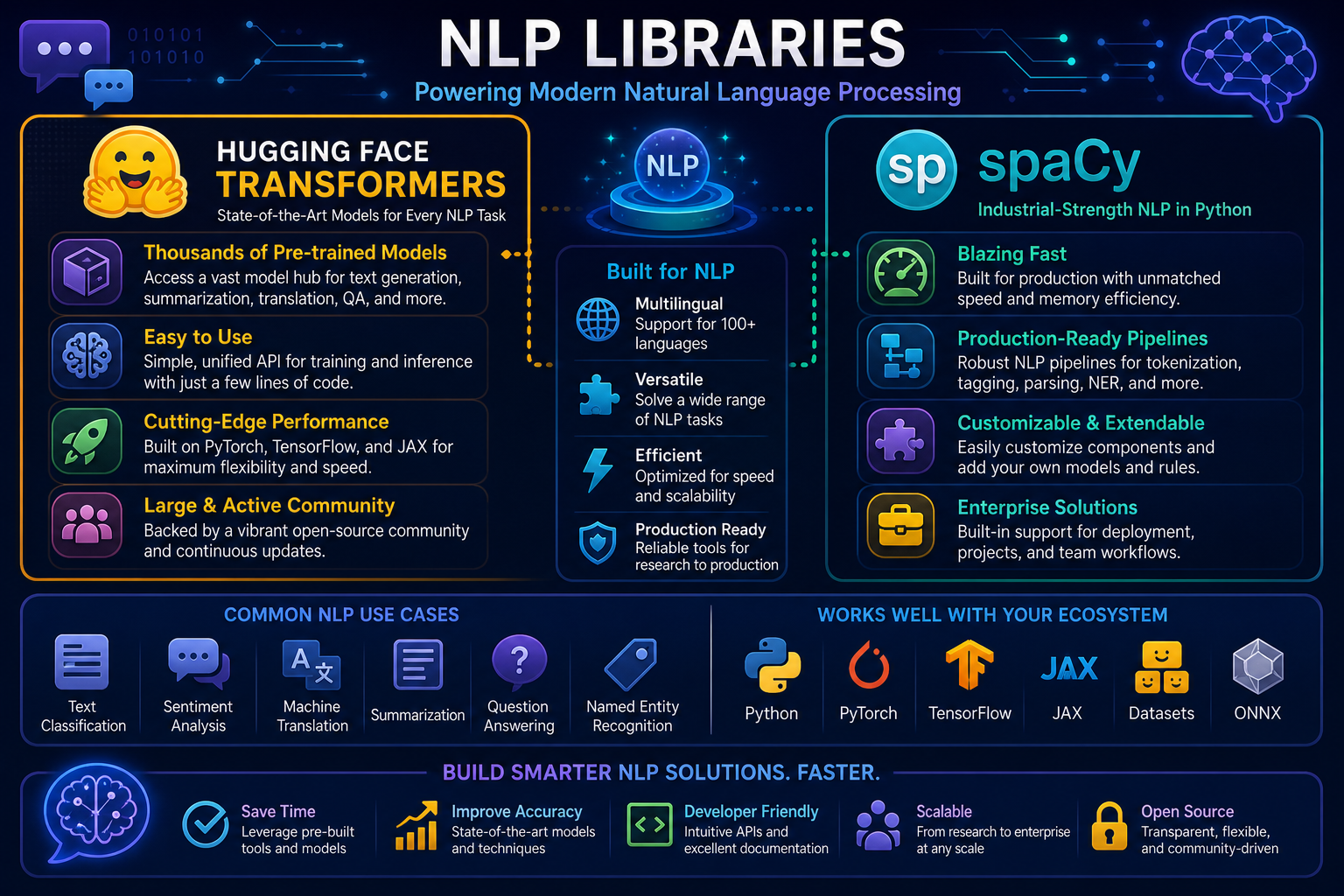
The official Transformers documentation describes Transformers as a model-definition framework for state-of-the-art machine learning models across text, computer vision, audio, video, and multimodal tasks, for both inference and training. Hugging Face documentation also describes the library as maintained by Hugging Face and the community and notes support for PyTorch, TensorFlow, and JAX, along with thousands of pretrained models for many modalities. The documentation also highlights framework interoperability and the ability to move models across major frameworks and export them for deployment.
5. Transformers Design Philosophy
Transformers is best understood as a pretrained-model and model-definition ecosystem centered on state-of-the-art neural architectures. Its primary value is not only that it provides code for transformer-based models, but that it packages model definitions, tokenizers, pretrained checkpoints, and task pipelines in a reusable and interoperable way.
This makes it especially powerful for modern NLP workflows that depend on pretrained language models and transfer learning.
6. Multi-Framework Orientation of Transformers
One of the official distinguishing features of Transformers is framework interoperability. The documentation states that Transformers supports PyTorch, TensorFlow, and JAX and that models can be moved across those frameworks for different stages of the model lifecycle. This matters because it allows users to align experimentation, fine-tuning, and deployment choices with the broader engineering stack.
7. Model and Checkpoint Ecosystem
The official documentation emphasizes the very large number of model checkpoints available through the Hugging Face
Hub. Conceptually, this means the practical search space for users is not only model architecture choice, but also
checkpoint choice:
Select(model family, pretrained checkpoint, task adaptation).
This pretrained model ecosystem is one of the biggest reasons Transformers became central to modern NLP workflows.
8. Typical Transformers Use Cases
Transformers is especially appropriate for:
- text classification
- token classification
- question answering
- summarization
- translation
- text generation
- embedding extraction
- multimodal and cross-modal tasks
Because its official positioning extends beyond only text, it is best seen as a broad state-of-the-art model ecosystem with especially strong NLP roots.
9. Strengths of Hugging Face Transformers
- large pretrained checkpoint ecosystem
- strong support for modern NLP and transformer-based tasks
- framework interoperability across PyTorch, TensorFlow, and JAX
- useful abstractions for training and inference pipelines
- broad modality coverage beyond text alone
These strengths are directly supported by the official documentation and Hub integration pages.
10. Limitations of Hugging Face Transformers
Transformers is not primarily a lightweight linguistic preprocessing toolkit in the way spaCy is. It is strongest when the problem is model-centric and pretrained-representation-centric. For some production NLP workflows that rely heavily on rule-based processing, token-level linguistic pipelines, or extremely fast classical NLP operations, other libraries may still be a better fit around or before the model layer.
11. spaCy Overview
The official spaCy homepage describes spaCy as a free open-source library for Natural Language Processing in Python and emphasizes its “industrial-strength” positioning. The homepage also highlights components such as named entity recognition, part-of-speech tagging, dependency parsing, word vectors, sentence segmentation, text classification, lemmatization, morphological analysis, and entity linking. The spaCy 101 guide further describes it as a free, open-source library for advanced NLP in Python, and the course materials describe spaCy as a modern Python library for industrial-strength NLP.
12. spaCy Design Philosophy
spaCy is best understood as a production-oriented NLP library focused on practical language pipelines and efficient processing. Its official messaging emphasizes doing “real work,” building real products, and maintaining a simple and productive API. This positions spaCy differently from a pretrained-model hub: it is designed around end-to-end processing pipelines, linguistic annotations, and practical workflow speed.
13. Pipeline-Centric Orientation of spaCy
spaCy workflows are typically organized around pipelines. A text is processed through components that may perform:
- tokenization
- sentence segmentation
- tagging
- dependency parsing
- named entity recognition
- text classification
- entity linking
This pipeline orientation makes spaCy particularly strong for structured production NLP workflows where multiple annotation steps need to be combined and applied consistently.
14. Linguistic and Rule-Based Strengths of spaCy
spaCy supports both machine-learning-driven and rule-based approaches. The official course materials explicitly note that spaCy is used to build advanced natural language understanding systems using both rule-based and machine learning approaches. This matters because many production NLP tasks still benefit from controlled, deterministic logic around tokenization, matching, and annotation, not only large pretrained models.
15. Typical spaCy Use Cases
spaCy is especially appropriate for:
- named entity recognition pipelines
- part-of-speech tagging
- dependency parsing
- rule-based matching and information extraction
- production text preprocessing
- building custom NLP pipelines for enterprise workflows
16. Strengths of spaCy
- strong industrial and production orientation
- fast and practical pipeline-based NLP workflow
- rich linguistic annotation capabilities
- support for both machine learning and rule-based processing
- productive Python API for real-world NLP systems
These strengths are directly reflected in the official homepage, usage guides, and course materials.
17. Limitations of spaCy
spaCy is not primarily a giant pretrained checkpoint ecosystem in the way Transformers is. It can integrate transformer-based components, but its identity is more strongly tied to production NLP pipelines, linguistic annotations, and practical industrial text processing than to acting as the main hub for large language model checkpoints and state-of-the-art cross-framework model definitions.
18. Transformers vs spaCy: Core Orientation
A practical distinction is:
- Hugging Face Transformers is centered on pretrained model definitions, fine-tuning, and modern neural NLP and multimodal model workflows.
- spaCy is centered on industrial-strength NLP pipelines, linguistic processing, and efficient production text workflows.
This is one of the most useful ways to understand the difference between the two libraries.
19. Representation Learning vs Pipeline Processing
Transformers is strongest when the problem benefits from pretrained neural representations and transfer learning. spaCy is strongest when the problem benefits from structured annotation pipelines, deterministic processing, fast production text handling, or a mixture of ML and rule-based logic.
These are complementary rather than competing strengths.
20. Interoperability and Combination
In practice, the two libraries are often combined. A common pattern is:
- use spaCy for tokenization, rule-based logic, or production pipeline orchestration
- use Transformers for embeddings, fine-tuned classifiers, QA, summarization, or generation tasks
This layered architecture works because modern NLP systems often need both linguistic structure and powerful pretrained neural models.
21. Production Considerations
spaCy’s official materials strongly emphasize production readiness and practical throughput. Transformers brings production value too, especially through its model ecosystem and inference pathways, but its main identity is more model-centric than pipeline-centric. As a result:
- spaCy often fits operational NLP services and linguistic pipelines very naturally
- Transformers often fits state-of-the-art task performance and transfer-learning-driven applications very naturally
22. Model-Centric vs System-Centric Workflows
A useful way to compare them is:
- Transformers: model-centric, checkpoint-centric, fine-tuning-centric
- spaCy: system-centric, pipeline-centric, annotation-centric
This explains why teams often use both in the same architecture rather than picking only one.
23. Choosing the Right Library
A practical selection guide is:
- Choose Hugging Face Transformers when you need pretrained transformer models, transfer learning, modern neural NLP, or generative capabilities.
- Choose spaCy when you need fast industrial NLP pipelines, linguistic annotations, rule-based matching, or production-friendly language processing workflows.
- Use both together when the application needs strong language pipelines plus powerful pretrained neural models.
24. Common Failure Modes
- using only large pretrained models where fast rule-based or pipeline-based NLP would be sufficient
- using only classical pipeline processing when the task truly requires pretrained semantic representations
- treating the libraries as direct substitutes rather than complementary tools
- ignoring production latency and deployment requirements when choosing a model-heavy stack
- ignoring linguistic preprocessing needs when focusing only on pretrained checkpoints
25. Best Practices
- Choose the library based on the role it needs to play in the NLP system, not on general popularity alone.
- Use Transformers for pretrained neural power and spaCy for fast industrial pipeline structure when both are needed.
- Keep tokenization, annotation, and model assumptions aligned across the full workflow.
- Evaluate not only accuracy, but also speed, maintainability, deployment fit, and pipeline complexity.
- Design NLP systems as layered architectures rather than assuming one library should do everything.
26. Conclusion
Hugging Face Transformers and spaCy are both foundational NLP libraries, but they solve different classes of problems from different design centers. Transformers provides a powerful pretrained-model ecosystem for modern neural NLP and multimodal tasks, with strong support for inference and training across major deep learning backends. spaCy provides fast, industrial-strength NLP pipelines built for real production language processing and linguistic analysis.
The most useful question is not which library is universally better, but which one is better suited to the specific role required in the system. In many mature NLP architectures, the best answer is not “either-or” but “both”: spaCy for robust pipeline structure and practical text processing, and Transformers for powerful pretrained model behavior and state-of-the-art task performance.