
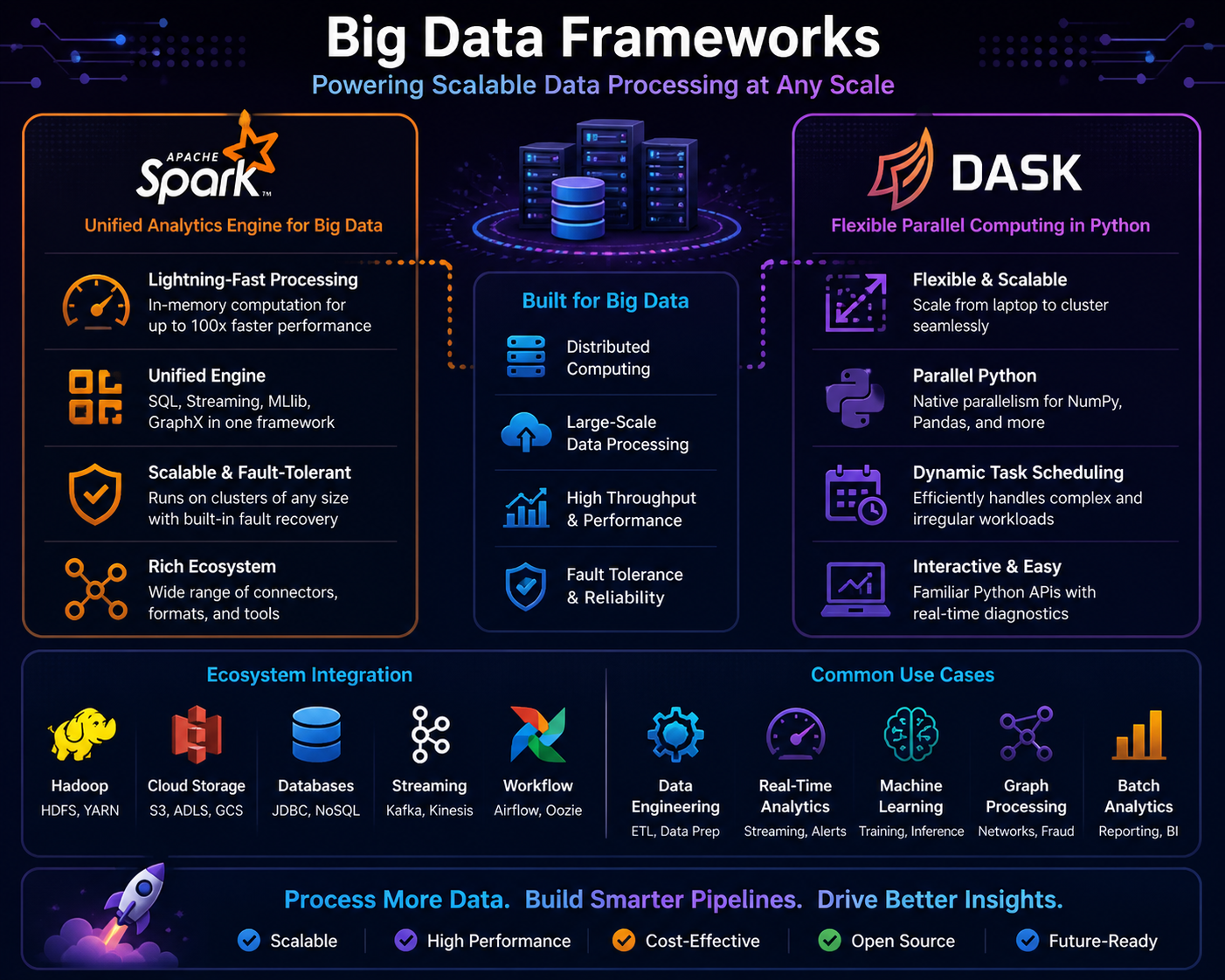
Big data frameworks are distributed computing systems designed to process datasets and workloads that exceed the practical limits of single-machine memory, storage, or compute. They help organizations scale data engineering, analytics, machine learning, and streaming workloads across clusters while preserving a workable developer model. Among the most important frameworks in the modern ecosystem are Apache Spark and Dask. Each solves large-scale computation problems, but they differ significantly in design philosophy, execution model, language orientation, and operational fit.
Abstract
Big data systems exist because many modern workloads cannot be handled efficiently by a single machine, either due to scale, memory limits, runtime constraints, or the need for parallel and distributed execution. Apache Spark and Dask are two prominent frameworks that address these needs from different starting points. Spark is a unified engine for large-scale data analytics with rich support for batch processing, SQL, machine learning, graph processing, and structured streaming across multiple languages. Dask is a Python-native library for parallel and distributed computing that scales familiar Python and PyData workflows across cores, machines, and clusters. This paper explains the technical foundations of distributed big data computation and compares Spark and Dask in terms of execution models, APIs, fault tolerance, workload patterns, streaming, machine learning integration, ecosystem fit, and deployment trade-offs. All formulas are embedded inline in HTML-friendly format for direct use in WordPress or similar editors.
1. Introduction
Let a dataset be represented as:
D = {(xi1, xi2, ..., xim)}i=1n.
When n and the total data volume become too large for one machine, or when the
computation over D is too slow to execute serially, distributed computation becomes
necessary. A big data framework provides an execution model for partitioning data and computation across workers so
that large jobs can be completed more efficiently and reliably.
Conceptually, if total computation is F(D), a distributed framework attempts to express
it as:
F(D) ≈ Combine(F1(D1), F2(D2), ..., Fk(Dk)),
where each Dj is a partition of the full workload.
2. Why Big Data Frameworks Matter
Big data frameworks matter because modern data workloads often involve:
- datasets larger than memory on one machine
- CPU-intensive transformations
- repeated analytics on many partitions
- streaming or incremental computation
- machine learning on large tabular or event datasets
- distributed scheduling and fault-tolerant execution requirements
A framework must therefore solve both a data problem and a systems problem.
3. A General View of Distributed Execution
Let total processing time on a single machine be T1. If a workload is split
across p workers, idealized parallel execution time might be:
Tp ≈ T1 / p.
In practice, distributed execution also incurs coordination, shuffling, scheduling, serialization, and network
overhead, so real speedup is less than ideal:
Speedup = T1 / Tp.
Big data frameworks differ strongly in how they manage these overheads.
4. Apache Spark Overview
The Apache Spark homepage describes Spark as a “multi-language engine for executing data engineering, data science, and machine learning on single-node machines or clusters,” and the Spark documentation describes it as a “unified analytics engine for large-scale data processing.” The official overview also states that Spark provides high-level APIs in Java, Scala, Python, and R, and supports higher-level tools including Spark SQL, pandas API on Spark, MLlib, GraphX, and Structured Streaming.
5. Spark Design Philosophy
Spark is best understood as a unified distributed analytics engine. Its architecture is designed to support multiple workload classes within one computation framework rather than forcing users to adopt separate systems for batch, SQL, ML, graph workloads, and streaming. This unification is one of Spark’s defining ideas.
6. Spark’s Programming Model
Spark exposes high-level APIs while executing optimized distributed jobs underneath. A user typically expresses transformations and actions over distributed data abstractions, and Spark builds execution graphs that operate across a cluster.
If distributed partitions are D1, ..., Dk, Spark schedules
transformations so that work on partitions can execute in parallel before a later aggregation or shuffle stage.
7. Spark SQL and Structured Data
Spark’s official overview explicitly lists Spark SQL and structured data processing as core parts of the platform. This matters because many enterprise big data workloads are not just raw file processing jobs, but structured analytics pipelines where SQL-like and DataFrame-style abstractions are central.
8. Spark Structured Streaming
Spark’s Structured Streaming page states that Structured Streaming makes it easy to build streaming applications and pipelines with the same familiar Spark APIs, and that it abstracts concepts such as incremental processing, checkpointing, and watermarks. The page also emphasizes low latency and cost-effectiveness within the Spark engine.
9. Spark Ecosystem Strength
One of Spark’s strongest characteristics is ecosystem breadth. The official documentation highlights support for:
- Spark SQL
- pandas API on Spark
- MLlib
- GraphX
- Structured Streaming
This makes Spark especially valuable in organizations that want one distributed computation platform for many data workloads.
10. Strengths of Apache Spark
- unified platform for batch, SQL, ML, graph, and streaming workloads
- multi-language APIs including Python, Scala, Java, and R
- strong fit for large-scale enterprise data processing
- well-developed distributed execution engine and ecosystem breadth
- good support for structured and incremental processing
These strengths are directly reflected in the official Spark documentation and product overview.
11. Limitations of Apache Spark
Spark’s strength as a large-scale unified analytics engine also means it is a substantial platform. For teams that want lightweight Python-first parallelism on familiar in-memory workflows, Spark can feel heavier than necessary. This is a reasoned comparison based on Spark’s official positioning as a large-scale multi-language engine rather than a minimal Python library.
12. Dask Overview
The Dask documentation describes Dask as a Python library for parallel and distributed computing. The Dask homepage also describes it as a flexible open-source Python library for parallel computing, while the FAQ explains that Dask commonly helps connect Python analysts to distributed hardware for data science and machine learning workloads. Dask documentation further describes Dask DataFrame as parallelizing pandas for larger-than-memory computing on a laptop or on a distributed cluster.
13. Dask Design Philosophy
Dask is best understood as a Python-native scaling layer for the PyData ecosystem. Rather than presenting itself as one large unified analytics platform across many languages, Dask focuses on helping Python users scale familiar tools such as NumPy-, pandas-, and scikit-learn-style workflows from a single machine to distributed execution.
The official docs emphasize that it is “just a Python library,” which reflects this lightweight, Python-first positioning.
14. Dask Collections and APIs
Dask provides multiple ways to express distributed work, including:
- Dask DataFrame for parallelized pandas-like tabular work
- Dask Array for parallelized NumPy-style workloads
- dask.delayed to parallelize general Python code
- distributed scheduling and futures-based execution
The tutorial and docs explicitly show Dask DataFrame, Dask Arrays, dask.delayed, and Distributed as core ways of working.
15. Dask DataFrame
The Dask DataFrame documentation states that Dask DataFrame helps users process large tabular data by parallelizing pandas, either on a laptop for larger-than-memory computing or on a distributed cluster. The tutorial further explains that a Dask DataFrame is composed of many pandas DataFrames partitioned along the index.
16. Dask Distributed
The distributed documentation describes dask.distributed as a lightweight library for
distributed computing in Python that extends both the concurrent.futures and Dask APIs to moderate-sized clusters.
This is important because it shows Dask’s identity as a general-purpose Python parallel computing toolkit, not only a
DataFrame engine.
17. Dask and Machine Learning
Dask also has a machine learning extension ecosystem. The Dask-ML documentation describes Dask-ML as providing scalable machine learning in Python using Dask alongside popular machine learning libraries such as scikit-learn and XGBoost. This reinforces Dask’s role as a scaling framework for Python ML rather than as a fully separate ML platform.
18. Strengths of Dask
- strong Python-native scaling for familiar PyData workflows
- easy path from local computation to distributed execution
- good support for pandas-like, NumPy-like, and general Python workloads
- lightweight distributed execution options through dask.distributed
- natural fit for Python-heavy data science and ML teams
These strengths are directly supported by the Dask docs, tutorial, and FAQ.
19. Limitations of Dask
Dask’s Python-native strength also means its identity is less about providing one broad multi-language enterprise analytics platform and more about scaling Python workflows. For organizations that need a single engine spanning SQL, structured streaming, graph processing, and multi-language APIs at large enterprise scale, Spark may be the more natural fit. This is a reasoned comparison grounded in the official positioning of both tools.
20. Spark vs Dask: Core Orientation
A practical distinction is:
- Apache Spark is a unified analytics engine for large-scale data processing across multiple languages and workload types.
- Dask is a Python library for parallel and distributed computing that scales familiar Python workflows.
This difference is one of the most useful ways to choose between them.
21. Language Model Comparison
Spark’s official docs emphasize high-level APIs in Java, Scala, Python, and R. Dask’s official docs describe it as a Python library. Therefore:
- Spark is naturally multi-language.
- Dask is naturally Python-first.
This matters greatly for team composition and existing ecosystem investments.
22. Streaming and Incremental Processing
Spark has an official structured streaming subsystem that uses the same familiar Spark APIs and abstracts away checkpointing, watermarks, and incremental processing details. Dask can support streaming-like or incremental workflows through task and distributed patterns, but its official positioning in the sources surfaced here is not centered on a directly analogous first-class streaming subsystem.
23. DataFrame and Tabular Workloads
Both frameworks support large tabular workloads, but from different starting points:
- Spark approaches this through Spark SQL, DataFrames, and large-scale structured data processing.
- Dask approaches this through parallelized pandas-style DataFrames and Python-native scaling.
This means the developer experience often differs as much as the runtime model does.
24. Machine Learning Ecosystem Fit
Spark’s official overview lists MLlib as part of its higher-level toolset, reinforcing its role as a broad data and ML platform. Dask’s ML story is more about scaling Python ML workflows alongside tools such as scikit-learn and XGBoost, as reflected in Dask-ML.
25. Fault Tolerance and Execution Practicalities
Both frameworks address distributed execution reliability, but they do so in ecosystems with different operational assumptions. Spark is strongly associated with large-scale cluster analytics and enterprise data pipelines. Dask is strongly associated with Python users wanting to scale up existing scientific and data workflows across more hardware.
In practical terms, this often means Spark is preferred when the organization wants a large shared analytics engine, while Dask is preferred when the organization wants to extend Python-native analysis into distributed settings.
26. Performance and Workload Fit
Performance depends heavily on workload type, data format, scheduler overhead, memory behavior, and team implementation style. No framework is universally faster for all workloads. Instead, a useful comparison is whether the framework matches:
- the programming language ecosystem
- the workload shape
- the need for SQL or streaming
- the need for Python-native custom computation
- the organization’s deployment and governance model
27. Choosing the Right Framework
A practical selection guide is:
- Choose Apache Spark when you need a unified, multi-language engine for large-scale batch, SQL, streaming, and related analytics workloads.
- Choose Dask when you want to scale Python-native data science, pandas-like, NumPy-like, and custom parallel workloads across cores or clusters.
The best choice depends less on branding and more on language ecosystem, operational model, and workload class.
28. Common Failure Modes
- choosing Spark for a lightweight Python workload that mainly needs local-to-cluster scaling
- choosing Dask when the organization actually needs a unified enterprise SQL and streaming platform
- focusing only on benchmark headlines instead of workflow fit
- ignoring data movement and shuffle costs in distributed designs
- trying to replicate one framework’s design assumptions directly inside the other
29. Best Practices
- Choose the framework based on workload shape, team language ecosystem, and operational goals.
- Use Spark when unification across batch, SQL, streaming, and large-scale analytics is the priority.
- Use Dask when scaling existing Python and PyData workflows is the priority.
- Model distributed cost in terms of both compute and coordination overhead, not just worker count.
- Validate framework choice with representative workloads instead of relying on generic comparisons.
30. Conclusion
Apache Spark and Dask are both important big data frameworks, but they are optimized around different centers of gravity. Spark is a unified analytics engine built to support large-scale data engineering, SQL, machine learning, graph processing, and structured streaming across multiple languages. Dask is a Python-native parallel and distributed computing library designed to scale familiar data science and machine learning workflows across machines and clusters.
The most useful comparison is therefore not which framework is universally better, but which framework better matches the actual problem, data workflow, team skills, and operating model. When selected well, both Spark and Dask are powerful tools for turning large-scale data processing from a single-machine limitation into a distributed, practical, and scalable capability.