
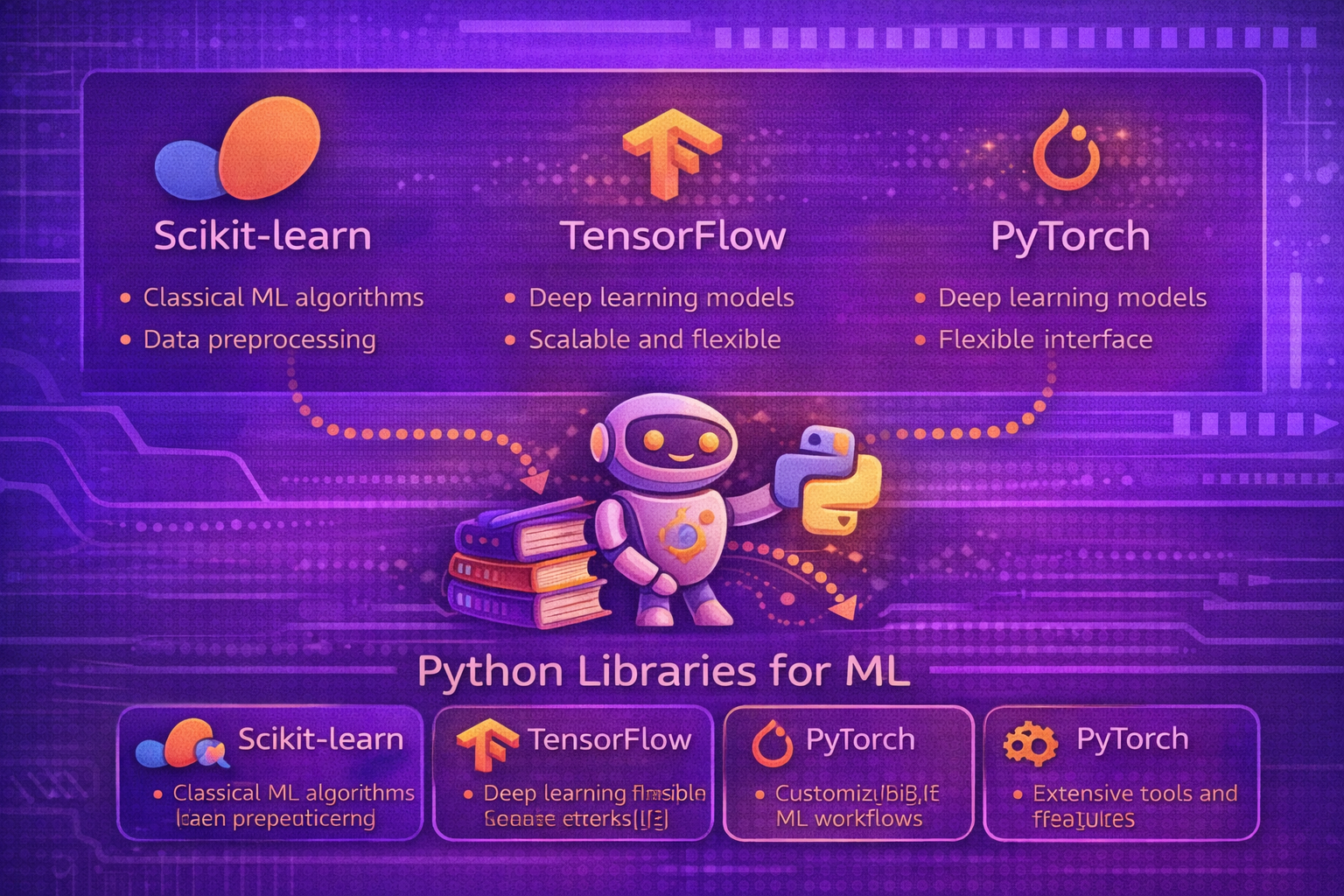
Python has become the dominant programming language for modern machine learning because of its expressive syntax, scientific computing ecosystem, and strong library support across data preparation, modeling, evaluation, experimentation, and deployment. Among the most important ML libraries in Python are scikit-learn, TensorFlow, and PyTorch. Each occupies a different place in the ecosystem and reflects a different design philosophy regarding abstraction level, computation model, developer ergonomics, and production orientation.
Abstract
Machine learning workflows in Python span a wide spectrum of tasks: preprocessing, classical supervised and unsupervised learning, neural network training, automatic differentiation, hardware acceleration, hyperparameter tuning, model evaluation, and deployment. No single library is best for every task. Scikit-learn is especially strong for classical machine learning and predictive data analysis on structured datasets. TensorFlow is a broad ML platform with strong end-to-end workflow and deployment pathways, especially through its Keras-centered user model. PyTorch is an optimized tensor and deep learning framework widely used for custom neural development and modern model experimentation. This paper explains the computational abstractions, workflow strengths, limitations, and practical fit of these three libraries, and compares where each is most appropriate in the machine learning lifecycle. All formulas are embedded inline in HTML-friendly format for direct use in WordPress or similar editors.
1. Introduction
Let a machine learning workflow be represented as:
W = (D, φ, A, λ, E, M),
where:
Dis the datasetφis preprocessing and feature logicAis the algorithm or model familyλis the hyperparameter configurationEis the evaluation procedureMis the resulting trained model
Python ML libraries support different parts of W. The right library depends on the
problem type, data modality, desired level of abstraction, hardware requirements, and deployment target.
2. Why Python Dominates ML Workflows
Python dominates ML because it combines:
- readable syntax and fast prototyping
- strong numerical foundations through NumPy-style array computing
- excellent interoperability with data tools such as pandas
- rich open-source model and visualization ecosystems
- good balance between research productivity and engineering practicality
Scikit-learn, TensorFlow, and PyTorch all benefit from this shared ecosystem while addressing different modeling needs.
3. A Common Mathematical View
At a high level, all three libraries support models of the form:
ŷ = f(x; θ),
where x is an input, θ is model state, and
ŷ is the prediction.
In supervised learning, training usually seeks:
θ* = argminθ (1/n) Σ L(yi, f(xi; θ)).
The libraries differ mainly in how users define f, how optimization is expressed, what
model families are emphasized, and how the surrounding workflow is structured.
4. Scikit-learn Overview
The scikit-learn documentation describes it as an open-source machine learning library that supports supervised and unsupervised learning and provides tools for model fitting, data preprocessing, model selection, and model evaluation. The scikit-learn homepage also describes it as providing simple and efficient tools for predictive data analysis. Its user guide shows broad coverage of supervised learning, unsupervised learning, model selection and evaluation, and related utilities.
5. Scikit-learn Design Philosophy
Scikit-learn is centered on a consistent estimator API. Users generally work with objects that expose familiar
methods such as:
fit,
predict,
transform,
and
score.
This design makes it especially strong for structured, repeatable workflows on tabular data and classical predictive modeling tasks.
6. Strengths of Scikit-learn
- excellent support for classical supervised and unsupervised learning
- strong preprocessing, feature transformation, and model selection utilities
- consistent API across many algorithms
- high productivity for tabular and medium-scale predictive problems
- good integration with NumPy and pandas-oriented workflows
7. Typical Scikit-learn Use Cases
Scikit-learn is especially appropriate for:
- classification and regression on structured data
- clustering and dimensionality reduction
- feature engineering pipelines
- cross-validation and model selection
- baseline model development before moving to more complex systems
8. Limitations of Scikit-learn
Scikit-learn is not primarily a large-scale deep learning platform. While its user guide includes neural network estimators, its center of gravity remains classical machine learning rather than GPU-centric deep learning ecosystems. This makes it highly effective for many structured-data problems, but less natural for modern large neural architectures.
9. TensorFlow Overview
TensorFlow’s official materials describe it as making it easy to create machine learning models that can run in any environment, and its guide states that TensorFlow 2 focuses on simplicity and ease of use, with eager execution and higher-level APIs. The learning pages also describe support across desktop, mobile, web, and cloud.
10. Keras in TensorFlow
The TensorFlow Keras guide describes Keras as the high-level API of the TensorFlow platform and states that it covers every step of the ML workflow from data processing to hyperparameter tuning to deployment. This is important because many TensorFlow users now interact primarily through a Keras-oriented workflow rather than through lower-level graph construction.
11. TensorFlow Design Philosophy
TensorFlow is best understood as a broad machine learning platform rather than only a tensor library. It is designed to support model development, training, serialization, deployment, and execution across different environments. This broader platform orientation distinguishes it from narrower workflow tools.
12. Strengths of TensorFlow
- strong end-to-end ML platform orientation
- good support for deep learning and neural workflows
- high-level productivity through Keras
- ability to target multiple environments including mobile, web, desktop, and cloud
- rich official ecosystem of guides, tutorials, and APIs
13. Typical TensorFlow Use Cases
TensorFlow is especially well-suited for:
- deep learning workflows
- image, text, and sequence modeling
- end-to-end production pipelines with deployment needs
- cases where cross-environment portability matters
- teams that want a broad ML platform rather than only a model-building library
14. Limitations of TensorFlow
TensorFlow’s breadth can also be a trade-off. Its platform-wide scope can feel heavier than necessary for simpler classical ML tasks or smaller tabular problems. In those cases, the additional power may exceed the actual problem needs.
15. PyTorch Overview
PyTorch documentation describes PyTorch as an optimized tensor library for deep learning using GPUs and CPUs. Its official beginner tutorials frame PyTorch around a complete ML workflow involving data, model creation, optimization, and model saving. Its documentation and tutorials strongly emphasize tensor operations and neural model development.
16. PyTorch Design Philosophy
PyTorch centers on tensor computation and deep learning model development. Its design has made it especially popular in research and experimentation settings where users need flexible model definition and clear control over training behavior.
17. Strengths of PyTorch
- strong deep learning and tensor computation model
- good ergonomics for experimentation and custom neural development
- optimized support for CPU and GPU workflows
- broad tutorial and documentation ecosystem
- widely used for modern neural architectures
18. Typical PyTorch Use Cases
PyTorch is especially appropriate for:
- custom deep learning research and experimentation
- modern computer vision and NLP pipelines
- multimodal and tensor-heavy workflows
- GPU-accelerated model training
- projects where architectural flexibility is a major priority
19. Limitations of PyTorch
PyTorch is not primarily a classical tabular ML toolkit in the way scikit-learn is. It can certainly be used for supervised learning in general, but its core identity is much more strongly tied to deep learning and tensor-centric workflows than to classical predictive analytics on structured datasets.
20. Classical ML vs Deep Learning Orientation
A practical distinction is:
- scikit-learn is strongest for classical ML and structured predictive workflows.
- TensorFlow and PyTorch are strongest for deep learning and tensor-centric model development.
This is not an absolute boundary, but it is one of the most useful distinctions for real tool selection.
21. API and Workflow Comparison
These libraries also differ in how users work with them:
- scikit-learn: estimator APIs, pipelines, classical evaluation workflows
- TensorFlow: platform-oriented development, commonly through Keras abstractions
- PyTorch: tensor programming with explicit neural workflow control
This affects both developer experience and the kinds of projects each library supports most naturally.
22. Hardware and Performance Considerations
For deep learning workloads, TensorFlow and PyTorch are designed to work effectively with GPUs and other accelerator environments. PyTorch explicitly describes itself as optimized for deep learning using GPUs and CPUs. Scikit-learn, by contrast, is most naturally associated with classical ML workflows and scientific Python stacks for structured data analysis.
23. Evaluation and Model Selection
All three ecosystems support evaluation, but scikit-learn provides especially rich utilities for cross-validation, scoring, and model selection in classical workflows. TensorFlow and PyTorch also support evaluation strongly, but their ecosystems are centered more around training and iterating on deep models than around providing a unified classical model-selection interface.
24. Production and Deployment Orientation
TensorFlow stands out for its explicit positioning around models that can run across desktop, mobile, web, and cloud, and for its Keras-based end-to-end workflow support. PyTorch also has strong practical deployment use, but its official positioning is more commonly expressed through tensor and deep learning workflows. Scikit-learn is highly deployable for classical models, but its core identity remains predictive data analysis rather than a full-stack deep learning platform.
25. Choosing the Right Library
A practical selection guide is:
- Choose scikit-learn for classical ML on structured data, fast baselines, and model selection workflows.
- Choose TensorFlow when you want a broad ML platform with strong deep learning and deployment pathways.
- Choose PyTorch when you want flexible deep learning development and tensor-centric experimentation.
The best choice depends on the data modality, the architecture needed, team familiarity, and the operational target.
26. Common Failure Modes
- using a deep learning framework for a small tabular problem that scikit-learn could solve more simply
- choosing a library because it is fashionable rather than because it fits the workload
- ignoring deployment requirements when selecting the training stack
- building complex neural systems before establishing strong classical baselines
- treating framework choice as purely technical instead of also organizational and operational
27. Best Practices
- Start with the simplest library that matches the actual problem and deployment requirement.
- Use scikit-learn first for many tabular baselines before escalating to deep learning unnecessarily.
- Use TensorFlow when broad deployment pathways and platform support are central requirements.
- Use PyTorch when flexible deep learning iteration and custom tensor workflows are the main priority.
- Evaluate tools not only by training convenience, but also by evaluation, deployment, monitoring, and team fit.
28. Conclusion
Scikit-learn, TensorFlow, and PyTorch are all foundational Python libraries for machine learning, but they occupy different parts of the ecosystem. Scikit-learn excels at classical machine learning and structured predictive workflows. TensorFlow provides a broad platform for building and running ML models across many environments, especially through its Keras-centered workflow. PyTorch provides an optimized tensor and deep learning framework that is especially strong for modern neural development and experimentation.
The most useful question is not which library is “best” in the abstract, but which one best fits the problem, data type, workflow style, deployment needs, and organizational context. When selected appropriately, these libraries complement rather than replace one another and together form much of the practical foundation of machine learning in Python today.