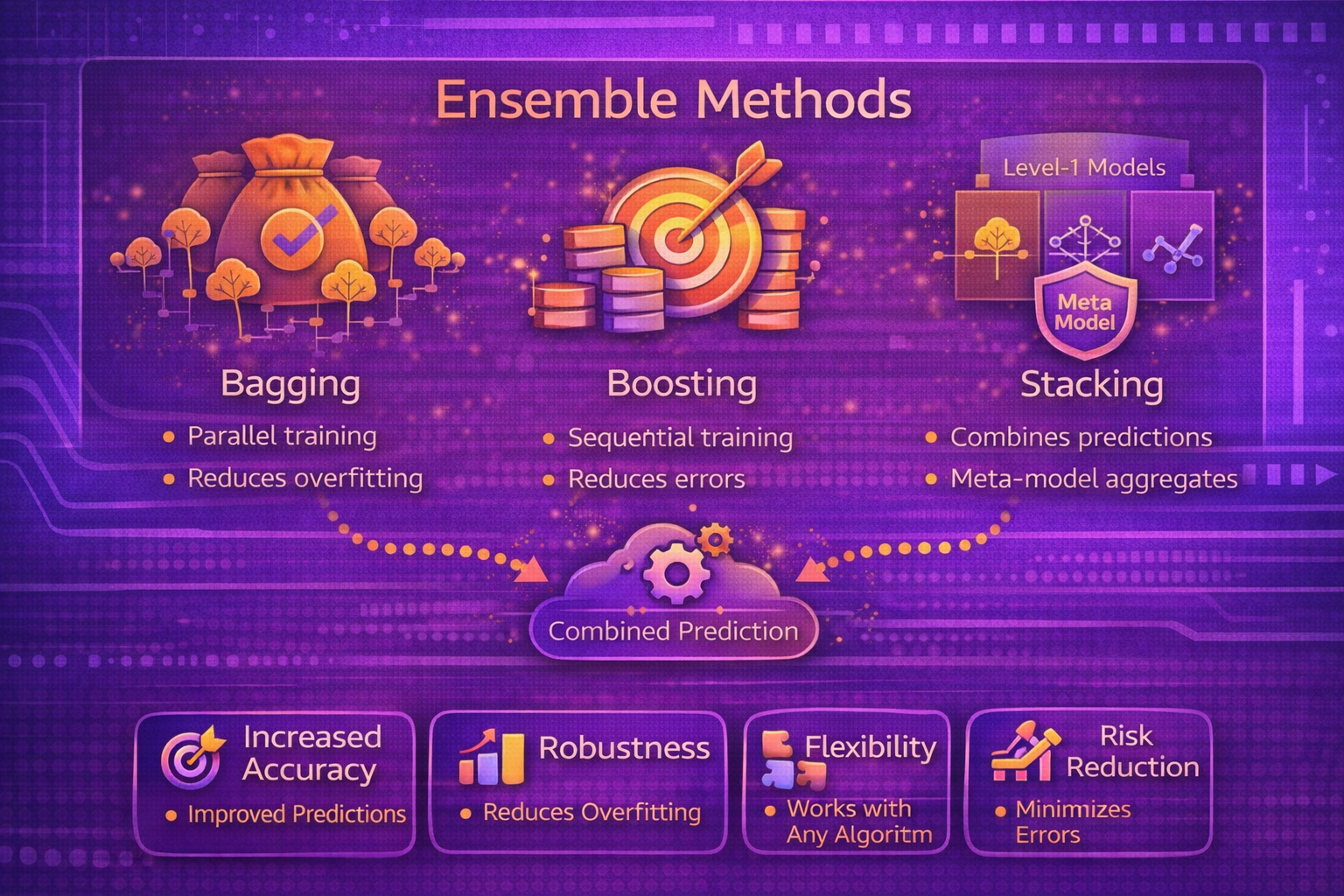
Ensemble Methods

Part 1: Foundations of Ensemble Learning

  1. What Is Ensemble Learning and Why Does It Work?
    Problem solved: Improving prediction accuracy and model robustness by combining multiple models.
  2. Base Learners in Python: Decision Trees, Logistic Regression, k-NN, SVM, and Naive Bayes
    Problem solved: Understanding which simple models can be combined effectively.
  3. How to Evaluate Ensemble Models in Python
    Problem solved: Measuring whether an ensemble is actually better than a single model using accuracy, precision, recall, F1, ROC-AUC.
  4. Bias, Variance, and Why Ensembles Generalize Better
    Problem solved: Reducing overfitting and underfitting through model combination.
  5. Real-World Applications of Ensemble Learning
    Problem solved: Knowing where ensembles are useful in fraud detection, spam filtering, churn prediction, medical diagnosis, and demand forecasting.

Part 2: Boosting Series

  1. Boosting Explained Simply with Python
    Problem solved: Improving weak learners step by step by focusing on previous mistakes.
  2. AdaBoost in Python with a Simple Classification Example
    Problem solved: Building a stronger classifier from weak decision stumps.
  3. How AdaBoost Reweights Misclassified Samples
    Problem solved: Understanding how the algorithm learns from hard examples.
  4. Gradient Boosting in Python for Structured Data
    Problem solved: Achieving strong predictive performance on tabular datasets.
  5. XGBoost for Real Business Problems
    Problem solved: High-performance classification and regression for production-grade structured data.
  6. LightGBM in Python: Faster Gradient Boosting for Large Datasets
    Problem solved: Handling large datasets efficiently with lower training time.
  7. Multi-Class Boosting in Python
    Problem solved: Extending boosting beyond binary classification.
  8. Multi-Label Boosting with Python Examples
    Problem solved: Predicting multiple labels at once, such as tagging articles with several topics.
  9. Boosting with Noisy Data: Challenges and Fixes
    Problem solved: Making boosted models more stable when labels contain errors.
  10. Why Boosting Often Resists Overfitting
    Problem solved: Explaining one of the most interesting theoretical benefits of boosting.

Part 3: Bagging and Random Forest Series

  1. Bagging in Python from Scratch
    Problem solved: Reducing model variance by training on bootstrap samples.
  2. Why Bagging Works Better for Unstable Models Like Trees
    Problem solved: Making predictions more stable and less sensitive to small data changes.
  3. Random Forest in Python: Classification and Regression
    Problem solved: Building a strong default model for many structured-data problems.
  4. Random Subspace Method Explained with Python
    Problem solved: Improving diversity by training models on different feature subsets.
  5. How Random Forest Creates Diversity Among Trees
    Problem solved: Understanding why randomness improves ensemble performance.
  6. Tuning Random Forest Hyperparameters the Right Way
    Problem solved: Balancing accuracy, speed, and overfitting.
  7. Feature Importance in Random Forest: What It Means and What It Misses
    Problem solved: Interpreting which features drive predictions.
  8. Bagging vs Boosting: When Should You Use Which?
    Problem solved: Choosing the right ensemble family for a practical use case.

Part 4: Combination Methods

  1. Voting Classifiers in Python: Hard Voting vs Soft Voting
    Problem solved: Combining different models in a simple and effective way.
  2. Averaging for Regression Ensembles
    Problem solved: Improving regression stability by combining model outputs.
  3. Stacking in Python with scikit-learn
    Problem solved: Learning how to combine multiple models with a meta-model.
  4. Stacking vs Blending: Which Ensemble Strategy Is Better?
    Problem solved: Selecting the right model-combination approach.
  5. Mixture of Experts: Routing Inputs to Specialized Models
    Problem solved: Using specialized models for different sub-problems.
  6. Dynamic Classifier Selection in Python
    Problem solved: Choosing the best model for each incoming test sample.
  7. Error-Correcting Output Codes for Multi-Class Problems
    Problem solved: Breaking hard multi-class tasks into more manageable subproblems.

Part 5: Diversity in Ensembles

  1. Why Diversity Matters in Ensemble Learning
    Problem solved: Preventing all models from making the same mistake.
  2. How to Measure Diversity Between Models
    Problem solved: Quantifying whether ensemble members are truly different.
  3. Pairwise and Non-Pairwise Diversity Measures in Python
    Problem solved: Comparing models using disagreement, correlation, and ambiguity.
  4. Visualizing Ensemble Diversity
    Problem solved: Making abstract diversity concepts easier to understand.
  5. Ways to Increase Diversity in Your Ensemble
    Problem solved: Improving performance by varying data, features, algorithms, or hyperparameters.
  6. When Diversity Metrics Fail
    Problem solved: Understanding that more diversity does not always mean better accuracy.

Part 6: Ensemble Pruning

  1. What Is Ensemble Pruning and Why Can Fewer Models Perform Better?
    Problem solved: Reducing complexity while keeping or improving accuracy.
  2. Ranking-Based Ensemble Pruning in Python
    Problem solved: Selecting only the most useful models.
  3. Clustering-Based Pruning for Large Ensembles
    Problem solved: Removing redundant models that behave similarly.
  4. Optimization-Based Ensemble Pruning
    Problem solved: Finding the best subset of models mathematically or heuristically.
  5. Speeding Up Inference with Pruned Ensembles
    Problem solved: Making ensembles practical in real-time systems.

Part 7: Clustering Ensembles

  1. What Is a Clustering Ensemble?
    Problem solved: Combining multiple clustering results for more reliable unsupervised learning.
  2. Consensus Clustering in Python
    Problem solved: Producing a stable final clustering when different algorithms disagree.
  3. Similarity-Based Clustering Ensemble Methods
    Problem solved: Aggregating cluster assignments based on sample similarity.
  4. Graph-Based Clustering Ensembles
    Problem solved: Representing clustering results as graphs for better consensus.
  5. Relabeling Problems in Clustering Ensembles
    Problem solved: Fixing label mismatch across clustering outputs.
  6. Transformation-Based Clustering Ensemble Methods
    Problem solved: Converting cluster outputs into a form that can be combined more effectively.

Part 8: Anomaly Detection and Isolation Forest

  1. Anomaly Detection Basics with Python
    Problem solved: Finding rare, suspicious, or abnormal records in data.
  2. Isolation Forest Explained with a Fraud Detection Example
    Problem solved: Detecting anomalies without needing labeled fraud examples.
  3. Sequential vs Parallel Ensemble Methods for Anomaly Detection
    Problem solved: Choosing the right strategy for rare-event detection.
  4. Isolation Forest in Production: Practical Considerations
    Problem solved: Threshold setting, contamination rate, and false positives.
  5. Extensions of Isolation Forest
    Problem solved: Adapting anomaly detection to different data conditions.
  6. Learning Emerging New Classes
    Problem solved: Detecting patterns that belong to unseen categories.

Part 9: Semi-Supervised Ensembles

  1. Semi-Supervised Learning with Ensembles
    Problem solved: Training models when labeled data is limited but unlabeled data is abundant.
  2. Self-Training and Co-Training in Python
    Problem solved: Leveraging unlabeled data to improve performance.
  3. How Ensembles Help Semi-Supervised Learning
    Problem solved: Using multiple learners to create more reliable pseudo-labels.
  4. Parallel Semi-Supervised Ensembles
    Problem solved: Improving stability when learning from partial supervision.
  5. Semi-Supervised Clustering Ensembles
    Problem solved: Combining weak labels and unsupervised structure.
  6. Using Diversity in Semi-Supervised Ensembles
    Problem solved: Preventing confirmation bias from pseudo-labeling.

Part 10: Class Imbalance and Cost-Sensitive Learning

  1. Handling Imbalanced Datasets in Python
    Problem solved: Improving detection of rare classes such as fraud, disease, or defects.
  2. Why Accuracy Fails on Imbalanced Data
    Problem solved: Avoiding misleading evaluation results.
  3. Precision-Recall, F1, G-Mean, ROC, and AUC for Imbalanced Problems
    Problem solved: Choosing the right metric when classes are skewed.
  4. Cost-Sensitive Learning in Python
    Problem solved: Penalizing costly mistakes more heavily than less important ones.
  5. Bagging for Imbalanced Classification
    Problem solved: Improving minority-class detection through resampling and ensembling.
  6. Boosting for Imbalanced Data
    Problem solved: Focusing learning effort on rare but important cases.
  7. Hybrid Ensemble Methods for Imbalanced Problems
    Problem solved: Combining sampling and ensemble strategies for better rare-event prediction.

Part 11: Deep Learning and Deep Forest

  1. Ensembles in Deep Learning: Why One Neural Network Is Often Not Enough
    Problem solved: Improving stability and accuracy in neural network predictions.
  2. Deep Forest Explained with Python
    Problem solved: Using a deep layered forest alternative to deep neural networks on tabular data.
  3. Deep Forest vs Random Forest vs Neural Networks
    Problem solved: Choosing the right model for tabular datasets.
  4. Forest and Autoencoder Combination Models
    Problem solved: Combining representation learning with tree-based models.
  5. Deep Forest for Multi-Label Problems
    Problem solved: Extending deep forest to more complex label structures.
  6. Accelerating Deep Forest Models
    Problem solved: Reducing training cost for layered tree-based ensembles.
  7. Metric Learning and Deep Forest Extensions
    Problem solved: Improving similarity-aware predictions.

Part 12: Advanced and Future Topics

  1. Weakly Supervised Learning with Ensembles
    Problem solved: Learning when labels are incomplete, inexact, or noisy.
  2. Open-Environment Learning and Changing Data Distributions
    Problem solved: Handling data drift and real-world change.
  3. Online Learning with Ensembles in Python
    Problem solved: Updating models continuously on streaming data.
  4. Drifting Ensembles for Non-Stationary Data Streams
    Problem solved: Keeping models useful when patterns change over time.
  5. Reinforcement Learning and Ensemble Ideas
    Problem solved: Improving policy learning and uncertainty estimation.
  6. Model Interpretability for Ensembles
    Problem solved: Explaining predictions from complex combined models.
  7. Reducing an Ensemble to a Simpler Single Model
    Problem solved: Distilling complexity into a more explainable form.
  8. Rule Extraction from Ensemble Models
    Problem solved: Converting black-box behavior into understandable business rules.
  9. Visualizing Ensemble Behavior
    Problem solved: Helping stakeholders understand how combined models make decisions.
  10. Future of Ensemble Learning in Python
    Problem solved: Exploring how ensembles fit with AutoML, streaming ML, explainability, and hybrid AI systems.