
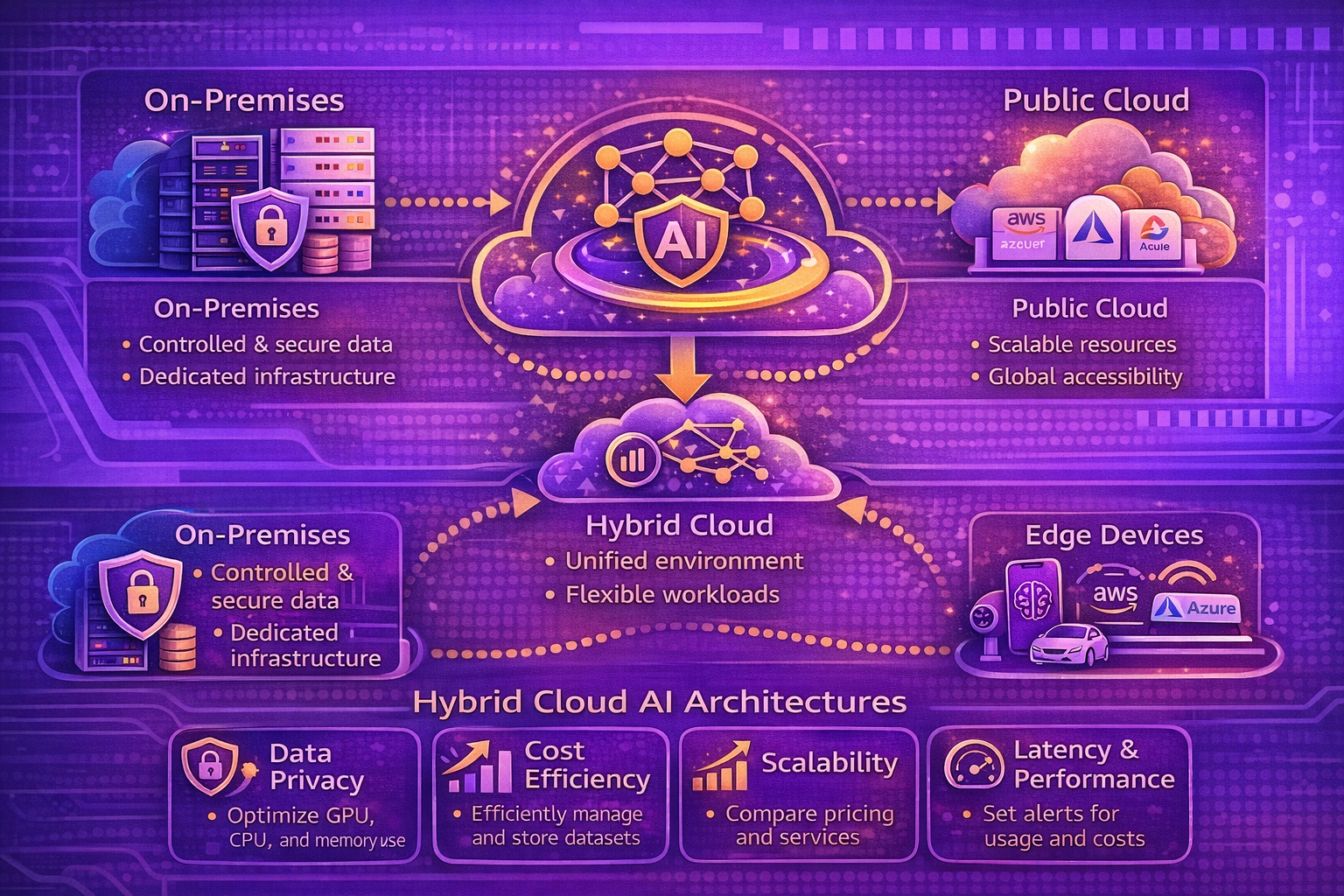
Hybrid cloud AI architectures are system designs in which AI workloads are distributed across a combination of on-premises infrastructure, private cloud resources, edge environments, and one or more public cloud platforms. These architectures emerge when organizations need to balance scalability, cost, latency, sovereignty, security, regulatory requirements, and existing enterprise infrastructure while still enabling modern machine learning and AI capabilities. This whitepaper explains the technical foundations, patterns, and trade-offs of hybrid cloud AI.
Abstract
AI systems rarely operate within a single, perfectly uniform infrastructure environment. Enterprises often have sensitive data on-premises, operational systems in private networks, cloud-native analytics in public platforms, latency-sensitive workloads at the edge, and governance requirements that prevent unrestricted centralization. Hybrid cloud AI architectures address this reality by distributing data, training, inference, orchestration, and governance across multiple execution domains. This paper explains the motivations for hybrid cloud AI, architectural patterns, data movement models, deployment topologies, feature access strategies, model lifecycle coordination, security and identity design, networking considerations, observability, resilience, cost optimization, and governance implications. It also analyzes trade-offs among centralized and distributed designs and shows how hybrid architectures enable organizations to operationalize AI without abandoning existing infrastructure or compliance obligations. All formulas are embedded inline in HTML-friendly format for direct use in WordPress or similar editors.
1. Introduction
Let an AI system be represented as:
S = (D, φ, M, T, I, G),
where:
Dis the data landscapeφis the feature and transformation logicMis the model lifecycleTis the training and inference topologyIis the infrastructure environmentGis the governance and control framework
In a hybrid cloud AI architecture, I is not a single homogeneous environment. Instead,
it is a composed execution fabric spanning multiple operational domains.
2. What Hybrid Cloud Means in AI Context
In general infrastructure terms, hybrid cloud means combining on-premises and cloud environments. In AI, the concept is broader because the architectural question is not only where compute runs, but also:
- where data is stored
- where feature processing occurs
- where models are trained
- where inference is executed
- where governance controls are enforced
A hybrid AI architecture is therefore a distributed systems design problem, not merely a hosting choice.
3. Why Hybrid Cloud AI Architectures Exist
Organizations adopt hybrid AI architectures for several common reasons:
- sensitive data cannot leave certain environments
- legacy systems remain on-premises
- public cloud offers elastic training compute
- edge or local inference is required for latency or reliability
- cost structures differ across workloads
- regulatory or residency rules constrain data movement
Hybrid AI is often the practical architecture chosen when pure cloud centralization is not feasible or desirable.
4. Primary Deployment Domains
A hybrid AI system may involve one or more of the following domains:
- on-premises: enterprise data centers, private networks, controlled hardware
- private cloud: virtualized or containerized internal cloud platforms
- public cloud: elastic infrastructure for training, storage, and scalable serving
- edge: devices or local compute near the point of data generation
The key architectural task is deciding what runs where and why.
5. Centralized vs Distributed AI Execution
In a centralized design, major workloads are moved into one dominant environment. In a distributed hybrid design, workloads remain partitioned according to constraints and workload suitability.
If the full workload set is
W = {w1, w2, ..., wn},
hybrid architecture assigns each workload to an execution domain:
Assign(wi) → {on-prem, private cloud, public cloud, edge}.
6. Data Gravity
One of the most important reasons hybrid architectures persist is data gravity. Large datasets are expensive,
time-consuming, or non-compliant to move freely across environments. If dataset size is
V and transfer rate is r, then simple transfer time is:
t = V / r.
In practice, transfer feasibility is influenced not only by bandwidth, but by cost, policy, and operational risk.
7. Data Residency and Sovereignty
Some AI systems must keep certain data within defined geographical, legal, or organizational boundaries. This means
that even if the public cloud provides ideal elasticity, the architecture may need to ensure:
Location(Dsensitive) ∈ AllowedDomain.
Hybrid architectures are often the natural result of sovereignty and residency requirements.
8. Training in Hybrid Environments
Training workloads are often more elastic and burst-oriented than inference workloads. A common hybrid pattern is:
- store regulated source data on-premises or in controlled environments
- prepare or anonymize training subsets
- run heavy training jobs in public cloud compute
- bring trained artifacts back into governed serving environments when needed
This allows access to scalable GPUs while still respecting data constraints.
9. Inference in Hybrid Environments
Inference placement depends on latency, data proximity, and operational dependency. Common patterns include:
- public-cloud inference for internet-scale APIs
- on-prem inference for internal enterprise applications
- edge inference for ultra-low-latency or offline use cases
- split inference, where local systems perform preprocessing and cloud systems handle heavier scoring
10. Split Workload Patterns
Hybrid AI often decomposes the end-to-end pipeline:
data ingestion → transformation → training → model registry → deployment → inference → monitoring.
These stages do not need to live in the same environment. For example:
- ingestion may occur on-prem
- training may occur in public cloud
- registry may be centralized
- inference may be local or edge-based
11. Feature Engineering Across Domains
A major hybrid challenge is maintaining consistent feature logic across environments. If training uses transformation
φtrain and serving uses
φserve, system validity depends on:
φtrain(x) = φserve(x)
or equivalent semantics.
This becomes harder when training and serving operate in different technology stacks or infrastructure domains.
12. Feature Stores in Hybrid Architectures
Feature stores can support hybrid AI by separating:
- offline feature computation for training
- online feature serving for inference
But hybrid deployments complicate this because features may need to be materialized, replicated, cached, or computed differently across environments with different latency and access constraints.
13. Data Movement Models
Hybrid architectures must decide whether to:
- move raw data to compute
- move compute to data
- move only derived features or aggregates
- train locally and share only model updates
These choices affect cost, security, and operational complexity.
14. Federated or Distributed Learning Pattern
In some hybrid environments, local domains retain data while participating in centralized learning coordination.
Conceptually, if local update from site k is
Δθk, aggregated update may be:
Δθ = Σ wkΔθk.
This is useful when data centralization is restricted, though it introduces additional coordination and privacy challenges.
15. Networking Considerations
Hybrid cloud AI depends heavily on network design. Important considerations include:
- private connectivity between environments
- latency between data and compute domains
- throughput for large artifact or dataset transfer
- firewall and segmentation policy
- service discovery across domains
If network latency is Lnet and inference or feature access depends on
cross-domain calls, then:
Ltotal = Lcompute + Lnet + other stages.
16. Identity and Access Control
Hybrid AI architectures require unified or federated identity control across environments. This often includes:
- service-to-service authentication
- role-based access control
- cross-domain secret management
- least-privilege policies
- separation of development and production permissions
Without consistent identity control, hybrid architectures quickly accumulate security and governance gaps.
17. Security Architecture
Security in hybrid AI must address:
- data encryption at rest and in transit
- workload isolation
- network segmentation
- artifact signing and integrity controls
- logging and auditability
- third-party model and dependency risk
Hybrid systems expand the trust boundary, so security design must be consistent across domains.
18. Model Registry and Artifact Governance
A central model registry is often useful in hybrid architectures because it provides one authoritative control point for:
- model versions
- approval states
- artifact lineage
- deployment history
- rollback capability
If versions are M(1), M(2), ..., M(t), the registry
acts as the control plane from which different domains pull approved artifacts.
19. Hybrid Deployment Topologies
Common hybrid AI topologies include:
- train in cloud, serve on-prem: common for regulated internal systems
- train in cloud, serve at edge: common for mobile, IoT, and industrial use
- train on-prem, serve in cloud: useful when sensitive source data cannot leave but public APIs need elasticity
- multi-cloud serving with on-prem data controls: used for resilience or platform diversification
20. Observability Across Environments
Observability becomes harder in hybrid systems because signals are fragmented across domains. Important telemetry includes:
- pipeline success and failure states
- feature freshness
- training run metadata
- model version currently deployed in each domain
- latency and error rates across network boundaries
- drift and serving health metrics
A unified observability plane is often necessary to avoid blind spots.
21. Reliability and Resilience
Hybrid architectures can improve resilience by avoiding single-environment dependence, but they also introduce more failure modes. If component failure probabilities are distributed across multiple dependencies, end-to-end reliability depends on how those dependencies are coupled.
Resilience strategies include:
- local fallback behavior
- cached feature access
- graceful degradation
- multi-region or multi-domain failover
- queue-based decoupling where possible
22. Cost Optimization in Hybrid AI
Hybrid architectures are often chosen partly for cost reasons. Public cloud may be efficient for bursty training, while on-prem or edge resources may be more economical for steady-state inference or data residency needs.
If total cost is:
Ctotal = Conprem + Cprivate + Cpublic + Cedge + Cnetwork + Cops,
then hybrid optimization is about workload placement, not only provider pricing.
23. Control Plane vs Data Plane
A useful way to think about hybrid AI is to separate:
- control plane: policies, registries, deployment management, approval flows, configuration
- data plane: actual training, inference, feature retrieval, and runtime execution
In hybrid systems, the control plane is often centralized even when execution is distributed.
24. Compliance and Auditability
Hybrid architectures often exist precisely because compliance obligations vary by workload and data type. Important governance needs include:
- data lineage
- access audit logs
- model approval traceability
- environment-specific policy enforcement
- evidence for regulatory reviews
Auditability must therefore be designed across domains rather than assumed from one platform’s native logs.
25. Platform Standardization
A major success factor in hybrid AI is platform standardization. Teams benefit when they standardize:
- artifact formats
- deployment APIs
- feature contracts
- identity patterns
- monitoring schemas
- promotion workflows
Standardization reduces the integration burden that hybrid architectures otherwise create.
26. Common Failure Modes
- moving data across domains without a clear need
- training-serving mismatch due to inconsistent feature logic
- fragmented identity and secrets management
- cross-domain latency undermining real-time inference
- duplicated tooling and weak control-plane governance
- insufficient observability across environment boundaries
27. Strengths of Hybrid Cloud AI Architectures
- support data residency and sovereignty constraints
- allow cloud-scale training without full centralization
- enable local or edge inference for latency-sensitive use cases
- preserve investment in existing enterprise systems
- improve flexibility for different workload classes
28. Limitations and Trade-Offs
- higher architectural complexity than single-environment designs
- more difficult security and governance coordination
- cross-domain networking can become a bottleneck
- tool fragmentation may slow delivery
- end-to-end observability is harder to achieve
29. Best Practices
- Place workloads where they fit best based on data gravity, latency, cost, and compliance rather than ideology.
- Centralize control-plane functions such as model registry, approvals, and lineage where possible.
- Keep feature logic consistent across training and serving domains through shared contracts or reusable pipelines.
- Design networking, identity, and observability as first-class parts of the architecture.
- Use hybrid designs deliberately, not as an accidental by-product of uncoordinated infrastructure growth.
- Continuously review workload placement as costs, regulations, and usage patterns evolve.
30. Conclusion
Hybrid cloud AI architectures exist because real-world enterprises rarely operate under the simple assumptions of fully centralized cloud-native AI. Sensitive data, legacy systems, latency requirements, sovereignty constraints, and cost structures often require AI systems to span multiple environments simultaneously.
The key to successful hybrid AI is not merely connecting environments, but designing a coherent architecture across them. That means deciding deliberately where data lives, where training runs, where inference happens, how governance is enforced, and how control and observability remain unified. When designed well, hybrid cloud AI architectures can combine the elasticity of the cloud, the control of on-premises systems, and the responsiveness of edge deployment into a practical and scalable enterprise AI operating model.