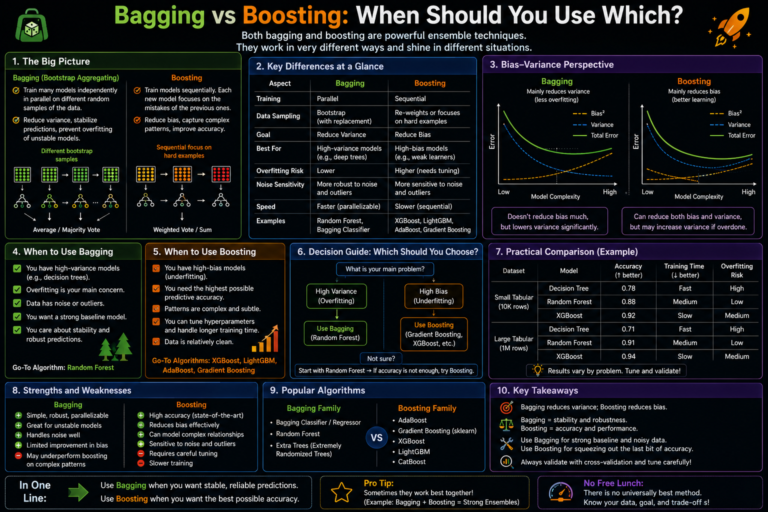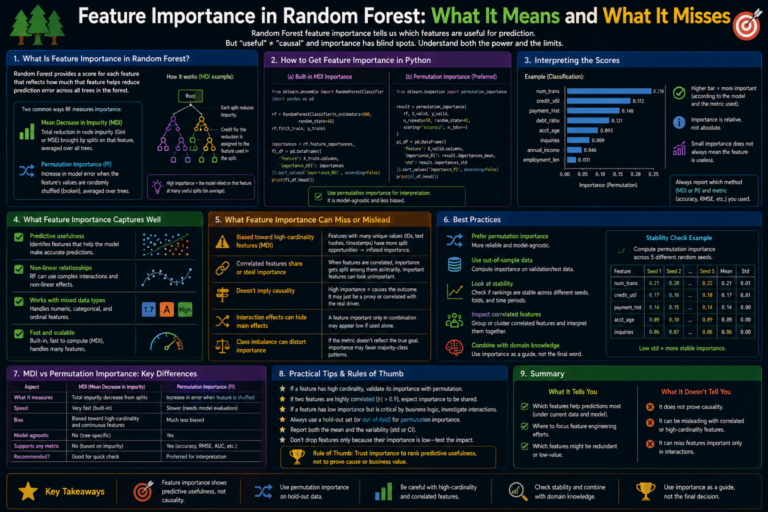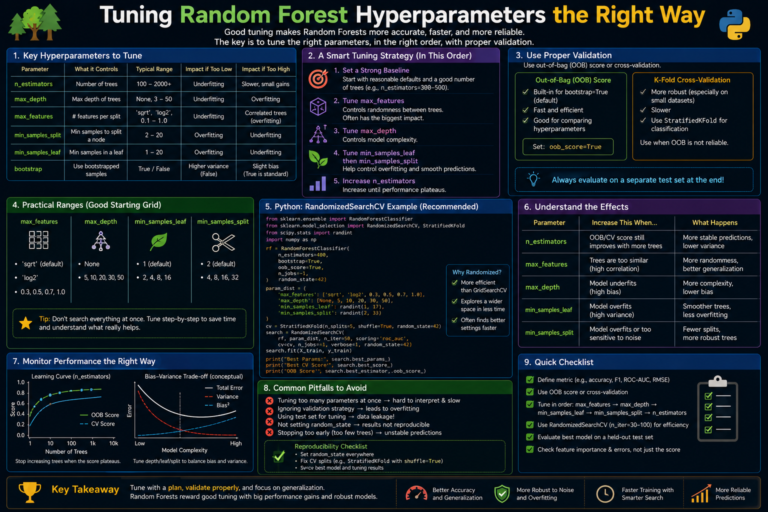

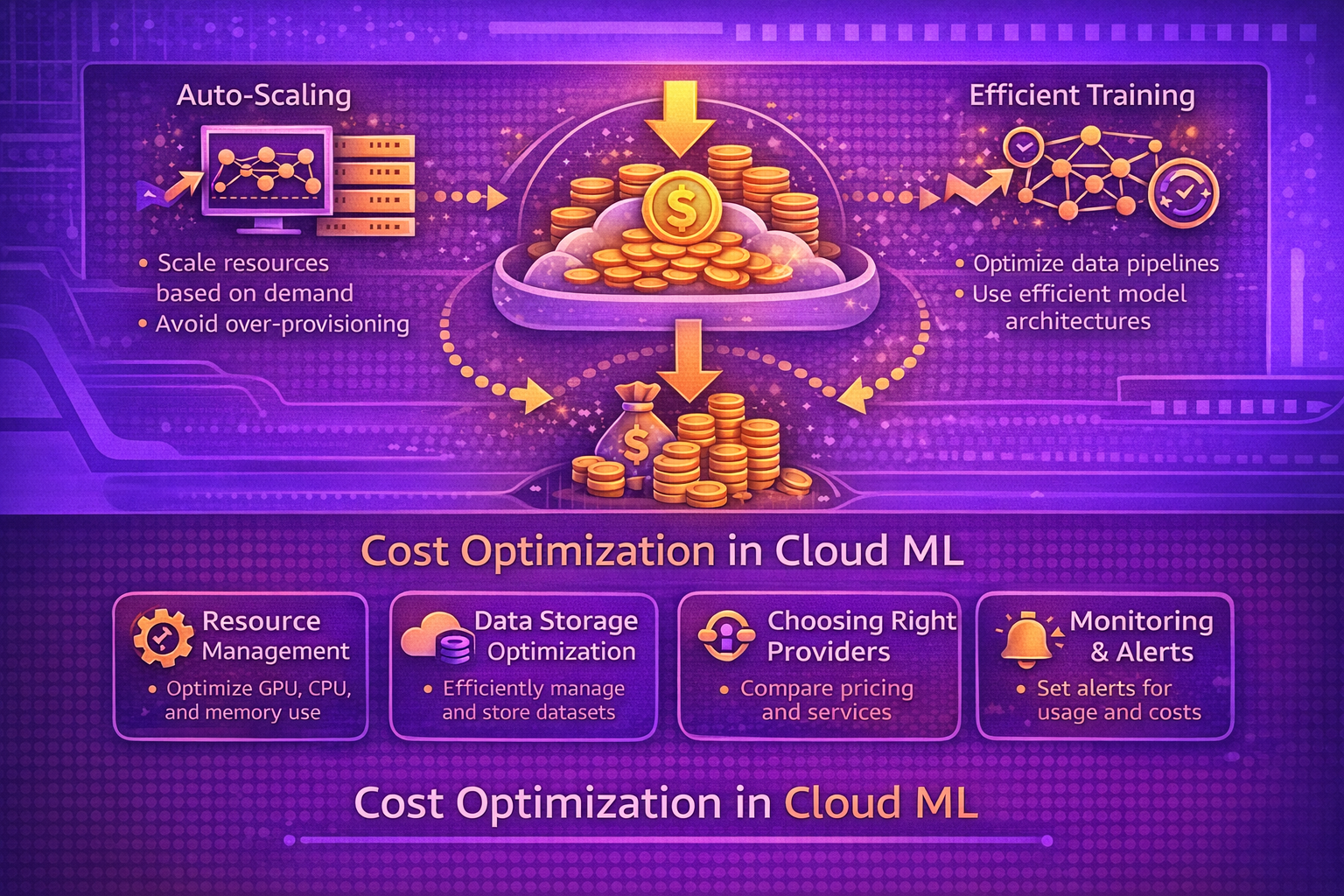
Cost optimization in cloud machine learning is the discipline of reducing the total cost of building, training, deploying, monitoring, and operating ML systems without materially harming business value, model quality, reliability, or delivery speed. Because cloud ML spans data pipelines, storage, experimentation, training clusters, inference endpoints, feature systems, monitoring, and governance, cost optimization must be treated as an end-to-end systems problem rather than as a narrow infrastructure tuning exercise.
Abstract
Cloud machine learning can become expensive very quickly due to high-performance accelerators, large data movement, long-running experimentation, over-provisioned serving fleets, poorly governed environments, repeated retraining, excessive logging, and inefficient storage practices. Many organizations initially focus only on model accuracy and later discover that cost has become a major barrier to scaling adoption. This paper explains the technical and operational foundations of cost optimization in cloud ML across training, inference, storage, data pipelines, experimentation, feature engineering, orchestration, and governance. It covers unit economics, right-sizing, autoscaling, spot and preemptible usage, workload scheduling, storage tiering, model compression, batch versus online inference trade-offs, observability cost control, and FinOps-aligned governance patterns. All formulas are embedded inline in HTML-friendly format for direct use in WordPress or similar editors.
1. Introduction
Let the total cost of a cloud ML system be represented as:
Ctotal = Cdata + Cstorage + Ctrain + Cinfer + Cnetwork + Cops + Cmonitor.
Cost optimization aims to reduce Ctotal while preserving acceptable
performance, reliability, and business outcomes.
This immediately implies that focusing only on GPU price or endpoint count is too narrow. The cost structure is multi-component and often dominated by interacting decisions across the full lifecycle.
2. Why Cloud ML Costs Rise Quickly
Cloud ML workloads are especially prone to cost growth because they frequently involve:
- large-scale data storage and movement
- high-cost GPUs or specialized accelerators
- parallel experimentation and hyperparameter search
- long-lived serving endpoints
- redundant environments and idle resources
- heavy logging and monitoring pipelines
- repeated retraining without business justification
Optimization therefore requires workload awareness, not just generic cloud cleanup.
3. Cost Optimization as a Multi-Objective Problem
Cloud ML cost optimization is rarely a pure cost minimization problem. In practice, teams seek to optimize a trade-off
among cost, accuracy, latency, reliability, and delivery speed. A simplified objective can be viewed as:
Objective = BusinessValue - λ·Cost,
where λ reflects how strongly cost pressure should influence architectural choices.
The best design is therefore not always the cheapest possible design. It is the most efficient design that still satisfies the real requirements.
4. Unit Economics for ML
One of the most important practices in cloud ML cost control is understanding unit economics. Examples include:
- cost per training run
- cost per successful model iteration
- cost per 1,000 inference requests
- cost per user served
- cost per retraining cycle
- cost per active feature pipeline
If a serving system processes N requests at total inference cost
Cinfer, then cost per request is:
Creq = Cinfer / N.
These metrics are essential because aggregate cloud bills alone do not reveal where optimization effort should go.
5. Training Cost Fundamentals
Training cost is often approximated by:
Ctrain ≈ r · t · n,
where:
ris hourly rate per compute instancetis training durationnis the number of instances or accelerators
This simplified form hides storage, orchestration, and data-transfer costs, but it captures the main driver: expensive compute multiplied by time.
6. Experimentation Cost
ML teams often underestimate the cost of experimentation. If each run costs
Crun and the team executes
K runs, then experimentation cost is roughly:
Cexp = K · Crun.
Hyperparameter sweeps, ablation studies, repeated notebook runs, and failed experiments can cause large hidden spend if not governed properly.
7. Inference Cost Fundamentals
Inference cost depends on runtime architecture. A simplified form is:
Cinfer = Cidle + Cactive + Cnetwork.
In always-on endpoints, idle cost can be a large component. In serverless or scale-to-zero designs, active invocation cost may dominate instead.
8. Storage Cost
Storage cost often grows through:
- raw datasets
- intermediate transformed data
- feature tables
- checkpoints and model artifacts
- logs and traces
- backups and snapshots
If storage volume is V and per-unit storage rate is
s, then simplified storage cost is:
Cstorage = s · V.
The real issue is that storage cost compounds over time as redundant artifacts accumulate.
9. Data Transfer and Network Cost
Data movement can be an underappreciated cost driver, especially when:
- training data is repeatedly copied
- cross-region access occurs
- feature stores and model endpoints sit in different zones
- multi-cloud pipelines are used
If transferred data volume is D and egress rate is
e, then:
Cnetwork = e · D.
10. Right-Sizing Compute
One of the simplest optimization practices is right-sizing. Many teams over-provision training nodes or inference endpoints “just to be safe.” Right-sizing means aligning compute capacity with actual workload demand.
If required compute load is L and provisioned capacity is
P, over-provisioning ratio may be expressed as:
OverProvision = P / L.
Ratios far above 1 usually signal clear optimization opportunities.
11. Accelerator Selection
GPUs and specialized accelerators are often necessary, but not always. Cost optimization requires checking whether a workload truly needs the most expensive hardware tier. For example:
- small tabular models may run efficiently on CPUs
- lightweight inference can sometimes use cheaper instances
- batch jobs may tolerate lower-cost but slower hardware
The cheapest successful hardware is often better than the fastest hardware that provides unnecessary headroom.
12. Spot and Preemptible Capacity
Cost can be significantly reduced for interruption-tolerant workloads by using spot or preemptible instances. These are well-suited for:
- distributed training with checkpointing
- hyperparameter sweeps
- batch feature generation
- non-urgent offline jobs
If on-demand rate is ron and spot rate is
rspot, potential direct compute savings per hour are:
Δr = ron - rspot.
The trade-off is interruption risk, so checkpointing and retry design become essential.
13. Checkpointing Strategy
For interruption-prone training or long experiments, checkpointing can reduce wasted compute. If checkpoint interval is too long, a failure may waste large training time. If checkpoint interval is too short, overhead becomes costly.
This is a classic operational trade-off: optimize the balance between protection and extra overhead.
14. Hyperparameter Optimization Cost Control
Hyperparameter search can explode cost because it multiplies training runs. If search space contains
K candidate configurations and each costs
Crun, brute-force exploration can be prohibitive.
Cost-aware strategies include:
- random search instead of full grid search
- Bayesian optimization
- early stopping of weak runs
- multi-fidelity tuning
- budget-based pruning of bad trials
15. Early Stopping
Early stopping reduces training waste by halting runs that are unlikely to improve enough. If validation metric at
epoch t is m(t), training may stop when the expected
improvement remains below a practical threshold.
This reduces both direct compute cost and opportunity cost from spending time on weak configurations.
16. Batch vs Real-Time Inference Trade-Off
One of the largest cloud ML cost decisions is whether inference should be online or batch-oriented. Real-time inference typically increases idle infrastructure cost, while batch inference can process many records at much lower cost per prediction if latency requirements allow.
If a workflow does not need immediate predictions, moving from online to batch can dramatically reduce
Cinfer.
17. Autoscaling for Inference
Autoscaling helps match serving capacity to request demand. If request rate at time
t is λt, capacity should be adjusted so that
the system maintains target latency without keeping too many idle replicas.
Poor autoscaling configuration can waste money through both over-scaling and under-scaling.
18. Scale-to-Zero and Serverless Patterns
For bursty workloads, scale-to-zero or serverless inference can reduce idle cost significantly. If idle endpoint cost
is Cidle, removing always-on replicas can cut spend when request frequency
is low.
The trade-off is often cold-start latency:
Lcold = Lwarm + Δcold.
19. Model Compression for Cost Reduction
Compression techniques such as pruning, quantization, and distillation can reduce:
- model size
- memory footprint
- inference latency
- required instance class
If compressed model size is S' and original size is
S, then storage and sometimes compute costs may decrease in proportion to:
S' / S.
Compression is especially valuable when it enables a move to cheaper serving hardware.
20. Storage Tiering and Lifecycle Policies
Data, checkpoints, and model artifacts should not all remain in expensive hot storage forever. Cost-aware storage design often includes:
- hot tiers for active training and serving assets
- warm tiers for recent but infrequently accessed artifacts
- cold or archive tiers for long-term retention
- expiration policies for intermediate outputs
Lifecycle policies help prevent long-term cloud cost drift.
21. Duplicate Data and Artifact Reduction
ML systems often create unnecessary duplication through:
- copied datasets across environments
- repeated feature snapshots
- multiple identical checkpoints
- redundant logs
Eliminating duplication is often one of the easiest cost wins because it reduces both storage and transfer spend.
22. Pipeline Scheduling and Orchestration
Poor scheduling wastes cloud spend. Examples include:
- running large jobs during expensive or congested periods
- keeping clusters alive between dependent tasks
- recomputing unchanged features unnecessarily
- failing to shut down ephemeral environments
Good orchestration minimizes idle waiting and unnecessary recomputation.
23. Incremental and Selective Retraining
Not every model needs full retraining on a fixed calendar. If the business value improvement from retraining is
Vretrain and retraining cost is
Cretrain, retraining cadence should be justified when:
Vretrain > Cretrain
or when governance requirements mandate refresh.
Drift-triggered or selective retraining can reduce waste compared with blind retraining schedules.
24. Feature Store Cost Discipline
Feature stores improve consistency, but they can become costly if every feature is materialized, refreshed, and served at high frequency. Cost control requires asking:
- which features truly need online freshness
- which can be computed offline
- which should be retired because they no longer create value
25. Logging and Monitoring Cost
Observability is essential, but logging every request, feature value, model score, and trace detail at full fidelity can become expensive. Monitoring cost is often driven by:
- log volume
- metric cardinality
- trace retention
- high-frequency dashboards and alerts
Cost-aware observability often uses sampling, aggregation, shorter retention for low-value telemetry, and selective deep tracing.
26. Environment Sprawl
Cloud ML teams often create many environments for experiments, testing, training, staging, and demos. If each
environment has baseline cost Cenv and the team maintains
N loosely governed environments, total baseline spend becomes:
Cenv-total = N · Cenv.
Idle notebooks, forgotten clusters, and long-lived demo endpoints are common sources of waste.
27. Reservations and Commitment Strategies
For predictable workloads, reserved capacity or commitment-based pricing can reduce spend relative to purely on-demand usage. This works best when demand is stable enough that the organization can commit with confidence.
The trade-off is reduced flexibility if usage patterns change significantly.
28. Cost Allocation and Chargeback
Cost optimization improves when teams can see who is spending what and why. Useful allocation dimensions include:
- product
- team
- model
- environment
- training vs inference
- project or cost center
Without visibility, optimization responsibility becomes vague and waste persists.
29. FinOps for Cloud ML
FinOps in ML means aligning engineering, product, and finance around measurable cloud efficiency. This includes:
- budget setting
- unit cost tracking
- forecasting
- anomaly detection on spend
- cost-aware architecture reviews
- showback or chargeback
Cost optimization becomes sustainable when it is operationalized rather than treated as a one-time cleanup.
30. Cost-Aware Architecture Choices
Strong cost optimization often comes from earlier design choices rather than late cleanup. Examples include:
- choosing smaller model families where possible
- using retrieval or cascaded architectures instead of expensive monolithic inference
- separating online and offline features carefully
- using batch scoring when real-time is unnecessary
- co-locating storage and compute to reduce transfer costs
31. Common Failure Modes
- optimizing accuracy while ignoring cost per business outcome
- running all experimentation on premium hardware by default
- keeping always-on endpoints for low-traffic workloads
- retraining too often without measurable value
- retaining every artifact and log indefinitely
- lacking team-level cost visibility and accountability
32. Strengths of a Cost-Optimized Cloud ML Operating Model
- improves scalability of AI adoption
- reduces wasted infrastructure spend
- helps align ML investment with business value
- enables more experimentation within fixed budgets
- improves operational discipline and platform maturity
33. Limitations and Trade-Offs
- the cheapest design may not meet latency or reliability targets
- aggressive optimization can slow teams if overcontrolled
- spot/preemptible strategies require stronger failure handling
- compression and right-sizing may reduce performance headroom
- some workloads are inherently expensive because of business-critical constraints
34. Best Practices
- Measure cost at the workload and unit-economics level, not only from the monthly cloud bill.
- Right-size training and serving resources continuously based on observed demand.
- Use batch inference whenever business requirements do not require real-time predictions.
- Adopt spot or preemptible compute for interruption-tolerant jobs with checkpointing.
- Compress models and optimize serving paths before scaling expensive hardware.
- Apply storage lifecycle policies and remove redundant artifacts aggressively.
- Build FinOps visibility into ML platforms so teams can own their spending decisions.
35. Conclusion
Cost optimization in cloud ML is not simply about spending less. It is about building machine learning systems whose technical design, operating model, and business value remain sustainable as they scale. Because ML costs span data, storage, training, inference, monitoring, and governance, optimization must be approached as an end-to-end engineering and financial discipline.
The most effective organizations treat cost as a first-class quality attribute alongside accuracy, latency, and reliability. When cost optimization is embedded into architecture decisions, experimentation patterns, serving design, and platform governance, cloud ML becomes significantly more scalable, predictable, and valuable over the long term.