
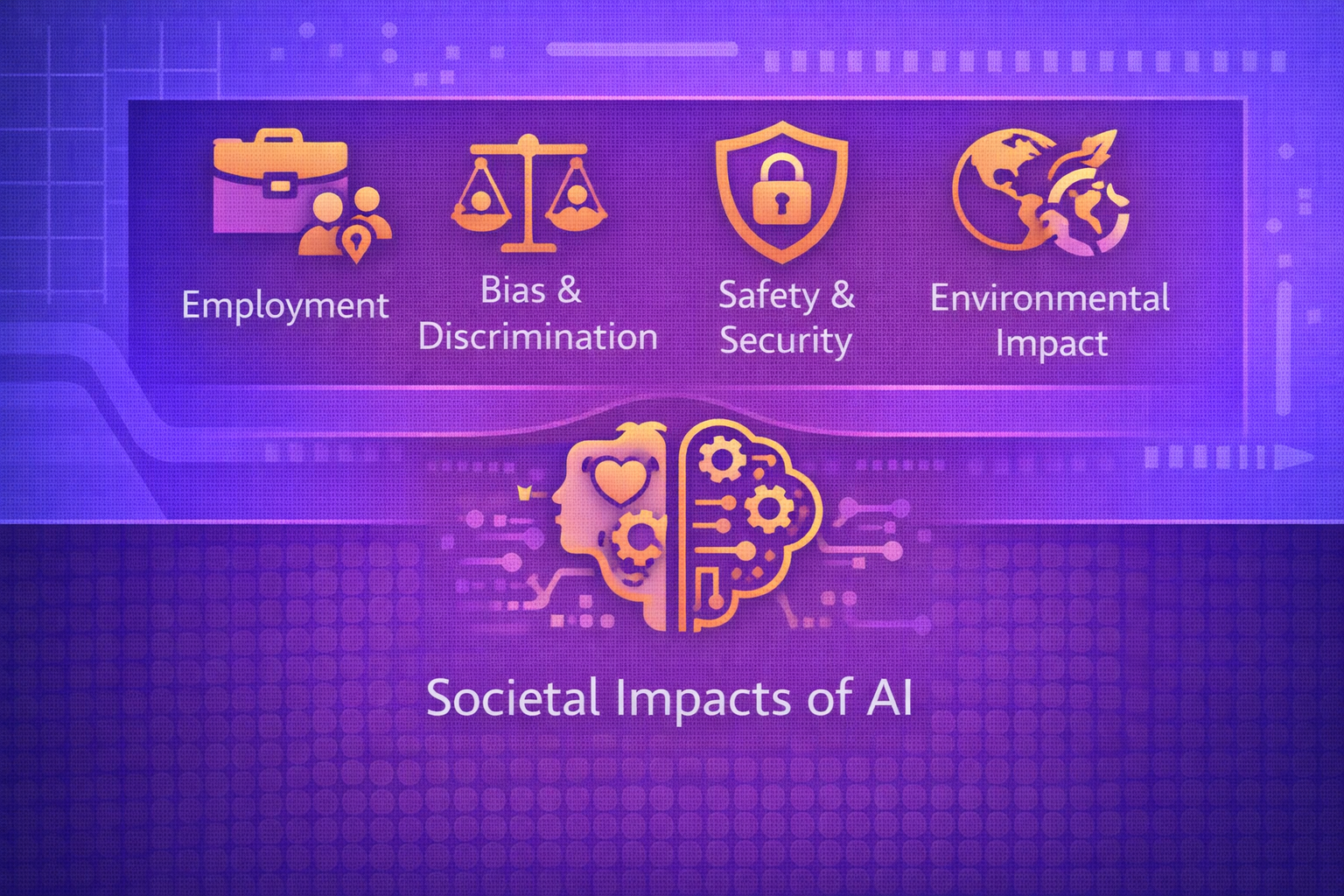
Artificial intelligence is no longer only a technical capability. It is a societal force that influences labor, institutions, access to information, decision-making, privacy, public trust, inequality, and governance. The societal impacts of AI emerge not only from model accuracy or technical sophistication, but from how AI systems are deployed, who controls them, what incentives shape them, and which populations are affected by them. This whitepaper explains the major dimensions of AI’s societal impact through a technical and systems-oriented lens.
Abstract
AI systems are increasingly embedded in social, economic, political, and institutional processes. They influence how people receive information, access services, obtain jobs, interact with government systems, receive healthcare recommendations, undergo risk assessment, and participate in digital environments. As a result, the impacts of AI must be analyzed beyond model performance. This paper examines the societal implications of AI across labor markets, education, healthcare, public administration, inequality, information ecosystems, privacy, security, environmental cost, culture, and democratic governance. It explains why societal impacts are shaped by feedback loops, unequal access, data concentration, automation incentives, and governance gaps. It also explores how technical design choices interact with policy, institutions, and public trust. All formulas are embedded inline in HTML-friendly format for direct use in WordPress or similar editors.
1. Introduction
Let an AI system be represented as:
S = (D, M, U, I, G),
where:
Dis the data and knowledge base usedMis the model or decision logicUis the user population and usage contextIis the institutional or market environmentGis the governance structure surrounding the system
Societal impact arises not from M alone, but from the interaction of all components of
S.
2. Why Societal Impact Matters
AI is often framed as a productivity technology, but it also redistributes power, attention, opportunity, and risk. A technically successful system can still have negative societal effects if it:
- amplifies inequality
- concentrates power in a few institutions
- erodes privacy
- reduces human agency in high-stakes settings
- spreads misinformation or manipulative content
- creates labor displacement without transition support
Understanding societal impact is therefore necessary for responsible deployment and policy design.
3. AI as a General-Purpose Technology
AI increasingly behaves like a general-purpose technology, meaning it can affect many sectors simultaneously. Its effects propagate through multiple domains:
- business operations
- public services
- creative work
- education
- healthcare
- security
- communication systems
Because it is broadly applicable, its societal consequences are both wide-ranging and unevenly distributed.
4. Economic Productivity and Growth Effects
AI can increase productivity by automating tasks, augmenting decision-making, accelerating research, and reducing
information-processing costs. If output is represented by
Y and productivity by A, then one simplified economic
intuition is:
Y = A · F(K, L),
where K is capital and L is labor.
AI may increase A by improving how knowledge and computation are applied across work.
5. Labor Market Disruption
One of the most visible societal impacts of AI is labor disruption. AI can automate certain tasks, augment others,
and restructure job roles. The effect is often task-level rather than occupation-level. If job
J is composed of tasks
{t1, t2, ..., tn},
then AI may affect only a subset of those tasks rather than replacing the entire job immediately.
This creates a complex mix of substitution, augmentation, and job redesign.
6. Job Displacement vs Job Augmentation
AI can both replace and enhance human labor. A useful distinction is:
- displacement: tasks or roles become economically unnecessary
- augmentation: workers become more productive with AI assistance
The societal outcome depends on whether institutions, firms, and labor markets convert AI efficiency into broader prosperity or concentrate benefits narrowly.
7. Unequal Distribution of Gains
Even when AI increases total productivity, the gains may not be distributed evenly. If total economic gain is
G, then the social question is not only how large
G is, but how it is distributed across workers, firms, sectors, and regions.
Societal concern arises when AI-generated gains flow mainly to capital owners, dominant firms, or high-skill workers, while adjustment costs fall on others.
8. Skills, Education, and Human Capital
AI changes the value of different skills. Routine cognitive tasks may become more automatable, while human judgment, domain expertise, communication, and oversight roles may become more important.
Education systems may therefore need to shift from simple information recall toward:
- critical thinking
- systems understanding
- AI literacy
- human-AI collaboration skills
- ethics and evaluation capacity
9. Access and the Digital Divide
AI can improve access to tools and knowledge, but it can also deepen inequality if access is uneven. If population
access to AI capability is represented by
Access(g) for group g, then societal inequality may widen
when:
Access(g1) ≫ Access(g2).
Unequal access can occur through infrastructure, language coverage, affordability, education, or institutional exclusion.
10. AI in Education
In education, AI can:
- personalize tutoring
- support accessibility
- help with feedback and assessment
- increase learning productivity
But it also raises concerns about:
- academic integrity
- overreliance on generated content
- unequal access to advanced tools
- data privacy for students
The societal effect depends on whether AI is used to deepen learning or merely to shortcut effort.
11. AI in Healthcare
In healthcare, AI can improve diagnosis support, triage, imaging interpretation, clinical documentation, and operational efficiency. However, societal consequences include:
- bias against underrepresented populations
- privacy risk in sensitive medical data
- over-automation of clinical judgment
- liability ambiguity
- unequal access to advanced medical AI
The impact on public health depends not only on model accuracy but also on how systems are validated, governed, and integrated into care pathways.
12. Public Sector and Administrative Uses
Governments and public institutions may use AI in benefits administration, fraud detection, case triage, service delivery, and policy analysis. While AI can improve efficiency, misuse can create serious harms when opaque systems influence rights, entitlements, or enforcement decisions.
In these settings, accountability, due process, explainability, and appeal rights become central societal concerns.
13. Information Ecosystems and Public Discourse
AI systems influence how information is generated, recommended, filtered, and amplified. This affects public discourse through:
- algorithmic ranking
- recommendation systems
- synthetic media generation
- search summarization
- automated persuasion and targeting
If exposure function is E(content | user), AI-mediated ranking can reshape what large
populations see, believe, and share.
14. Misinformation and Synthetic Media
Generative AI lowers the cost of producing text, images, audio, and video at scale. This creates beneficial uses, but also increases the risk of misinformation, impersonation, and mass persuasion.
Societal risk grows when synthetic content is cheap to generate and difficult to verify in real time.
15. Democratic and Institutional Impacts
AI can affect democratic systems through:
- automated propaganda
- microtargeted influence
- synthetic political communication
- information overload and trust erosion
- bureaucratic decision automation
These impacts matter because democratic legitimacy depends heavily on trustworthy information, institutional transparency, and the ability of citizens to contest decisions.
16. Bias, Discrimination, and Social Inequality
AI systems can reproduce or amplify structural inequalities if the data, labels, or optimization objectives reflect
historical bias or exclusion. If group-specific outcome rate is
P(ŷ = 1 | A = a),
substantial disparities across groups may indicate societal inequity in access to opportunity or exposure to harm.
The societal concern is especially high in domains such as hiring, lending, housing, healthcare, and public services.
17. Concentration of Power
AI development often requires large amounts of data, compute, talent, and capital. This can concentrate power in a
small number of firms, states, or platforms. If capability is represented by
C and concentrated among a few actors, then:
Power Concentration ↑ as control over C becomes more unequal.
Concentration can shape innovation, market competition, cultural influence, and geopolitical leverage.
18. Privacy and Surveillance
AI can expand surveillance capacity by making it cheaper to analyze massive amounts of behavior, imagery, text, location data, or biometric information. Societal concerns include:
- erosion of anonymity
- behavioral profiling
- predictive monitoring
- chilling effects on speech and association
- asymmetric institutional power
The issue is not only data collection, but the inference power AI adds to collected data.
19. Human Agency and Overreliance
AI systems may reduce effort and improve efficiency, but they can also weaken human judgment when users become over-reliant on system outputs. If decision support accuracy is high most of the time, users may defer even when the system is wrong.
This creates societal concern in domains where humans must remain meaningfully responsible for decisions.
20. Cultural and Creative Impacts
AI affects cultural production by changing how text, music, design, images, and video are created. This can expand access to creative tools, but it also raises questions about:
- authorship and originality
- cultural homogenization
- training on creators’ work
- economic displacement in creative industries
- flooding of information channels with low-cost synthetic content
21. Language, Inclusion, and Representation
AI systems do not serve all cultures and languages equally. If performance by language group is
Perf(lang), large gaps between dominant and underrepresented languages can create
unequal access to digital capability.
Societal inclusion depends on multilingual support, cultural sensitivity, and meaningful representation in training and evaluation.
22. Environmental Impacts
Large AI systems can require substantial energy, water, hardware, and supply-chain resources. A simplified impact
view might express environmental cost as:
EnvCost = f(compute, energy intensity, hardware footprint, cooling needs).
Societal discussion about AI therefore includes sustainability, especially for compute-intensive training and widespread inference deployment.
23. Security and Societal Risk
AI can improve cyber defense, fraud detection, and operational resilience, but it can also lower barriers for harmful activity such as:
- phishing and social engineering
- malware assistance
- automated deception
- synthetic identity fraud
- scalable manipulation campaigns
Societal impact therefore includes both defensive and offensive acceleration.
24. Global and Geopolitical Effects
AI is also a geopolitical capability. Nations compete over:
- compute infrastructure
- semiconductor supply chains
- foundation model leadership
- regulatory influence
- military and intelligence applications
This means societal impact extends beyond local institutions into international power structures and strategic dependencies.
25. Institutional Readiness and Governance
The societal effect of AI depends heavily on institutional capacity to govern it. If governance quality is
G and deployment scale is S, then systemic risk often
increases when:
S grows faster than G.
Governance lag can lead to harmful deployments before accountability mechanisms catch up.
26. Trust and Legitimacy
Public trust in AI depends not only on technical performance, but on whether people perceive systems as fair, explainable, safe, and contestable. Trust can be eroded by:
- opaque errors
- inconsistent behavior
- hidden data use
- unclear accountability
- large visible harms with weak remediation
Loss of trust can itself become a major societal cost even when individual models appear accurate.
27. Measuring Societal Impact
Societal impact is difficult to reduce to one number. It often requires multi-dimensional evaluation across:
- economic gain
- distributional effects
- fairness outcomes
- privacy exposure
- institutional legitimacy
- environmental cost
- public trust
A simplified conceptual score might look like:
Impact = Benefits - Harms,
but in practice the terms are heterogeneous and not easily commensurable.
28. Positive Societal Opportunities
AI also offers substantial societal upside when deployed responsibly, including:
- expanded access to knowledge
- assistive technologies for disability support
- faster scientific discovery
- better resource allocation
- improved diagnostics and public services
- productivity growth that can support broader prosperity
The central question is not whether AI has benefits, but whether those benefits are distributed fairly and governed responsibly.
29. Common Failure Modes in Social Deployment
- deploying systems faster than governance can keep up
- optimizing efficiency while ignoring distributional harm
- treating accuracy as a complete proxy for public value
- using AI to scale surveillance without sufficient safeguards
- introducing educational or workplace tools without inclusion planning
- ignoring long-term institutional and cultural effects
30. Strengths of a Societal Impact Lens
- expands evaluation beyond technical metrics
- reveals who benefits and who bears the costs
- improves policy and governance design
- supports more equitable deployment decisions
- helps align AI development with public interest
31. Limitations and Challenges
- societal impacts are hard to quantify precisely
- different stakeholders value outcomes differently
- short-term and long-term effects may diverge
- impacts often depend more on institutions than on models alone
- rapid technical change can outpace social and regulatory adaptation
32. Best Practices
- Assess AI systems at the socio-technical level, not only at the model level.
- Examine who gains, who loses, and who is excluded from access.
- Evaluate effects on labor, education, information quality, privacy, and institutional trust together.
- Use governance and public-interest review for high-impact deployments.
- Monitor real-world effects after launch rather than assuming benefits from offline performance.
- Design for augmentation, contestability, and inclusion where possible.
33. Conclusion
The societal impacts of AI are profound because AI changes not only what machines can do, but how institutions function, how people work, how information flows, and how power is distributed. These impacts can be positive, negative, or mixed, and they are rarely determined by algorithms alone. They emerge from deployment choices, market structures, governance systems, and the unequal ways in which different groups experience technological change.
A serious understanding of AI therefore requires more than technical evaluation. It requires social, economic, institutional, and ethical analysis of how AI systems interact with the world around them. When AI is assessed through this broader lens, the goal becomes not merely building more capable systems, but building systems whose benefits are durable, inclusive, and aligned with the public good.