
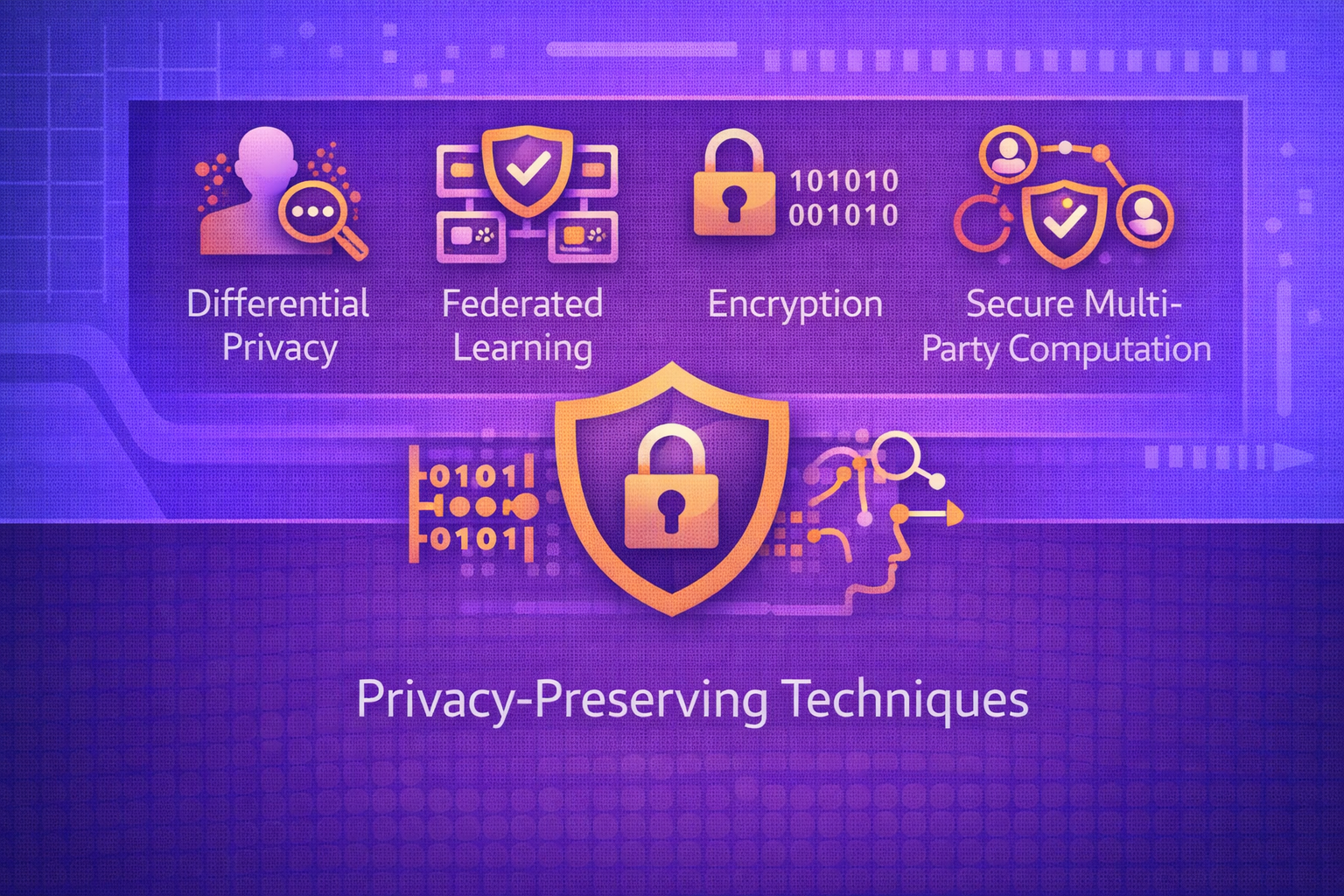
Privacy-preserving techniques are methods used to reduce the risk that sensitive information about individuals, organizations, or protected data assets is exposed during collection, storage, analysis, model training, inference, sharing, or publication. In modern AI and data systems, privacy preservation is not a single tool but a layered discipline involving data minimization, access control, statistical protection, cryptographic computation, secure systems design, and governance. This whitepaper explains the technical foundations and major categories of privacy-preserving techniques used in data science, analytics, and machine learning.
Abstract
Data-intensive systems increasingly operate on personal, confidential, regulated, or commercially sensitive information. Traditional security controls alone are often not sufficient because privacy risks can arise even when systems are not explicitly breached. Sensitive information may leak through direct identifiers, quasi-identifiers, inference attacks, model memorization, linkage across datasets, or improperly governed analytical outputs. Privacy-preserving techniques aim to reduce these risks while preserving as much utility as possible. This paper explains major technical approaches including de-identification, pseudonymization, anonymization, k-anonymity, l-diversity, t-closeness, differential privacy, federated learning, secure multi-party computation, homomorphic encryption, secure enclaves, synthetic data, access control, and privacy-aware model governance. It also explains the privacy-utility trade-off, attack models, and limitations of each approach. All formulas are embedded inline in HTML-friendly format for direct use in WordPress or similar editors.
1. Introduction
Let a dataset be represented as
D = {(xi, yi)}i=1N,
where records may contain sensitive attributes, identifiers, or confidential relationships. Privacy-preserving
design asks how useful computation can be performed on D while limiting what any
adversary can learn about a particular individual or protected data element.
Privacy risk exists across the full lifecycle:
- data collection
- storage and access
- transformation and sharing
- model training
- inference and deployment
- logging and monitoring
- publication and reporting
2. What Privacy Preservation Means
Privacy preservation means reducing the probability or impact of unwanted disclosure, re-identification, inference, or extraction of sensitive information. This does not always mean making data useless. Instead, it often means controlling what is revealed, to whom, under what assumptions, and at what acceptable risk level.
A useful abstract framing is:
Utility = useful information retained
and
Privacy Risk = sensitive information exposed.
Most privacy-preserving techniques try to improve privacy while minimizing utility loss.
3. Threat Models
Privacy techniques only make sense relative to a threat model. Common threat models include:
- an attacker trying to re-identify individuals in released data
- an insider accessing more than necessary
- a model memorizing sensitive training examples
- an external party inferring whether a person was in a dataset
- colluding entities reconstructing private inputs
The choice of privacy-preserving method depends strongly on which threat is being addressed.
4. Direct Identifiers and Quasi-Identifiers
Direct identifiers are attributes that explicitly identify a person, such as name or government ID. Quasi-identifiers are attributes that may not identify someone alone but can identify them when combined, such as date of birth, ZIP code, and gender.
Privacy risk often comes not only from explicit identifiers but from combinations of seemingly harmless attributes.
5. De-Identification
De-identification refers broadly to removing or transforming personal identifiers from data. Typical techniques include:
- removing direct identifiers
- masking values
- generalizing categories
- tokenizing keys
- coarsening location or time precision
De-identification reduces obvious exposure but does not guarantee anonymity if linkage attacks remain possible.
6. Pseudonymization
Pseudonymization replaces direct identifiers with artificial substitutes such as tokens. If original identifier is
id and substitute token is t, then the mapping may be:
id → t.
Pseudonymization reduces direct exposure but is reversible if the mapping table exists. It is therefore not the same as full anonymization.
7. Anonymization
Anonymization aims to transform data so that individuals cannot reasonably be re-identified. In practice, strong anonymization is difficult because auxiliary external data may allow record linkage.
Therefore, anonymization should be understood as a risk-reduction process, not a magical binary state.
8. k-Anonymity
A dataset satisfies k-anonymity if every combination of quasi-identifiers appears in at least
k records. Conceptually, for every quasi-identifier pattern
q:
count(q) ≥ k.
This means each record is indistinguishable from at least
k - 1 others with respect to those attributes.
8.1 Strengths and Weaknesses of k-Anonymity
k-anonymity is intuitive and useful for release control, but it has limitations:
- it does not protect against attribute disclosure within a group
- it can fail if sensitive values are too homogeneous
- it can lose utility when generalization becomes aggressive
9. l-Diversity
l-diversity strengthens k-anonymity by requiring diversity in sensitive attributes within each equivalence class.
Informally, each group should contain at least
l well-represented sensitive values.
This helps defend against cases where a group is k-anonymous but all records share the same sensitive outcome.
10. t-Closeness
t-closeness further strengthens group privacy by requiring that the distribution of a sensitive attribute within each equivalence class be close to its distribution in the full dataset.
If sensitive distribution in a group is Pgroup and the global sensitive
distribution is Pglobal, then t-closeness requires a distance condition such
as:
distance(Pgroup, Pglobal) ≤ t.
11. Data Minimization
One of the most important privacy-preserving techniques is to collect and retain less data. Data minimization means
only collecting what is necessary for the intended purpose. If the full attribute set is
X = {x1, ..., xm},
responsible design asks whether the system truly needs all of X or only a subset.
The best way to prevent leakage of unnecessary data is often not to collect it at all.
12. Access Control and Least Privilege
Privacy preservation is not only statistical or cryptographic. Operational controls matter greatly. Access control systems should ensure that users and services can access only the minimum data required for their role.
If user privilege level is p(u), then least-privilege design aims to make
p(u)
no greater than necessary for the authorized task.
13. Encryption at Rest and in Transit
Encryption is a foundational privacy-enabling control. It protects data during storage and transmission. While encryption does not solve all privacy problems, it reduces the chance that unauthorized parties can directly read the raw data if infrastructure is compromised or traffic is intercepted.
14. Differential Privacy
Differential privacy is one of the strongest formal privacy frameworks. A randomized mechanism
M is (ε, δ)-differentially private if for any two
neighboring datasets D and D' differing in one
individual, and for any output set S:
P(M(D) ∈ S) ≤ eε P(M(D') ∈ S) + δ.
The idea is that the presence or absence of one person should not change the output too much.
14.1 Privacy Parameters
In differential privacy:
εcontrols privacy loss magnitudeδallows a small probability of larger deviation
Smaller ε usually means stronger privacy but lower utility.
15. Sensitivity and Noise Injection
A common way to achieve differential privacy is to add random noise calibrated to query sensitivity. If function
f(D) has sensitivity:
Δf = max |f(D) - f(D')|
over neighboring datasets, then the noise magnitude is often scaled in proportion to
Δf / ε.
This allows privacy-preserving release of counts, averages, or learned statistics.
16. Privacy Budget
Differential privacy composes over repeated queries. If multiple private releases are made, total privacy loss grows.
This is often tracked through a privacy budget. Informally:
εtotal ≈ Σ εi
under simple composition reasoning.
This is why repeated access to the same protected dataset must be governed carefully.
17. Differentially Private Machine Learning
Differential privacy can also be applied to model training. One common pattern is to clip per-example gradients and
add noise before aggregation. If per-example gradient is
gi, clipped gradient may be:
ḡi = gi / max(1, ||gi|| / C),
where C is the clipping norm.
Noise is then added to the aggregate gradient to reduce information leakage from any single example.
18. Federated Learning
Federated learning is a distributed training approach where raw data remains on local devices or local institutions,
while model updates are shared. If local participant
k computes update Δθk, the central server may
aggregate:
Δθ = Σ wk Δθk.
This reduces the need to centralize raw data, though it does not eliminate all privacy risks because updates themselves can leak information if not protected.
18.1 Federated Learning Limitations
Federated learning is privacy-helpful but not automatically private. Risks remain from:
- gradient leakage
- model inversion
- membership inference
- malicious client behavior
It is often combined with secure aggregation or differential privacy.
19. Secure Aggregation
Secure aggregation allows a server to learn only the aggregate of participant updates, not each individual update.
If participants submit values v1, ..., vn, the server learns:
Σ vi
but not each vi separately.
This is particularly useful in federated learning deployments.
20. Secure Multi-Party Computation
Secure multi-party computation, or SMPC, allows multiple parties to jointly compute a function without revealing
their private inputs to one another. If parties hold private values
x1, x2, ..., xn,
they can compute:
f(x1, x2, ..., xn)
without exposing the inputs directly.
SMPC is powerful for cross-organization analytics where data sharing is restricted.
21. Homomorphic Encryption
Homomorphic encryption allows certain computations to be performed on encrypted data. If encryption function is
Enc(·), then some schemes allow:
Enc(x) ⊕ Enc(y) = Enc(x + y)
or analogous multiplicative operations depending on the scheme.
This makes it possible to compute on data without decrypting it, though cost and complexity remain significant for many workloads.
22. Trusted Execution Environments
Trusted execution environments, sometimes called secure enclaves, provide hardware-backed isolated regions where computation can occur with reduced exposure to the surrounding system. They do not replace all other privacy controls, but they can reduce risk during sensitive computation.
23. Synthetic Data
Synthetic data is artificially generated data intended to mimic important statistical structure of real data without
directly exposing actual individual records. If synthetic dataset is
Dsyn, the goal is that:
Utility(Dsyn) ≈ Utility(Dreal)
for certain tasks, while lowering disclosure risk.
However, synthetic data is not automatically safe. Poor generation methods may still leak training records or preserve sensitive outliers too closely.
24. Membership Inference and Model Privacy
In membership inference attacks, an adversary tries to determine whether a specific record was part of a model’s training set. If a model overfits or memorizes training examples, the risk increases.
Privacy-preserving model design therefore includes regularization, controlled access, differential privacy, and monitoring for overexposure.
25. Model Inversion and Reconstruction Risks
Some attacks try to infer sensitive features or reconstruct likely training examples from model outputs. This is especially relevant when model confidence scores or detailed APIs expose too much information.
Privacy-preserving serving may therefore restrict output detail, rate-limit queries, or use confidence clipping.
26. Query Minimization and Result Limitation
Privacy can often be improved by limiting how much detailed information a system returns. For example:
- return coarse categories instead of raw scores
- avoid exposing row-level details unnecessarily
- limit repeated queries on narrow subpopulations
- suppress small-count aggregates
If group size is n and
n < k,
some systems suppress or aggregate results to reduce re-identification risk.
27. Privacy by Design
Privacy-preserving techniques are most effective when built into system design from the beginning. Privacy by design includes:
- minimizing data collection
- partitioning access
- logging sensitive access
- choosing privacy-safe defaults
- performing privacy impact assessments
Retrofitting privacy after large-scale collection is often harder and less effective.
28. Privacy-Utility Trade-Off
Nearly all privacy-preserving methods involve a trade-off. Stronger privacy often reduces fidelity, convenience,
accuracy, or analytical detail. Conceptually:
as Privacy ↑, Utility may ↓.
The real engineering challenge is to locate an acceptable operating point rather than maximizing one quantity in isolation.
29. Governance and Compliance Context
Privacy-preserving techniques must be paired with governance, including:
- purpose limitation
- retention rules
- consent handling where required
- incident response
- cross-border data transfer controls
- auditable access histories
Technical privacy alone is not enough if organizational controls are weak.
30. Common Failure Modes
- removing direct identifiers but leaving quasi-identifiers vulnerable
- assuming pseudonymization equals anonymization
- using federated learning without protecting model updates
- publishing too many statistics and exhausting privacy budget
- treating synthetic data as automatically safe
- keeping sensitive data longer than necessary
31. Strengths of Privacy-Preserving Techniques
- reduce disclosure risk without always eliminating analytical value
- support lawful and trustworthy data use
- enable collaboration across boundaries where raw sharing is restricted
- improve resilience against inference and linkage attacks
- strengthen user and institutional trust
32. Limitations and Trade-Offs
- no single technique solves every privacy threat
- formal guarantees often reduce utility
- weak threat modeling leads to false confidence
- cryptographic approaches can be computationally expensive
- poor governance can negate good technical controls
33. Best Practices
- Start with a clear threat model before selecting privacy controls.
- Minimize collection and retention of sensitive data whenever possible.
- Combine technical privacy methods with access control, auditing, and governance.
- Use formal methods like differential privacy when strong guarantees are required.
- Do not assume de-identification alone is sufficient against linkage attacks.
- Evaluate privacy-utility trade-offs explicitly for the intended use case.
- Monitor privacy risk continuously across training, serving, logging, and sharing workflows.
34. Conclusion
Privacy-preserving techniques are essential in modern AI and data systems because privacy risk does not arise only from obvious breaches. It also emerges from linkage, inference, memorization, oversharing, and poorly controlled analytical access. Protecting privacy therefore requires more than encryption or masking alone.
The strongest privacy strategies are layered. They combine minimization, de-identification, formal statistical protections, secure computation, controlled access, and governance. The right combination depends on the threat model, the sensitivity of the data, the required utility, and the deployment context. When applied well, privacy-preserving techniques allow organizations to extract value from data and AI systems while better protecting the people and institutions represented in that data.